

The EV charging experience has entered a new phase, and Issam Tidjani, Co-Founder and CEO at Cariqa, framed it precisely. The past few years were about deployment – getting chargers onto streets. Now adoption is picking up, so the question becomes whether those chargers get used, and whether using them is any good.
That shift matters because the customer has changed. Early adopters were often technical people who almost enjoyed troubleshooting. Mass adopters simply want things to work.
Moreover, the stakes are commercial rather than merely experiential. Every failed session is lost revenue for the operator, and for a fleet, potentially a missed delivery.
Who was on stage
Afonso Ramos is Co-Founder and CPO at Power Dot, a charge point operator focused on destination charging.
Peter Badik is Chairman of the Board and Founder at GreenWay, another operator, taking a different strategic approach to the customer relationship.
Murvah Iqbal is CEO and Co-Founder at Hived, an all-electric parcel delivery company, representing the end customer side.
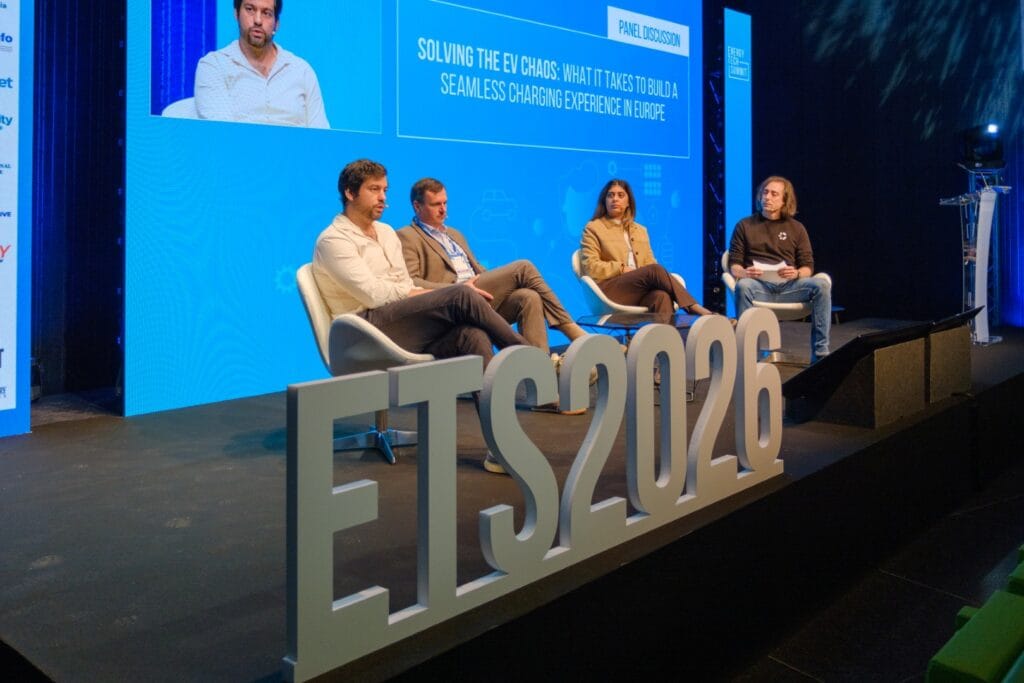
Panel speakers on stage at Energy Tech Summit 2026
One in seven sessions fails
Tidjani opened with the number that defines the problem. Industry charging success rates still sit at around 80 to 86%, which means that even in the best case, roughly one in seven sessions does not succeed.
Ramos did not soften it. How you measure success rate barely matters, he argued. What matters is that a driver arrives, unlocks the charger, plugs in, charges and leaves – every single time.
Failure costs more than the session. It breaks trust, and once broken, users stop trusting chargers outside their homes. Consequently, it puts the transition itself into question, because a driver who has had that experience starts missing their previous car.
Why the chain breaks
Ramos then walked through why reliability is so hard, and the answer is that a single charging session depends on an unusually long chain.
It starts with the user. Then it needs the car, the charging infrastructure, the software running that infrastructure, and often a further party, the mobility service provider, running yet more software.
Each link is a potential point of failure. The session can fail at the user, at the car, at the charging station, at the operator’s software, or at the service provider – though, as Ramos put it, it is never the customer’s fault.
Therefore his diagnosis is about cooperation rather than technology. Charge point operators and mobility service providers need to work together, share data, and share feedback on communication errors and authentication. Similarly, operators need to work more closely with car manufacturers and with charger vendors.
Industry associations exist, he acknowledged. Even so, two things are missing: clear accountability for where a session actually failed, and the cooperation needed to fix it. Problems are scattered across every party in the chain.
His conclusion sounded broad, and he defended it as actionable. The industry has to start behaving as an ecosystem, because when one participant wins, everyone wins – and everyone is needed for the transition to work at all.
The apple, and the apple pie
Badik gets asked constantly why sessions fail, and he explains it with an analogy he was happy to mime on stage, having failed to find an actual apple at breakfast.
You can simply bite the apple. Alternatively, you can take it home, slice it, add sugar and cinnamon, and eat it that way. Or you can bake it into a pie.
EV charging works the same way. You can arrive at a charger, tap a credit card and charge – the bite. Or you can use an operator’s app, which shows whether the charger is free before you drive there, and may offer subscriptions or loyalty pricing. Or a third party that does not operate the charger at all can wrap further services around it – the pie.
Notably, Badik objected to the framing of the session as chaos. It is not chaos, in his view. It is a palette of choices, and everyone should be able to pick.
That said, he thinks regulation should guarantee the choice exists. You should always be able to pay at the charger, and you should always be able to use an external provider that gives you access to a wider network.
He also made a point about how unusual this problem is. A charging session involves two machines – the charger and the car – plus a human in the middle, plus a great deal of software from multiple companies. Machines with software is common. Machines with people is common. All three together is rare, and that is where things go wrong.
When failure is not an option
For Iqbal, the question of reliability has a different shape entirely. A failed charging session simply cannot happen, because a delivery driver has committed times and a customer waiting for a parcel.
Charging reliability has therefore been paramount to Hived’s core business since it started in 2021. Drivers charge at depot where possible, yet the company relies heavily on public infrastructure too.
Over the years, Hived has built detailed knowledge of which charge points are reliable, how fast they charge, and what amenities they offer – which matters for drivers spending time there. All of that feeds into the company’s routing algorithms, so drivers get directed to chargers that will deliver the expected percentage of battery.
One in seven is not good enough, though, which is why the company has invested in its own infrastructure. Hived is currently completing a megawatt charging installation at its depot.
Training drivers to be EV drivers
Hived’s fleet is 100% electric. The company leases many of its middle mile trucks, while in the final mile many drivers own their own electric vans.
Consequently, education became part of the operation. Drivers go through thorough onboarding covering how to adapt to EVs, how to drive more efficiently and how to charge. The company then tracks driving in practice: if a driver burns through range faster than the route predicts, that signals a need for more training.
Hived also steers drivers toward specific brands and software providers it knows to be reliable, precisely to keep the experience seamless on the road. Iqbal described the whole effort as marginal gains, pursued holistically to get drivers competent with EVs faster.
Why the same charger has a dozen prices
Tidjani raised the consequence that confuses drivers most. The same charging point, with the same plug and the same power, can carry dozens of different prices – and the price on the payment terminal is sometimes higher than the price in a third-party app.
Because drivers cannot see the commercial arrangements underneath, that variation breeds suspicion. They start wondering who is overcharging them, which damages trust in the operator.
Badik returned to the apple. It looks like the same charging point, yet it is not the same transaction. Tapping a card is a direct transaction with the operator, with the price displayed, much like a petrol station. Using the operator’s own app brings subscription programmes or other benefits. Using a provider embedded in your car dashboard is a different service again.
Different things, therefore, carry different prices. “I wouldn’t like to live in a world where everything is the same,” he said, and where only one choice exists. Every participant in the value chain runs its own strategy, and the market settles as people learn their own preferences.
What matters to him is not uniformity but avoiding infrastructure limited to a single access model, which he considers unhealthy. He also flagged that the underlying cost structure – why charging at home differs so sharply from charging on a motorway – is a substantial separate topic. On price variation itself, his verdict was firm: more choice is a feature, not a bug.
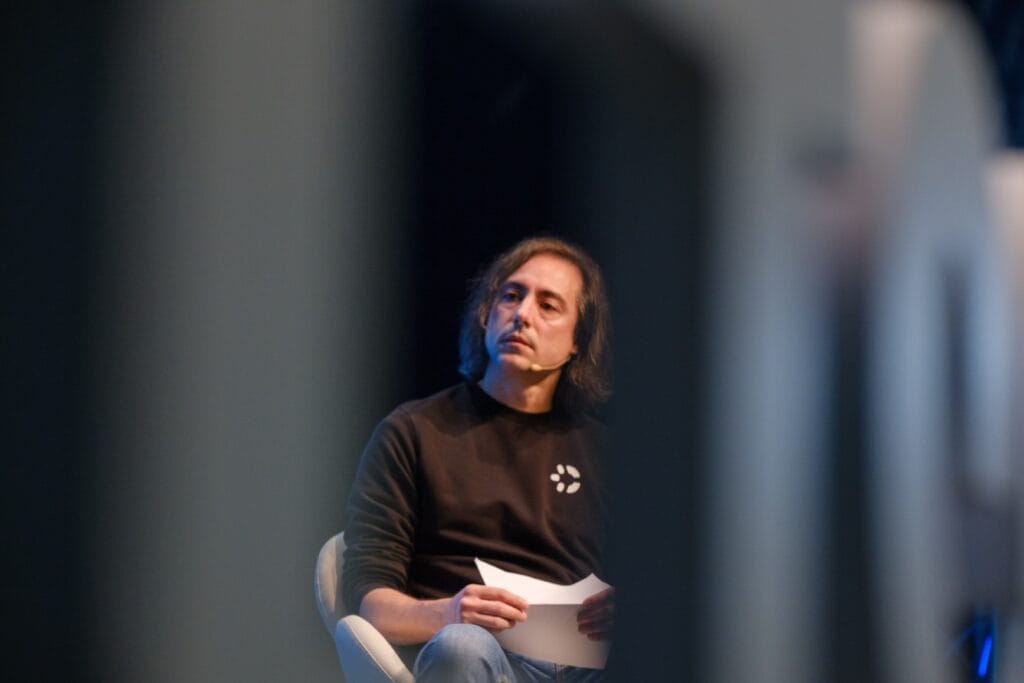
Panel moderator Issam Tidjani, Co-founder and CEO of Cariqa at Energy Tech Summit 2026
Simplicity before transparency
Ramos took the analogy back a step. You can eat the apple in several forms, yet you still have to be able to eat the apple. The charger always has to work, whatever the commercial wrapper.
On pricing, he wanted to start somewhere other than transparency. Pricing needs to be simple and predictable, and today it frequently is neither. Complex structures confuse users, who almost never know what to expect.
He agreed that variation is a feature rather than a bug, with one condition attached. A kilowatt hour is a kilowatt hour, so if you pay more, you must get more – a subscription, control over the charger, something the payment terminal does not give you.
His expectation is that the market eventually enforces this. Whoever charges more without adding value will either have to reduce prices or leave. Still, the industry should simplify pricing structures itself rather than waiting, and make the extra value obvious wherever the price is higher.
What charging costs a fleet
For Iqbal, total cost of ownership is the whole reason the company is electric. Hived is not EV-first as a customer proposition, she stressed, but because building a parcel network efficiently in the 21st century means running EVs.
Public fast charging, however, undermines that advantage. In London especially, fast charging can cost the equivalent of filling a diesel tank, which erases the efficiency gain entirely.
Therefore the company routes to avoid it, treating fast charging as an emergency option. Where it is unavoidable, Hived negotiates preferential rates with suppliers.
The strategy instead centres on depot charging at overnight tariffs. With the new megawatt installation, drivers will charge in 15 minutes while loading their vehicle, at wholesale rates.
Hived is also working upstream, partnering with charging manufacturers and providers, and with a vehicle manufacturer on a new last-mile EV optimized for route duration and driver needs. Iqbal was candid that the company has not yet reaped the rewards of being EV-first, while remaining convinced of the long-term case.
Two opposite strategies on the customer relationship
Tidjani drew out a genuine strategic divergence. Power Dot has no charging app and works exclusively through partnerships, whereas GreenWay invests heavily in its own digital interface.
Badik explained the reasoning behind owning the relationship: it lets the company set prices, and not at a single level. Prices can vary by location, by time of use and by customer, which allows the operator to find a sweet spot.
The economics explain why that flexibility matters. For any operator, he said, up to two thirds of costs are fixed – depreciation on the investment, rental, operations – and those get paid regardless of how many kilowatt hours are delivered. Utilization therefore drives everything.
That also explains why a customer committing to volume is so valuable. Such a customer can be offered substantially different prices and service levels, in something approaching a power purchase agreement, even if the industry is not quite there yet.
On whether customers respond to price, Badik described the usual distribution: some are highly price-responsive, some do not care, and most sit in between. However, testing elasticity properly is harder here than in digital industries, because the market still counts millions of customers in Europe rather than tens or hundreds of millions. Smaller samples simply take longer.
The fleet view: don’t make drivers wait
Iqbal closed the topic by endorsing destination charging from the customer side. A driver sitting idle while charging is wasting time, and time is money.
Hived is therefore developing charging that happens during loading, or during a lunch break – the same philosophy applied to a delivery operation.
Her final point echoed where the panel began. Nobody should try to build all of this themselves. Making charging seamless requires collaboration across customers, apps and infrastructure, with each party specializing in what it does best.
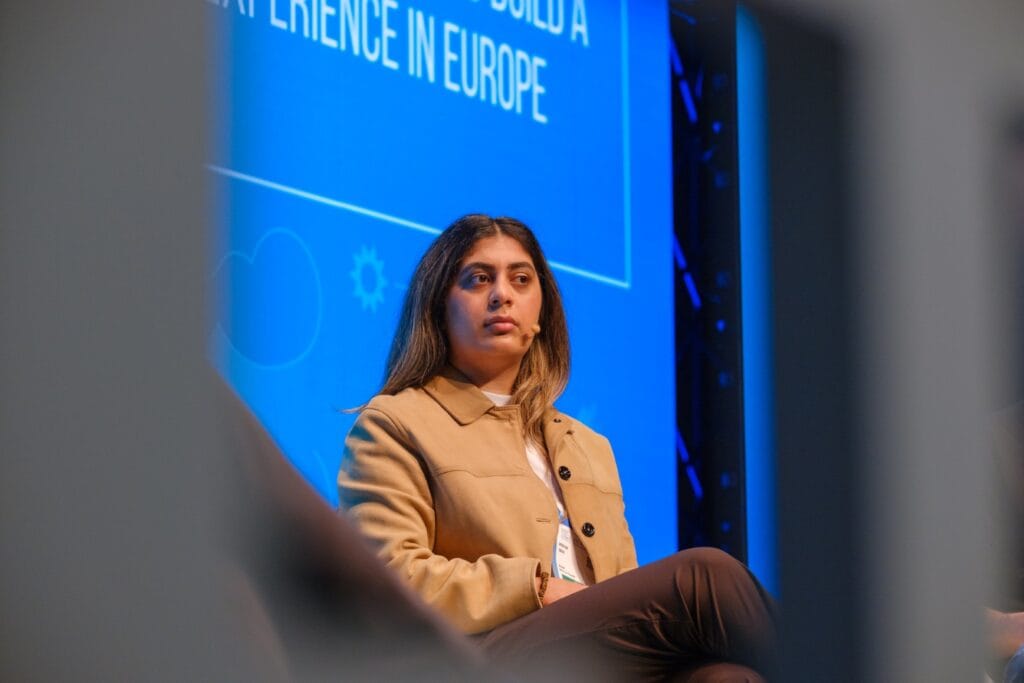
Murvah Iqbal is CEO and Co-Founder at Hived during the panel at Energy Tech Summit 2026
Takeaway
Two disagreements ran through this panel, and both are unresolved. The operators think price variation is a feature, because different services genuinely cost different amounts; the moderator thinks it erodes trust when drivers cannot see why. Meanwhile Power Dot and GreenWay have made opposite bets on whether an infrastructure company should own the customer relationship at all. What everyone agreed on is more damning than either. A charging session depends on five parties, no one of whom is accountable when it fails, which is why the success rate has stalled around 85%. The EV charging experience will not be fixed by better hardware. It will be fixed when somebody owns the failure.
Energy Tech Summit 2027 returns to Bilbao, April 7–8, with more conversations like this one.