
Europe funds the startups and then loses them at the scaling stage. Three perspectives on why demand creation, not innovation, is the gap.
Bianca Dragomir, Director at Cleantech for Iberia, opened by amending the panel title. A new global order, she suggested, might better be described as a new global disorder. Either way, cleantech policy now sits at the centre of three simultaneous pressures. These are the climate challenge, the competitiveness crisis and the security crisis.
The questions she put to the panel followed from that. Can Europe turn climate ambition into industrial strength? Can the current security situation accelerate deployment? And if so, what has to change in policy, in capital and in execution?
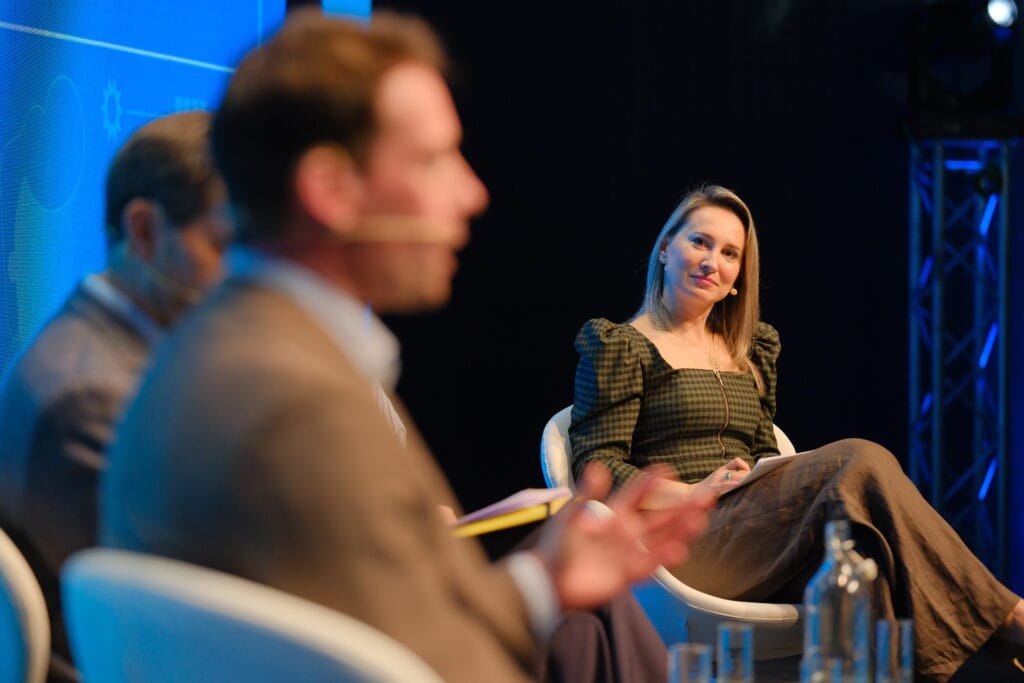
Energy Tech Summit panel session led by Bianca Dragomir, Director at Cleantech for Iberia.
Who was on stage
Christopher Frey is Head of Regulatory Affairs at Sunfire, a European electrolyzer manufacturer. Notably, the company is building one of its largest electrolyzers a few kilometres from the venue, at a Spanish refinery. That makes Spain one of its most important European markets.
Juan Diego Bernal is Managing Director for Energy Transition Technology Funds at A&G Global Investors. He brought the growth capital perspective.
Miriam Zaitegui Perez is Spain Director at the European Climate Foundation, working across climate policy and civil society.
The trilemma that was never really a trilemma
Zaitegui Perez opened by rejecting the framing of competing goals. In her view, the supposed trade-off between climate policy and economic progress was never true, whatever some voices claim.
Climate policy has never been designed at the expense of economies. Rather, the European Green Deal and its industrial counterpart have always been about building the physical ground that supports the planet. That includes the people on it, and future generations alike.
Because her first academic background is biology, she said, she tends to see everything as interconnected. Consequently, she reads these goals as reinforcing one another rather than competing.
On whether Europe has genuinely shifted, her answer was yes politically. However, the gap now lies in delivery, and in whether Europe believes in its own project. Her repeated refrain through the session was simple: stick to the plan, because it has worked and the data shows it.
Where the gap actually sits
Frey answered from the position of a company that has already crossed part of this journey. Sunfire, he said, is an example of a successful transition. It moved from a technology startup with a good product into a mid-sized industrial company, delivering real large-scale projects in industrial environments.
In his experience, Europe supports technology startups well, provided you are in the right place at the right time. For hydrogen, that moment came around 2020, when the continent recognized it needed hydrogen to decarbonize heavy industry.
He was careful to remind the room what that means in practice. Data centers may be the current preoccupation, yet the hard-to-decarbonize industries have not gone anywhere: refineries, steel making, fertilizers, aviation fuels and shipping.
European and national hydrogen strategies gave the sector tailwinds then, and EU funding programmes reinforced the private capital Sunfire could attract. Those programmes were national funding delivered under a European state aid framework, which made them easier to navigate.
So the funding stage worked. The problem is what comes next: creating large-scale demand, which Frey called by far the most important topic for his company.
That depends entirely on regulation. This is a new market competing against fossil molecules with a century-old ecosystem, established infrastructure and accumulated risk experience behind them. Demand for newcomers has to be created, and only regulation does that.
Currently, member states are moving at different speeds. Spain is advancing well, whereas others, including his own Germany, could do considerably more. Therefore the priority is coherence over time: fund the startups, let them scale, then create the market that lets them find customers, gain experience and reduce costs.
Time is the most expensive commodity
Bernal agreed, and located the gap firmly in execution. For a startup or scale-up, he argued, the most expensive commodity is time — and Europe wastes a great deal of it.
Permitting is his first example. Companies cannot wait 12 or 14 months to start a project, and many die during that wait. Grid connection is the second, where good products sit in a queue rather than in the market.
Spain is making incremental progress toward a better framework, he acknowledged. Even so, the underlying problem remains one of execution rather than ambition.
Two policies that would move capital
Dragomir noted the scale of what is at stake. She cited global cleantech market value growing around 20% a year over the past decade, and a record €768 million invested in emerging cleantech in the Iberian Peninsula last year. She then asked Bernal which policies would close the scalability gap.
He prefaced his answer with a disclaimer about not being a policy expert, then made a straightforward point: capital flows where revenue visibility is. Cleantech, he argued, cannot afford to carry a burden for being green. It should compete on equal terms with resource-based peers.
His first suggestion was carbon contracts for difference. If investors could see how the value of CO2 reduction is priced per technology, projects would become considerably more bankable, because revenue generation would be visible.
His second was public risk-taking on first-of-a-kind projects. Where the public sector steps forward and absorbs some risk, the private sector can write larger cheques than it otherwise would. Both measures, he said, matter most for high-capex, hardware-oriented projects.
Made in Europe, or made with Europe?
Turning to the recently published industrial accelerator act, Frey welcomed the step. Europe is finally getting serious about decarbonizing industry while keeping it competitive. That way, energy-intensive sectors such as steel and chemicals stay on the continent even when conditions elsewhere look more attractive.
Combining that with support for the technologies enabling the transformation is, in his view, the right idea. One piece of the puzzle is creating European demand for European cleantech products, so steel and chemical manufacturers buy from the innovative players already here.
Therefore he wants public support for industrial transformation tied, for the next five years or so, to sourcing from European innovators. That lets them scale here, gain experience and reduce costs, before competing eye to eye globally.
His verdict on the act as drafted was measured: a good starting point that has to be improved, with room to do so during the parliamentary procedure ahead.
Specifically, he wants stronger criteria for made in Europe and for resilience, because the current text contains loopholes and exceptions. Procurement criteria apply only to a percentage of hydrogen auctions, for instance, and a list of permitted partner countries sits alongside them.
A call for confidence
The naming itself tells a story. What was once called made in Europe is now called made with Europe. Frey read this as bowing to pressure from member states, including Germany, worried it might backfire.
His response was a call for confidence. Europe can set clear conditions: if you want public support for your hydrogen and your transformation, buy from European technology providers, because they exist and they compete with each other. What the sector needs is to bridge a critical scaling phase of five to seven years.
Twenty-seven silos, and the opex problem
Bernal added two structural points. First, Europe cannot operate as 27 silos and should act as a single market. A Spanish company scaling up should encounter no friction moving into Germany or anywhere else. Competing against the US or China, he argued, makes a united market compulsory in the very short term.
Second, Europe is fixated on capex while neglecting opex. Energy costs are where European industry cannot compete, so a genuinely strong European industry requires promoting opex reduction alongside capital support.

Highlight from panel session with Christopher Frey, Juan Diego Bernal, Miriam Zaitegui Perez, and Bianca Dragomir.
The missing social narrative
Zaitegui Perez approached made in Europe from an entirely different angle. Governance is usually her frame — how these things get ruled — but here she went to the societal question instead.
What is missing, in her view, is the social narrative. She drew on her own background: born in the industrial north of Spain, raised in the agricultural south, and shaped by inequalities that persist today.
Consequently, Europe has to avoid repeating past mistakes. As long as citizens do not see benefits in their own pockets and in their quality of life, she argued, no policy will survive in the long run.
Regional planning matters just as much as industrial planning. Spain’s sustainable mobility law, she noted, is not only about mobility. It concerns cities, transport infrastructure and regional cohesion — which is what made in Europe should genuinely be about.
Dragomir agreed, adding that any transition has to be collectively owned. Otherwise, opposition follows wherever infrastructure gets built.
Is there a silver lining?
Asked whether there was reason for optimism after a morning of difficult topics, Zaitegui Perez confessed to what she called the sickness of optimism. Without it, she said, she would be a very sad person doing this work.
Her reason for hope is that current events have made Europe’s continuing dependence on fossil fuels impossible to ignore. This strengthens rather than weakens the case for the existing plan. Europe should stop doubting itself and reacting to circumstances, and instead stick to the opportunity in front of it.
Spain, in her framing, won the energy lottery: the resources, the geographic position, and ties across the Mediterranean and Latin America. So the country can do this, and if Spain benefits, Europe benefits.
Bernal’s silver lining was about how the value proposition has changed. Two years ago, being green was arguably a luxury carrying a cost premium. Now, pragmatically, the same technologies that underpinned the energy transition are the ones that deliver sovereignty, independence and a more reliable power system.
Europe has done a lot of the homework, in other words. What remains is fine-tuning: continuing to promote renewables, building a more resilient and flexible system, and backing the technologies underneath both.
Frey suggested cutting through the noise and looking at the numbers instead. On the ground, the energy transition is moving forward. Technologies are being deployed, and they keep getting more affordable, more efficient and more powerful.
Historically, he added, energy and geopolitical crises have always catalysed changes that made the energy system more resilient, as happened after the oil shock of the 1970s. He expects the same now.
Europe has the ingredients, in his view — the technology and the capital — provided it treats this as a common project rather than 27 separate strategies. Spain, meanwhile, is demonstrating that a bet on renewables and reduced fossil reliance pays off precisely in situations like this one, and he expects other member states to follow.
One thing to change by 2030
Dragomir closed by asking each panelist for the single most needed change. She framed it around Europe becoming an architect rather than a victim of this transition.
Frey returned to his opening argument. Europe has to adopt the mindset that it is not merely the birthplace of these technologies and an innovative startup ecosystem, but also the home of scaling them. Concretely, that means following through after the R&D funding and the scaling support, by creating the market rather than watching companies disappear to regions where the market already exists.
Bernal called for radical regulatory humility. Policy should focus less on the how and more on the why and the what. Empower entrepreneurs and investors to find the most efficient technological pathway themselves, and prioritize speed and trial and error over obsessing about the rest.
Zaitegui Perez kept hers short and widened the stakes. Climate ambition is about the economy, and it is also about democracy, which is likewise at risk. Therefore Europe should continue walking the path it has already been walking.
Takeaway
The three panelists diagnosed the same failure from different positions. Europe funds innovation generously and then does not buy what it funded. Frey wants procurement conditions strong enough to bridge a five-to-seven year scaling window. Bernal wants permitting and grid queues to stop killing companies that already have working products, and a single market rather than 27. Zaitegui Perez wants citizens to see the benefit locally, because otherwise the politics will not hold long enough for any of it to matter.
Cleantech policy, on this evidence, is no longer short of ambition or technology. It is short of demand, speed and consent — and all three are in the gift of governments rather than markets.
Energy Tech Summit 2027 returns to Bilbao, April 7–8, with more conversations like this one.