
Equity alone cannot build a factory. A venture investor, a deep tech partner and a climate banker on where the rest of the money is, and how to reach it.
Climate tech has traditionally been funded through equity rounds, with venture capital at the centre. That model stretches badly once a company needs large upfront investment, long development timelines and industrial risk. Founders in Europe increasingly look for alternatives that avoid excessive dilution, which puts non-dilutive capital at the heart of the funding conversation.
A panel at Energy Tech Summit examined what that capital actually looks like in practice. Alberto Toril, Advisor at Cleantech for Iberia, moderated. He was joined by Christian Jølck, Co-founder and Partner at 2150; Rachel Slaybaugh, Partner at DCVC; and David Janashvili, who works in climate tech investment banking.
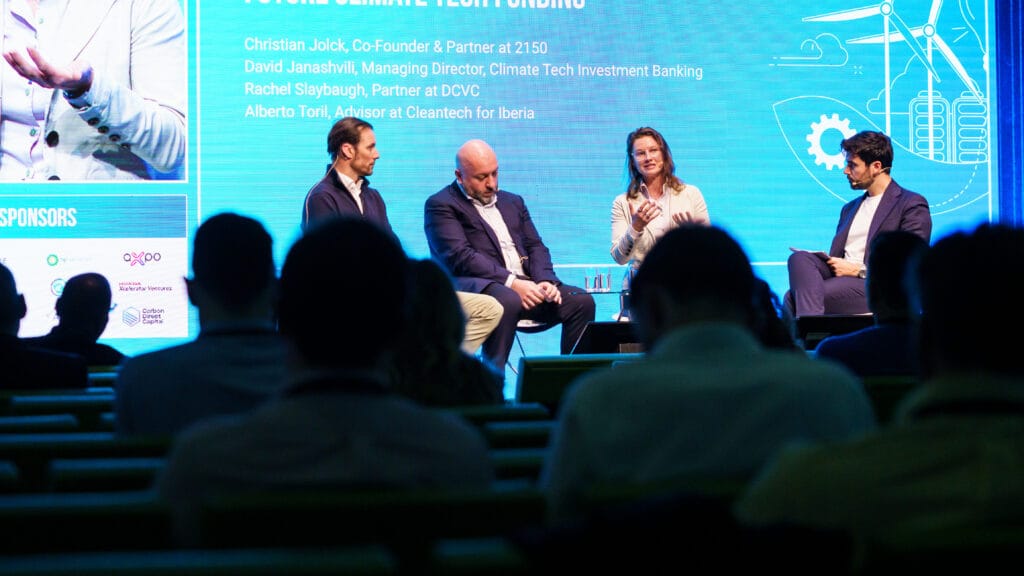
Christian Jolck, David Janashvili, Rachel Slaybaugh, and Alberto Toril speaking at Energy Tech Summit 2025
The capital has not disappeared, it has moved
Jølck opened with the point he wanted the room to take home. Hard tech is driving a shift in where capital sits, and some non-dilutive programmes are changing or disappearing. That is not the same as capital leaving.
His argument was that the money is moving into a different capital stack rather than evaporating, and that founders should not lose motivation over headlines. He also drew a parallel with wind and solar, where subsidy regimes changed as the market became more commercial. The same maturation is underway here.
Slaybaugh agreed and added the historical lesson. One of the defining mistakes of the earlier cleantech wave was trying to build highly capital-intensive projects with equity dollars, which was never going to work from a returns perspective. This time, more institutions are thinking properly about which financing vehicles fit which stage, and that ecosystem is filling out.
She was candid about the shifting picture. Grant funding for early and mid-stage work has thinned in the US. At later stages, where the conversation turns to project finance and infrastructure, the pattern holds: good companies have always been funded and will continue to be. The expected consequence is more rigour on fundamentals and rather less enthusiasm for the flavour of the day.
Risk is not one thing, and neither is capital
Janashvili pushed back on the vocabulary itself. Treating categories such as first-of-a-kind as homogeneous asset classes is, he argued, a fallacy. Climate tech spans many verticals carrying very different risks, and precision about which risk you actually face is what unlocks the right instrument.
He also flagged a question he thinks founders skip. “Innovation means creative destruction,” he said, and most of these companies are built to sell into existing value chains. Many of those chains are global oligopolies. How a company intends to fit into that environment over the next decade deserves far more attention than it usually gets, whether the product is something as simple as cement or as complex as sustainable aviation fuel.
His formulation of the capital question was the sharpest of the session. Capital is there, but it is not just there. A management team has to know exactly what it needs to insulate against, and then work with bankers to design products that address those specific exposures.
Offtakes and PPAs only carry part of the weight
The panel turned to the contracts that make non-dilutive financing possible. Slaybaugh mapped commitment strength against capital type. An early-stage company cannot obtain bank financing on a letter of intent, though more flexible or concessionary capital may accept evidence of commercial traction that is not yet firm. As you move towards risk-averse capital, commitments must harden. Project finance generally wants offtake agreements that are take-or-pay, or at least rigorously papered.
Power purchase agreements are the easy case, because everyone in energy knows what to do with them. The difficulty arrives in sectors that have never used such agreements. There, companies are inventing the contract for the first time, and conservative capital does not yet know how to assess it. Bringing rigour to those new agreements is, in her view, a real opportunity for the industry.
Janashvili added the caveat that matters most. A contract cannot be considered in isolation from execution. An ironclad agreement with an investment-grade counterparty still leaves a battery recycler exposed to feedstock yields, and to guaranteeing recovery rates on the materials it extracts. From a project finance perspective, the offtake is not the only thing that counts. Demonstrating that you can deliver, repeatedly, is what counts.
Historically that gap was bridged by government programmes designed to get first-of-a-kind projects proven, so the next project could attract commercial banks. As some of those bridges thin out, the question becomes how to draw in private pools of capital instead.
When non-dilutive capital fits
Asked about timing, Slaybaugh reframed the question. It is less about too early or too late than about matching the instrument to the stage.
Project finance is the clearest example. Going before you can demonstrate that your process works as intended risks two bad outcomes: failing to deliver what you promised and facing financial penalties, or accepting terms so punitive the project never makes sense. Grants invert over time. They are excellent early, then become burdensome to comply with relative to the money involved as a company grows.
He also named the underlying problem. Industries differ in maturity, and the energy sector has been thinking in long horizons for years while others have not. The capital stack for climate hardware has not formalised yet, and that transition will take years rather than days. For founders and investors alike, that uncertainty is simply the survival window to plan around.
Rebuilding the public side of the stack
On what the public sector should do, Jølck argued for a change of narrative. Non-dilutive public financing works when it is focused on productivity rather than spread thinly and broadly. In other words, the instruments themselves need product-market fit, exactly as companies do.
In the near term, he pointed to public and quasi-public banks as the institutions best placed to provide non-dilutive financing, since they function as an infrastructure layer for the wider economy. Those are the players who should step up while clarity develops on how European countries coordinate and how existing programmes evolve.
Janashvili agreed that public programmes have a strong record, citing US instruments such as Title 17 and advanced manufacturing programmes. Those have combined low default rates with standing up entire value chains and industries.
Where the private pools sit
The more provocative part of his answer concerned private capital. A technology company trading at a very high multiple has an implied cost of equity close to nothing, which in theory means it should be investing almost everywhere. Some are doing exactly that, with large technology companies pouring capital into nuclear and data centre ventures on the back of extremely cheap capital. He was not convinced this is right, since those shareholders have not necessarily mandated that deployment.
The more durable pools, in his view, are the large family office networks and conglomerates that control enormous assets and enjoy real flexibility. Accessing them requires discipline rather than enthusiasm: naming the specific risks that need solving, and explaining precisely how those investors can help.
Concessionary capital is less concessionary than it sounds
Janashvili closed his argument with a reframing worth sitting with. Early projects in a pipeline should lose money, because that is where the learning happens. What each completed milestone does is create substantial value in the parent company.
That is why investors seeking warrant coverage and equity exposure alongside project capital are, in his words, where it is at. Investors focused on making money from individual projects will find it very hard to achieve anything, which is precisely where concessionary money earns its place.
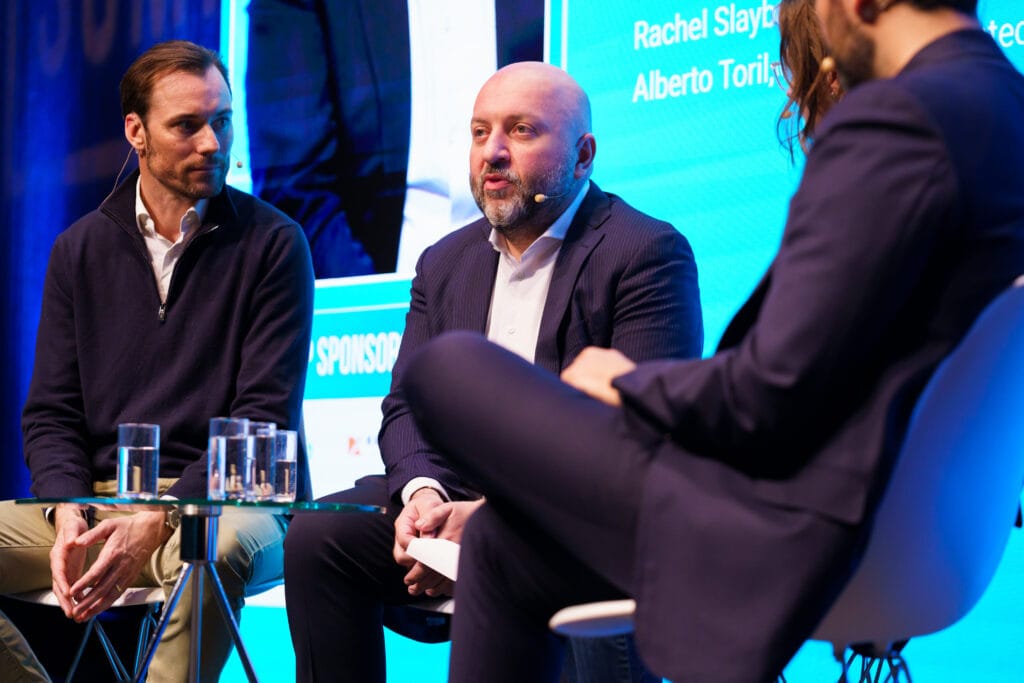
David Janashvili, Climate Tech Investment Banking expert at ETS2025
Europe’s window
Asked whether the Clean Industrial Deal changes the calculus, Jølck saw a genuine opening. His firm invests globally rather than out of European loyalty, which made the assessment more useful, not less.
His caveat was cultural rather than financial. Mindset has to change alongside the instruments. Without a larger cohort of ambitious entrepreneurs, no amount of capital will produce success. Europe has both people and money, so the binding constraint sits elsewhere.
He was blunter still about pace. When trillions of euros are described as available for the energy transition, the obvious question is why that money is not deployed. His answer was that everyone is moving too slowly, and that founders should tell the public sector directly when it is not moving fast enough.
What the panel told founders
The closing round produced four pieces of advice.
Slaybaugh went first, and deliberately unglamorously. Build a good business: a talented team, a large market, a credible path to working unit economics. Companies lose sight of that during hype cycles, and the backlash follows. On top of good fundamentals, do the work to sit at the right risk-reward point in the capital stack, so you approach a pool of capital that genuinely works for both sides.
Janashvili asked for candour, internally first. Total clarity and brutal honesty inside the organisation, a willingness to be challenged on everything, and a clear-eyed view of what will go wrong. He put the relationship plainly: “No banker and no investor is your friend. They’re there to make money.” People get found out faster than they expect.
He added a second suggestion that is easy to act on. Approach investors, including non-dilutive ones, with an enterprise risk management mindset borrowed from public company practice, covering reporting, risk management and communication. Even a company without that framework fully in place will find investors respond well to a credible plan to build it.
Jølck’s advice was about lead time. Preparation for non-dilutive financing takes far longer than founders expect, so it belongs in the business plan early rather than as a late scramble. Start early, and get to know the right people before you need them.
Slaybaugh had the last word on the mood. Uncertainty feels uncomfortable, but a great deal is changing, and change produces openings. “Never let a crisis go to waste,” as she put it.
Key takeaway
The panel converged on a single conclusion: this is not a choice between equity and everything else. Non-dilutive capital works alongside equity to carry companies through the scaling phase, and the capital itself exists in quantity. The difficulty is structural rather than absolute. Match the instrument to the risk, harden the commitments as you move towards conservative capital, and start the process long before you need the money. As Toril put it in closing, do not let the noise stop you from hearing the music.
Secure your pass
Energy Tech Summit Europe returns to Bilbao on 7–8 April 2027, where investors, bankers and founders work through exactly these questions.