
Capital is plentiful at the start and plentiful at the end. The stretch in between is where good companies stall, and three investors explained why.
Getting a decarbonization technology from pilot to large-scale deployment is where most funding conversations get difficult. Scaling decarbonization technologies requires a kind of capital that behaves differently at each stage, and the handovers between those stages are where companies fall through.
A panel at Energy Tech Summit brought together three parts of that chain. Gabriel Scheer, Senior Director of Innovation at Elemental Impact, moderated. He was joined by Ilaria Rubbini, Investment Officer in the cleantech equity and growth capital division at the EIB; Gabriel Kra, Managing Director and Co-founder of Prelude Ventures; and Bas van Beijeren, Investment Director at Carbon Equity.
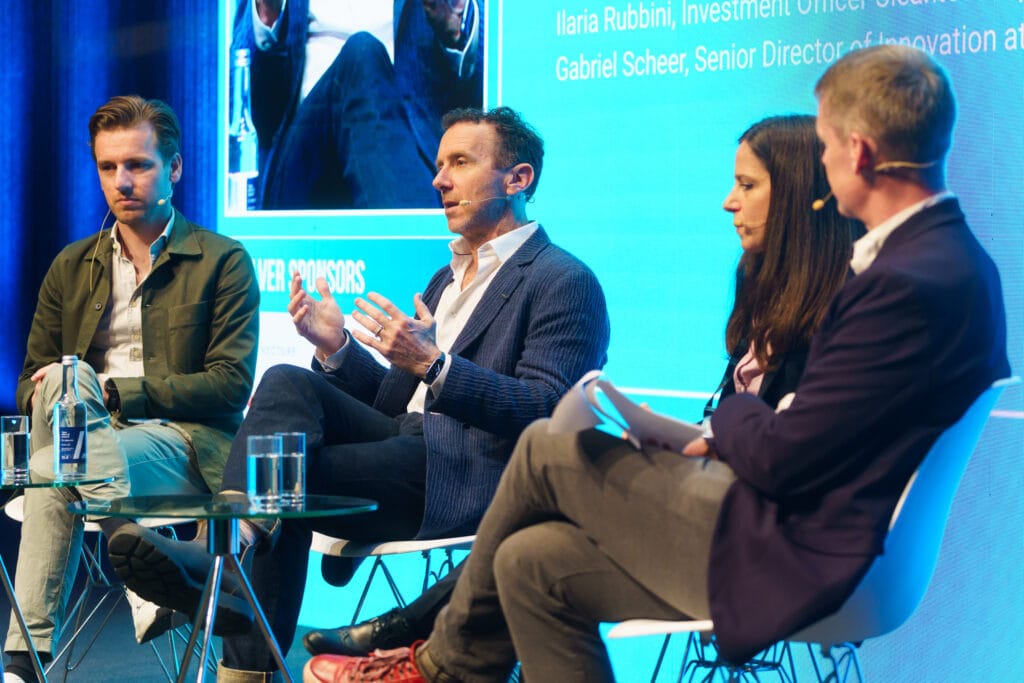
Panel speakers at Energy Tech Summit 2025
Nobody buys because of climate change
Kra gave the bluntest answer to what separates companies that scale from those that stall, and it had nothing to do with capital markets.
The differentiator is a robust product-market fit and a real economic value proposition. As he put it, nobody buys because climate change. Customers buy because a product is better, cheaper or more effective, or because a service solves an actual pain point. Companies that never find that fit do not succeed, regardless of how the funding environment looks.
Prelude invests early across seven verticals spanning energy, food and agriculture, the built environment, hard-to-abate industrials such as cement and steel, compute, mobility and carbon management. Initial cheques start small, with larger participation at Series A and a growth platform to support companies further along.
The hard middle
Van Beijeren described Carbon Equity’s unusual position. It is a climate tech fund investment platform that pools capital from private investors who cannot meet the minimum thresholds for venture or private equity funds, alongside family offices lacking the expertise to navigate the sector.
That vantage point makes the gap visible from both ends. Early-stage capital exists. So does late-stage capital: once a company is gross margin positive with substantial revenue, there is suddenly a great deal of money available. The difficulty sits in between, and it is worst for first-of-a-kind plants that are not profitable from the outset.
Scheer offered a useful correction to the usual phrase. It is less a missing middle than a hard middle. Van Beijeren agreed that deploying there is genuinely difficult, requiring large funds and deep expertise that few managers possess. He also noted that US funds tackling those rounds have historically done so alongside government programmes, and that similar support is gradually appearing in Europe.
How a public bank spans the whole stack
Rubbini described an institution deliberately built to cover the full range. The EIB is among the largest multilateral providers of climate finance and Europe’s largest venture debt provider, financing demonstration facilities through to first-of-a-kind projects across the EU, Norway and Iceland.
The instruments are layered by stage. Colleagues deploy European Innovation Council funds as pure equity at the earliest stage. Venture debt follows after Series A and B. Project finance arrives for larger projects with proven technology, and corporate lending sits alongside.
Advisory is the part founders often overlook. A dedicated team provides technical and financial support to less sophisticated companies, offering free help with financial modelling and business planning so they can become bankable before approaching commercial finance.
The EU Catalyst partnership adds blended structure. The EIB provides venture debt while Catalyst provides grants, which is often exactly what is missing to bring expensive technologies within reach of viability. Rubbini added a point about deal design that echoes what other panels raised: where an offtake agreement does not yet exist, the structure is built so that offtakers find it attractive to come in, rather than leaving all the risk with the startup.
What a bridge deal looks like in practice
Asked for a concrete example, Rubbini pointed to Energy Dome, the Italian company building CO2-based long duration energy storage. The EIB financed a demonstration facility in Sardinia with venture debt while Catalyst provided a grant, allowing the company to prove its technology at meaningful scale.
She described a second deal following the same logic in advanced materials, where the bank financed the tail end of a demonstration facility alongside existing equity investors and is also financing the first large-scale facility. In both cases the bank positions itself as a co-investor crowding capital in rather than substituting for it.
Scheer asked how the EIB relates to the European Investment Fund, and the distinction is worth knowing. The EIF operates as a fund of funds, investing in the managers rather than the companies, and provides guarantees to smaller businesses. It carries the same climate and sustainability mandate, invests across most European funds, and reaches startups indirectly through them.
The capital environment has shifted
Kra has been investing in the sector for more than a decade, and framed the current moment against that history.
For a stretch of recent years, capital was extraordinarily cheap. Companies raised substantial equity at attractive valuations and scaled quickly in both the US and Europe, supported by government funding, concessional capital and off-balance-sheet mechanisms that financed first projects and factories. Some used that window well and now have factories producing or close to producing. Others did not, and face a significant capital gap.
The interest rate environment has since changed, equity inflows have reduced sharply, and capital has moved towards lower-risk assets. For a company still searching for product-market fit or still working towards a first commercial facility, that requires adjustment. Kra’s advice was to treat the money currently in the bank as some of the least expensive capital the company will see for a while, and to get to gross margin positive and finish the first facility with the tools already in hand.
Europe’s deficit is expertise, not only capital
Van Beijeren made the sharpest comparative point of the session. Moving from pilot to large scale has been easier in the US on several dimensions, and capital is only one of them.
The bigger gap is scaling expertise. US funds are populated by managers who have done it before, and so are the companies. He described the recurring experience of speaking to a US fund and hearing that someone who previously built a gigafactory now runs engineering at a portfolio company. That bench does not yet exist to the same depth in Europe.
He sees encouraging movement on two fronts. US companies are increasingly siting commercial operations, first-of-a-kind plants and offtake in Europe. European companies are also growing from pilot to commercial stage, though he remains cautious about the pace, and noted that European founders rarely display the go-big-or-go-bust ambition common in the US.
Rubbini agreed that a shift this large cannot happen quickly, while pointing to the Clean Industrial Deal as a serious attempt to build the ecosystem, deploy net zero technologies and maintain European competitiveness. She also flagged an instrument in development at the bank: guarantees for advance payments and performance bonds, aimed at cleantech manufacturers who currently struggle to obtain working capital facilities without posting heavy collateral, often funded from equity or venture debt that is far too expensive for the purpose.
Where the action is, technology by technology
Kra walked through his portfolio to show how differently the picture looks depending on the technology and its stage.
For green hydrogen, the activity is moving to Europe. Prelude portfolio company Electric Hydrogen has front-end engineering studies underway across Spain, the Nordics and Germany, driven by product cost advantages and by regulatory mandates and incentives that are currently clearer in Europe.
For long duration storage, Form Energy’s momentum remains in the US, where a strong economic value proposition, identified customers and supportive state mandates mean the task is simply to deploy the first projects and demonstrate they work.
Boston Metal illustrates a third pattern, running a first facility in Brazil producing a non-steel product while developing iron and steel capability elsewhere over the coming years. Different geographies, different sequencing, same underlying goal.
Speed has become the value proposition
The most transferable insight came from a question about creative financing mechanisms, and Kra redirected it towards what customers now actually value.
Firm dispatchable zero-carbon power is a genuinely differentiated asset class. Something dispatchable, without the intermittency and lower capacity factors of solar or wind but with the same carbon characteristics, is extremely valuable.
What has changed is that the binding constraint is no longer only dispatchability. It is speed to new generation. Ordering a combined cycle gas plant carries a multi-year wait in the queue, which is unacceptable to a hyperscaler or data centre operator. A company that can deliver clean firm power faster than the conventional alternative has a commercial advantage independent of its carbon story. That is the proposition behind enhanced geothermal companies like Fervo, and it applies to long duration storage too. Some nuclear developers cannot quite reach that timeline, yet still secure long-term contracts.
The lesson generalises. Identify the customer need your product uniquely meets, and recognise when the decisive factor has shifted. In this case, delivery speed became the game changer.
What Europe would need to replicate
Van Beijeren sees more capital arriving from different pockets, including a substantial new European deep tech growth fund and increased activity from sovereign wealth funds, the EIB and the EIF. His frustration is with fragmentation. Support remains highly localised, solving one company’s problem in one country at a time, when what is needed is central coordination operating at a scale an order of magnitude larger.
Kra offered a corrective on how US programmes actually worked. Plenty of his portfolio companies received federal grants and incentive packages, but none received an unsolicited call announcing free money. It is a demanding process, and companies have to be prepared to take advantage of it.
He does see a genuine opening for Europe to attract activity that has historically happened in the US, particularly if it can adopt technology-neutral or technology-supportive policies that bring first-of-a-kind facilities onshore and help companies establish beachhead markets and first customers.
He extended that to talent on a longer horizon. The US has for generations been where ambitious scientists and researchers wanted to work. If that pull weakens, attracting those people to European countries would be a generational opportunity rather than a decadal one.
Van Beijeren added the open question underneath all of this. Europe already has scientists and holds a large share of relevant patents. What it lacks is scale operations and capital. So who benefits if activity relocates? US companies establishing in Europe, potentially crowding out European ones, and US venture funds opening European offices to serve portfolio companies deploying projects here. He was sanguine about it, noting the Americans will probably do a good job in Europe too.
The skills founders now need
Scheer closed by asking what founders should build into their own skill set given the range of capital sources now involved.
Rubbini framed it as literacy across the options. Understanding what each instrument does and where it fits, from early-stage European Innovation Council support and national promotional banks, through venture capital for risk equity, to venture debt once a company has completed its early rounds. What matters is a clear internal view of the path to profitability and how the company intends to reach scale.
Kra sharpened it. The skill is not raising equity. It is financing the company, the first factory and the first-of-a-kind plant, which is a different discipline entirely. He added a second observation aimed at technical founders: the thing you are actually building is the company. If you came straight from a PhD and have never worked inside an organisation of a few hundred people, you do not know what that machine looks like, so find a co-founder or partners who do.
Van Beijeren finished with a comparison rather than a technique. Investing across both continents, he sees a marked difference in how founders sell their company, their product and their equity. European founders, in his view, remain too humble relative to what they are actually building.
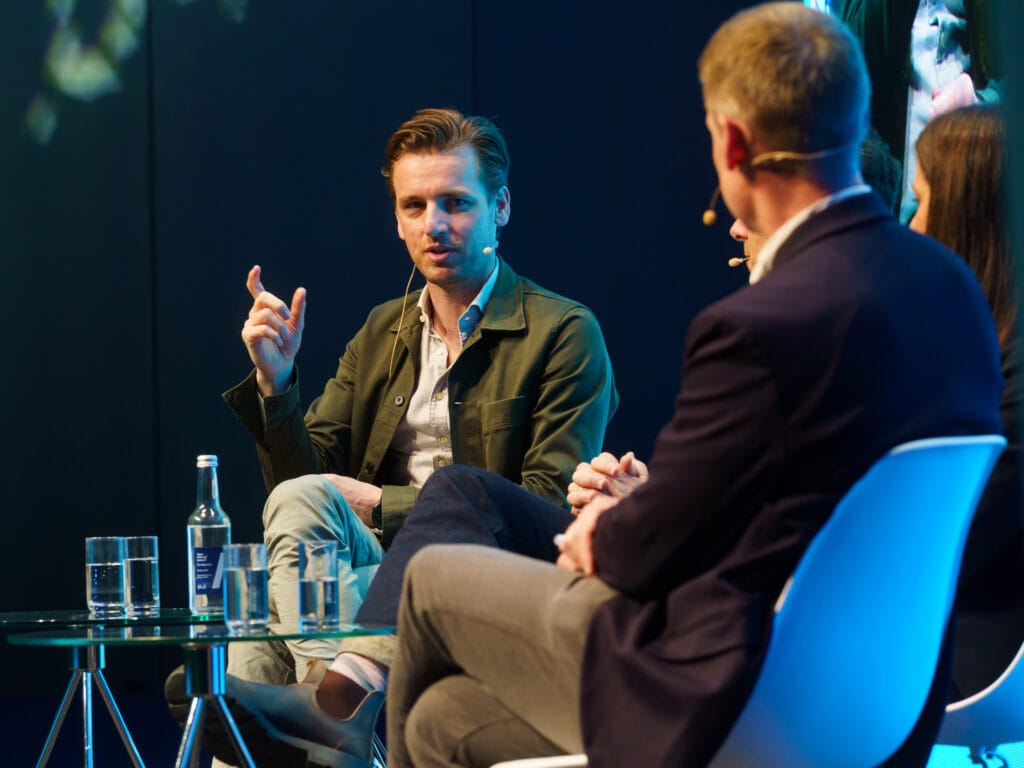
Bas van Beijeren, Investment Director of Carbon Equity speaking at Energy Tech Summit 2025
Key takeaway
Scaling decarbonization technologies is not held back by a shortage of money in aggregate. It is held back at the handovers: from proven technology to first plant, from grant to lender, from a good conversation to a signed contract. The companies that clear those handovers have a commercial reason to exist beyond decarbonisation, a team that has built at scale before, and a founder who treats financing the first factory as a core skill rather than a later problem.
Secure your pass
Energy Tech Summit Europe returns to Bilbao on 7–8 April 2027, bringing together the funds, public institutions and founders working on exactly this handover.