
Low-voltage networks run at under 10% utilisation and still get overbuilt. Plexigrid’s CEO on why the fix is control rather than concrete.
Grid bottlenecks have quietly become the thing standing between the energy transition and the assets it wants to connect. Alberto Mendez, co-founder and CEO of Plexigrid, opened his Energy Tech Summit keynote with the line that inspired his company: there’s no such thing as an energy transition without a grid transition.
The mismatch is architectural. Engineers built the grid a century ago for large, centralised, controllable power plants pushing predictable flows toward cities and households. The energy transition, however, is that system inverted — millions of nodes becoming hundreds of millions of distributed, intermittent, bidirectional ones instead.
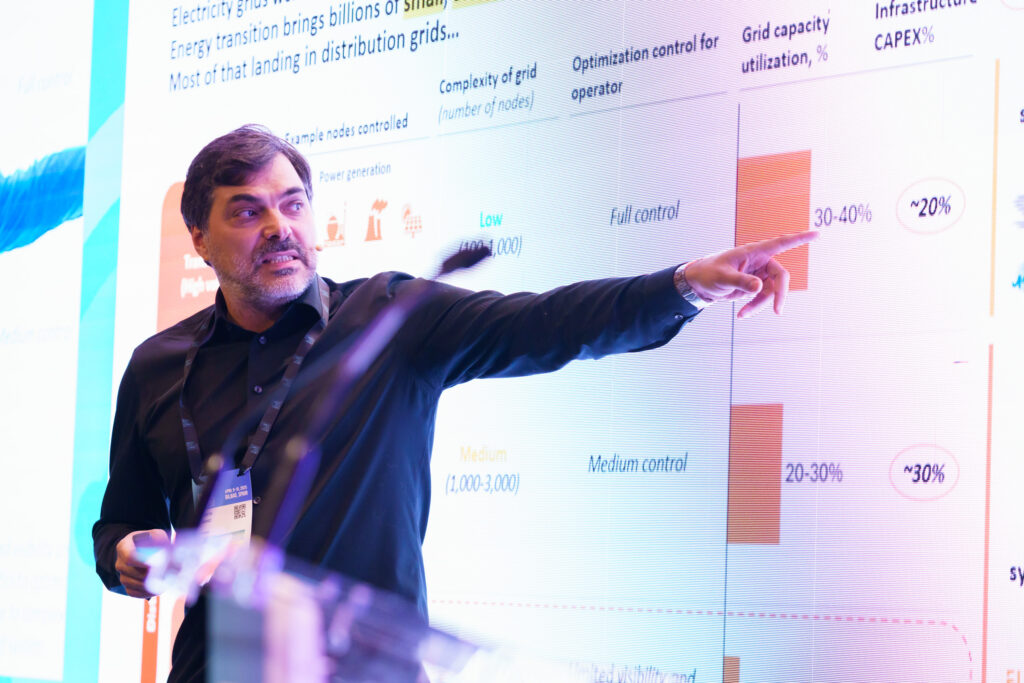
Alberto Mendez, co-founder and CEO of Plexigrid speaking at Energy Tech Summit 2025
The Cost Is Already on the Bill
Two consequences follow, and Mendez put both in commercial terms.
First, bottlenecks are now the number one cause of delays and cancellations for renewable and electrification projects. This holds true in every country with an advanced transition.
Second, grid fees are becoming the dominant line on electricity bills. The transition pushes energy prices down through cheap renewables, while at the same time pushing grid fees up, because operators have to build out the network to accommodate it.
The Efficiency Problem Nobody Sees
The heart of the keynote was a single comparison that explains why distribution costs are climbing.
Transmission is a flexible network with real-time control and visibility. As a result, it runs at 30–40% average utilisation across the year. Medium voltage, by contrast, drops to 20–30%. Low voltage sits below 10%.
The reason isn’t incompetence, but physics plus obligation. Operators cannot see what’s happening in real time, cannot control it, and still carry a security of supply mandate that the grid must hold on the coldest day of the year. That leaves exactly one available strategy: overbuild the entire low-voltage network for a peak that might occur fifty hours a year. The rest of the time, that spare capacity simply sits idle.
Mendez’s verdict was precise. “It’s effective but is not efficient.” And now, on top of a distribution system already operating at that level, the plan is to electrify everything.
The Onion, and the Missing Link
His model for the value chain is an onion. At the core sit the grid systems themselves — robust, long-lived, some dating to the 1970s and 80s, comparable to core banking systems. Around them sit newer layers and new players.
The fintech analogy carried the argument. A payments company adds value only because it connects back to core banking, since money ultimately moves between bank accounts. Similarly, in electricity, those connections already exist at transmission level: battery operators, flexible retailers, and anyone sitting on a flexible asset can monetise against spot markets or the transmission operator’s ancillary services.
At distribution, though, many of those links are simply missing. The largest gap is the ability of distribution operators to act like operators — meaning real-time control and orchestration across millions of nodes. Transmission, for comparison, involves only hundreds or thousands of nodes. Replicating that at low voltage is, as he put it, immensely more complex.
The prize, though, is convergence. If low voltage moves from sub-10% toward the utilisation transmission already achieves, it transforms everyone else on the chain too, because flexible assets gain an entirely new revenue stream.
He called this the flexibility iceberg: almost all flexibility players monetise against spot or ancillary markets, while beneath the waterline sits a very large optimisation problem nobody is addressing.
A Change on the Scale of Telecoms
Mendez framed what’s coming as the largest change in network control technology in decades. It’s arriving, moreover, alongside the largest re-regulation of electricity networks in decades — a shift some describe as the biggest in distribution in a century.
His comparison was telecoms moving from analogue copper fixed lines to GSM, the first generation of digital telephony developed by a European company, and onward from 2G to 5G.
Four Regulatory Religions
The most practically useful section covered how differently markets are approaching the same physical problem. Plexigrid operates across eleven markets, and Mendez described the regulatory approaches as flexibility “religions” — the physics are identical, but the mechanism isn’t.
Dynamic operating envelopes, used in Australia and New Zealand, are one approach: here, the digital twin sets maximum injection and consumption limits feeder by feeder and substation by substation.
Locational grid pricing, applied in Sweden, is another. It translates congestion into price signals street by street, so a congested street carries a different grid price at that moment than the next one over.
Flexible grid tariffs, as in Germany, offer a third route: putting a heat pump or EV on a flexible tariff earns a discount on grid fees.
Local flexibility markets, which he identified as the main direction of travel, form the fourth. Here, the real-time digital twin automatically purchases and activates flexibility, while aggregators and battery operators monetise it from the other side.
He was deliberately neutral about which one wins. “We have some favourites but we are agnostic.” The physical problem, after all, is singular, and all four approaches solve it reasonably efficiently.
Takeaway
People usually discuss grid bottlenecks as a construction backlog, and the reflex is to build more. Mendez’s argument, instead, is that low voltage isn’t short of capacity — it’s short of visibility, and the overbuilding is simply what you do when you cannot see. His demonstration showed most bottlenecks on a real network disappearing once operators activate flexibility, with only a stubborn few remaining that genuinely need steel. That reframes the question for distribution operators entirely: not how much grid to build, but how much of the existing grid they’re currently unable to use.
Energy Tech Summit brings together the startups, investors, and corporates building the energy transition. Founder’s Pass is €699, fixed.