

Measurement is expensive, protocols disagree, and buyers can’t compare projects. Four operators on what has to change before the market scales.
Carbon removal credits sit in a market that scrutiny has reshaped twice over. Melina Sánchez, principal at climate tech VC AENU, framed it in one line at the start: growth brings scrutiny, and scrutiny is what unlocks capital.
Trust is broader than the tonne
Michelle You co-founded Supercritical, a carbon removal marketplace covering every pathway from nature-based solutions through to direct air capture, working with buyers including a major airline and a large asset manager.
Her definition of trust went well past the crediting question of whether a tonne was genuinely removed. It includes transparency in the data, a clear view of pricing and supply availability, an assessment of delivery risk – will this credit actually arrive in future – and understanding the project’s social context, including co-benefits and any damage to local communities.
Asked how the definition shifted after the registry scandal of recent years, her answer was a flight to quality. Most credits sit in the avoidance market, and buyers have moved toward removal on the perception of higher quality, helped by a simple asymmetry: measuring a tonne removed is considerably easier than measuring a tonne avoided. The net effect on removal has been positive, though it also left real fear around greenwashing and reputational damage.

Mary Yap, Co-Founder & CEO of Lithos Carbon
Mature protocols versus emerging ones
Jason Aramburu, co-founder and CEO of Applied Carbon, described biochar as unusual in the removal landscape because the market is comparatively mature and the methodologies have been settled for years. Essentially there is one project type: you are certified or you are not, and certification imposes a defined testing schedule.
Mary Yap, co-founder and CEO of Lithos Carbon, works in a younger category. Lithos takes dusty volcanic rock – a waste by-product from mines – and moves it to farms, where it traps carbon permanently.
Her account of the market’s evolution was the clearest historical framing of the session. Early on there was widespread uncertainty about permanence and additionality, and a large volume of ex ante credits: I have done an activity that may capture carbon in future, pay me now. Lithos has never sold those. The company measures empirically instead, returning to every project site every six months to draw samples from the fields and establish how much carbon is actually trapped before delivering to the buyer – an ex post credit.
That shift, from activity-based credits to empirically measured ones, is the change she considers most important.
Ratings as market infrastructure
Tommy Ricketts runs BeZero Carbon, which neither sells nor builds credits. The company creates analytical infrastructure – his comparison was bond ratings, providing information rails for the market.
His argument for why that is needed was the sharpest of the panel. You will hear excellent stories from very good actors, he said, but there are dozens of other projects running similar activities under the same protocols, and the outcome is supposed to be identical – a tonne of carbon – while in practice it is not. A rating treats the claim probabilistically: to what extent is the project actually achieving what it claims?
BeZero builds independent datasets to interrogate each project bottom-up, then issues a rating that functions as a risk metric and benchmark for pricing, cost of capital and due diligence.
He was careful about the posture this implies. BeZero’s role is not to say a developer is wrong or a bad actor. It is to point out where evidence is woolly – where a distribution offering ten thousand possible outcomes has been reported at its most favourable – and to show what good practice looks like, so capital trends toward it. The alternative is my scientist versus your scientist, which is not systematic.

Tommy Ricketts, Co-Founder & CEO of BeZero Carbon
The real demand blocker
You identified the binding constraint on the supply side as demand – a classic chicken-and-egg problem. Suppliers need buyers willing to take risk and sign long-term offtakes, which unlock the project financing needed to scale. For a buyer already committed and budgeted, she argued an offtake is close to a no-brainer: a stable price per tonne in a volatile market, at a discount to a spot market that keeps getting more expensive under supply constraints.
She was also realistic about who is actually buying. The catalytic buyers are special cases. The typical company with a net zero target has a two- or three-person sustainability team focused on carbon accounting and internal carbon pricing, with no ability to distinguish biochar from enhanced rock weathering – which is exactly where standardization and like-for-like vetting reports matter.
Her diagnosis of what blocks the mass market was specific: guidance. Corporate target-setting frameworks have effectively allowed companies to defer removal purchases for decades, which makes no sense, because the supply will not exist later if nobody buys now. Corporates want prescriptive, clear targets with interim milestones rather than a vague upward path.
Ricketts, invited to comment as an investor, gave the panel’s bluntest summary. There are four reasons to buy a credit. Philanthropy, which is not a market. Claims, which drove the boom and has been largely killed by scrutiny. Transition frameworks, the biggest of which currently advises against buying credits – sitting on what he estimated as a very large dormant market. And regulation, which is arriving slowly.
His conclusion: “I don’t think it’s a trust problem. I don’t think it’s an infrastructure problem.” The startups on stage have solved those. What is missing is systematic buying.
Where Article 6 fits
An audience question on the Paris Agreement’s market mechanisms drew a useful clarification from Ricketts. The same project can be eligible across multiple regimes simultaneously – an Article 6.4 transaction, an Article 6.2 transaction, a domestic compliance market, a local carbon tax, or a voluntary credit. The protocol may differ, but the project does not, so these are potentially harmonized already.
He also offered a neat observation on the terminology. Every transaction of any financial asset is voluntary; calling this market voluntary really just describes the corporate incentive underneath it. Once a mandate replaces that incentive, the purchasing decision becomes compliance – but the credits themselves will likely coexist across all these markets. The alternative is balkanization into separate regional markets.
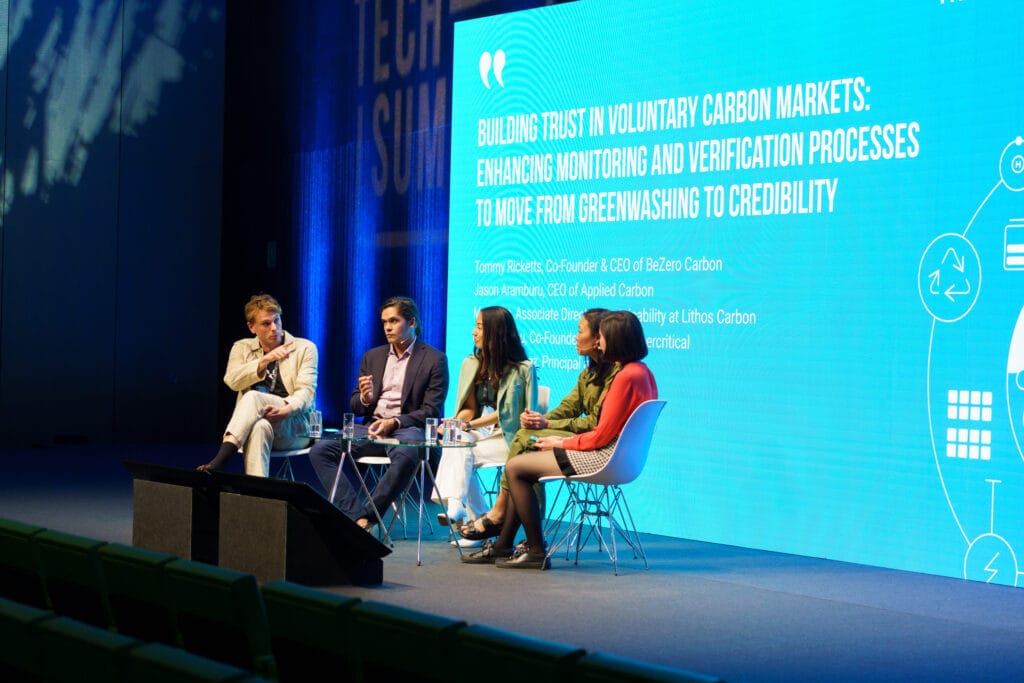
Panelists at Energy Tech Summit
Takeaway
Asked what changes over the next couple of years, both developers pointed at data rather than technology. In biochar, research is pushing validated permanence from centuries toward a millennium or more, with registries beginning to accept it – which would let buyers choose on price and co-benefits rather than permanence. At Lithos, the focus shifts toward the agronomic case: crop yields, soil moisture retention, and the argument that if farmers adopt these practices because they improve their own ground, carbon removal scales as a by-product of something they already want. Which is roughly where the whole panel landed. Carbon removal credits will not be trusted because someone insists they should be, but because the measurement gets cheap enough, and standard enough, for buyers to compare them without taking anyone’s word for it.
Secure your pass
Energy Tech Summit brings together the startups, investors and corporates building the energy transition. Founder’s Pass is €699, fixed.