

Compute is doubling faster than any efficiency curve. A network operator, a utility, an AI ethicist, and an investor on what actually helps.
AI energy demand has moved from a footnote to a planning constraint, and this panel had the advantage of four genuinely different vantage points on it. Claudine Emeott, Partner at Salesforce Ventures, moderated. She leads impact investing at a firm with a large generative AI fund, and a considerable interest in whether hardware can absorb what software is creating.
Four Seats at the Problem
Oscar Cantalejo leads Perseo, the corporate venture arm of Iberdrola. He looks for technologies that affect the utility’s activities and builds new businesses adjacent to its core, with data centres flagged as a major source of future demand growth.
Ronnie Chung heads Responsible AI at Centrica. His remit covers the familiar ethical territory — fairness, bias, explainability, data privacy, human autonomy — and extends into robustness and resilience, informed by recent failures in payment systems and airports. Sustainability sits inside that same remit.
Andrew Wee is Director of Hardware Partnerships at Cloudflare, responsible for all capex going into its data centres. His summary was the bluntest of the four: “AI keeps me up at night.”
Cindi Bough is Managing Director at Climate Investment, a specialist decarbonization firm investing across venture and growth, with emissions reduction as the central criterion.
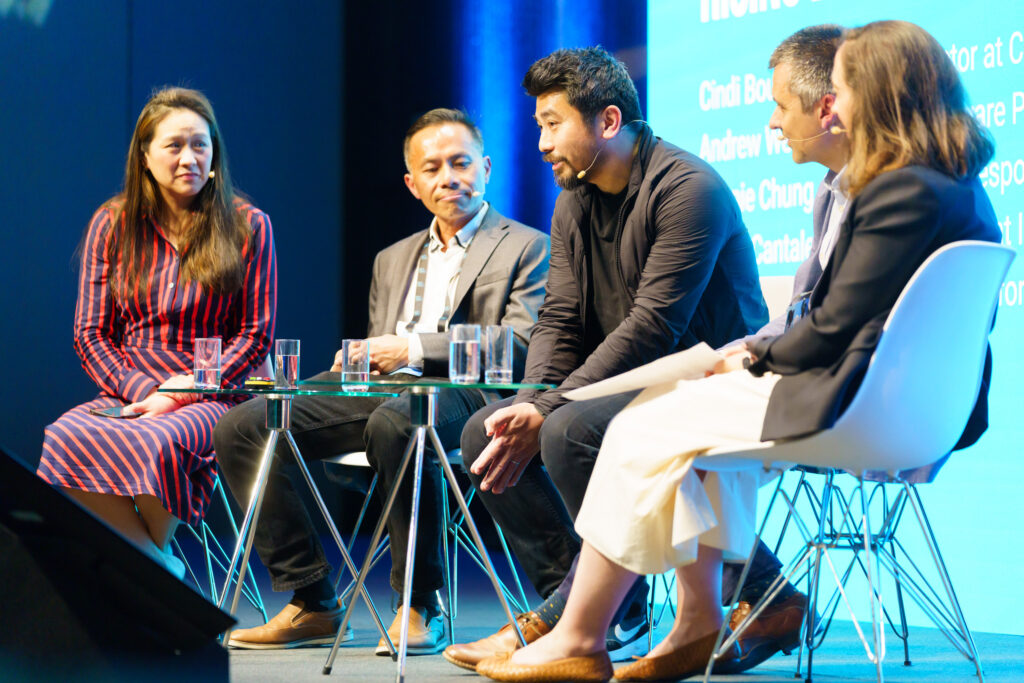
Panel speakers at Energy Tech Summit 2025
Sizing It From Inside the Network
Wee’s vantage point is unusual, because Cloudflare sees both ends of the traffic equation: major AI companies as customers, and millions of developers building on the network.
He identified four drivers of growth: language model traffic, AI search, AI automation, and a fourth that gets less attention — bot and cyber traffic. Both benign crawlers and malicious activity are rising as a consequence of everything else.
Bough added the training-versus-inference distinction that changes the shape of the problem. Training a model is expensive, but inference — the ongoing cost of using it — can run far higher, which turns a one-off cost into a permanent load. She also widened the frame past electricity to water and labour.
The Optimistic View From Spain
Cantalejo offered the panel’s most constructive framing, and it was geographically specific. Spanish data centres currently account for well under 1% of national electricity demand, while renewable deployment continues at scale and overall electricity demand has been falling.
That combination makes new data centre load an opportunity rather than a threat, since it’s a use for generation Spain already has. Iberdrola has set up a company specifically to accelerate that, supplying energy and seeking partners who want a presence in the market.
He was careful about the ambition, though. The goal isn’t gigawatts by 2030, but sensible progression from the current base — growth that the system can actually sustain.
Design Choices Carry an Energy Cost
Chung’s contribution reframed efficiency as an architectural decision made long before deployment.
The excitement around generative AI means people reach for it reflexively: think of a problem, apply genAI. But traditional machine learning approaches operate at kilowatt-scale usage, while generative inference, with chain-of-thought reasoning, sits at an entirely different order of magnitude. So model selection at the design stage is itself an environmental decision.
His illustration was the room in front of him. A few years ago, people recorded talks on handheld devices, then on phones. Now they run transcription models, translation, and agents reasoning over the content in real time, and each added layer consumes more.
The obstacle to managing any of it is visibility. Understanding your actual carbon footprint from AI usage is genuinely difficult, because vendors stay opaque about it. For a while, financial ops calculations served as a rough proxy for environmental cost, until cheaper models broke that correlation.
He was also candid about industry culture. Coming from consultancy, financial services, and banking himself, he noted those sectors don’t think about energy or sustainability when developing applications at all. That habit compounds as workloads move from classical machine learning, through language models, toward agentic systems.
Regulation Isn’t Coming
Bough asked directly whether standards or a carbon price for AI compute might emerge. Chung’s answer was pessimistic and reasoned.
Recent political shifts have moved attitudes toward deregulation, which he doesn’t endorse — instead, he argued for more effective, less bureaucratic regulation, rather than none at all. But the deeper obstacle is that AI capability has become a geopolitical competition, with national interests operating well above the corporate level. On that basis, he doesn’t expect meaningful regulation within five years.
What’s Actually Promising in Hardware
Bough’s deal flow view separated the durable from the opportunistic.
She sees many companies pivoting to supply power for data centres, driven by a timing mismatch. A data centre takes around two years to build, while a renewable plant supporting it takes roughly four, once siting, permitting, and interconnection are counted. That’s useful, but it isn’t the long-term innovation a venture investor is looking for.
The more interesting hardware areas, in her view, are lower-power chips, thermal management, and photonics. She flagged waste heat as both problem and opportunity: data centre heat is good quality heat, usable for repowering or thermal storage.
Her frustration was allocation. Not enough investment goes into hardware, because software optimisation offers faster and more standard venture returns. Her appeal to the room was direct: if you have a strong idea on energy efficiency, come and talk to us.
Where Wee Disagrees
Wee disagreed with one part of that, firmly. Returning from a major AI hardware conference, he described rack after rack of liquid cooling, and found it frightening rather than exciting. The question he kept asking was which businesses can actually support that capex and opex profile, beyond hyperscalers and model developers. His own preference was unusually honest: he wants to push liquid cooling as far down the road as possible.
Where he does see promise is silicon and system architecture. ARM-based CPUs cut power consumption substantially against the x86 standard, and Cloudflare was the first non-hyperscaler to deploy them in a data centre. RISC-V is the emerging follow-on, promising considerably better power efficiency again.
At system level, he pointed to composable infrastructure. In a traditional server, CPU, GPU, FPGA, storage, and memory are stranded together, so powering the server powers everything regardless of the workload. Disaggregating those components, and connecting them over high-speed links, lets you spin up only what a workload requires — fewer servers, lower opex.
Asked whether silicon is nearing its limits, his answer was no. The demise of silicon has been predicted many times, and engineers keep finding ways down toward the atomic scale. Photonics is interesting, and probably has a place at rack level and in data centre interconnects, but silicon remains the foundation.
How a Startup Actually Gets In
Bough asked Wee the question every founder in the room wanted answered: how does a startup get Cloudflare’s attention, and what does the commercialization cycle look like?
His answer was bracing. After introductory and technical conversations, the decisive stage is a proof of concept, where the hardware runs in Cloudflare’s own data centres carrying production traffic. And “nine out of ten times they fail,” because the testing on security, performance, and power is thorough enough that even promising candidates don’t finish. His encouragement was nonetheless genuine: you miss 100% of the shots you don’t take.
Cantalejo drew a parallel with renewables. Early enthusiasm focused on clean generation; only later did the industry develop recycling for panels and batteries, because the first wave created problems needing solutions. Data centres are following the same arc, with companies now working on issues nobody considered five years ago. From a utility’s perspective, he added, a data centre isn’t fundamentally different from any other large industrial customer — the job is cleaner, more efficient supply either way.
What Would Actually Help
On policy, Bough started with transparency rather than standards. Carbon intensity per unit of compute would let designers understand what their choices cost, and scores would help even without formal regulation.
Her second ask was procurement clarity. Startups believe they have something exceptional, and frequently don’t. The bridge between them and large buyers isn’t visible enough, which is precisely why she asked Wee about his process.
Chung was sceptical that transparency arrives voluntarily. The major model vendors have a commercial conflict, and giving deployers this information isn’t in their interest. His alternative is for companies to build it themselves: post-deployment observability, already common for security and fraud monitoring, extended to cover sustainability and carbon too. “I don’t think the vendors will do it for you.”
On co-locating renewables with data centres, Cantalejo said it’s already happening. Most new capacity is co-located or very close, avoiding network transport, where previously the mechanism was a power purchase agreement. Clean supply is now consistently requested, and carrying that credential matters to operators.
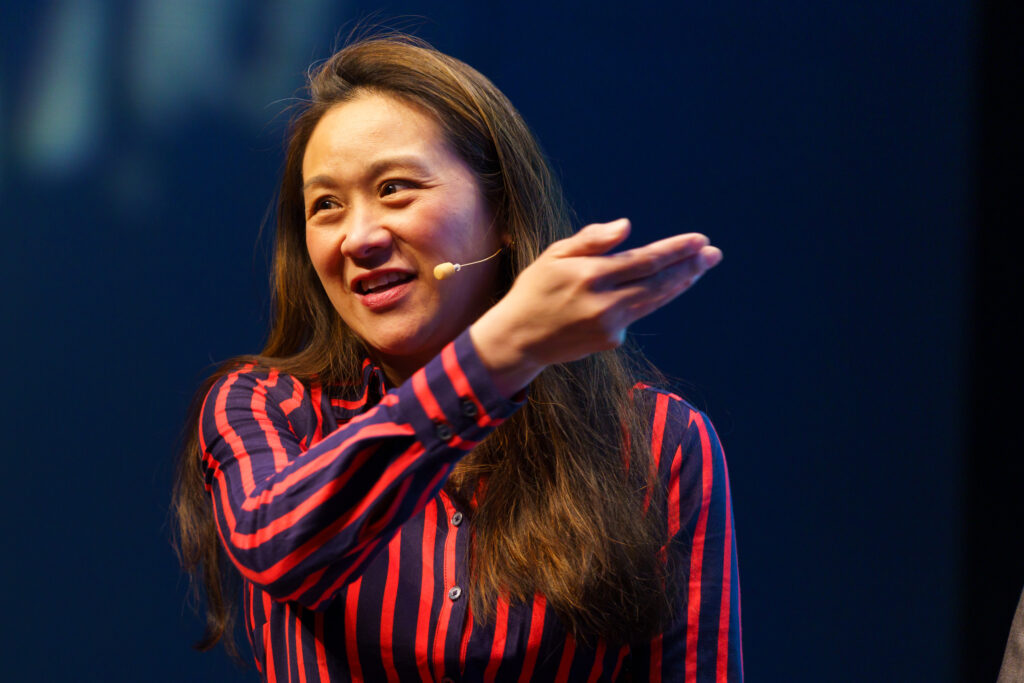
Cindi Bough, Managing Director at Climate Investment speaking at Energy Tech Summit 2025
Takeaway
An audience question from a Norwegian software founder drew the most useful exchange of the session. She asked how investors should evaluate AI in due diligence, given the vague answers she’d received so far. Bough’s answer was conventional and clarifying: traction, pilots, repeat customers, upsell. Chung’s was sharper. The vagueness exists, he said, because most investors don’t yet know what they should be auditing — which is an opportunity rather than an obstacle. Arrive with a defensible framework for how your AI use should be assessed, and you set the terms. Bough added education to the mix too: teach investors the market, because the space is new enough that nobody has the map yet.
That’s a fair summary of AI energy demand generally. The numbers are alarming, the measurement is absent, the regulation isn’t coming, and the people closest to it are still working out what to ask.
Energy Tech Summit brings together the startups, investors, and corporates building the energy transition. Founder’s Pass is €699, fixed.