

Sixty one-megawatt sites are easier to find than one sixty-megawatt site. What that does to how data centers get designed.
Edouard Bulteau, Operating Partner at Marble, opened with the constraint that now governs data center siting. Building a facility takes a couple of years. Getting a grid connection is a different matter entirely.
Waits run to several years in the US and seven to ten in major European hubs, with some US utilities reportedly quoting more than twelve. Grid access, he argued, has become the single biggest bottleneck – which raises an obvious question about where facilities get built, and a harder one about what to do.
Who was on stage
Patrick Giangrosso is Commercial Leader at LiteON, one of the larger providers of AC-DC power supplies at rack level. About eighteen months ago the company built a business around direct current data center infrastructure, which allows multiple energy inputs, interaction with the grid, and DC supplied straight to servers that are natively DC anyway.
Íngrid Munné Collado is Forecasting Lead at Electricity Maps, a startup that began in carbon accounting and now focuses on how forecasting can unlock flexibility – from electric vehicles to data centers – to reduce both emissions and running costs.
Luca Mezossy-Dona is Co-Founder and CGO at IONATE, which builds hardware and software for smart power. The company innovated on transformers, turning them into all-in-one smart devices with solid state capabilities that are commercially available today. Networked together and orchestrated with AI software, they become intelligent nodes – in the grid or inside a data center microgrid.
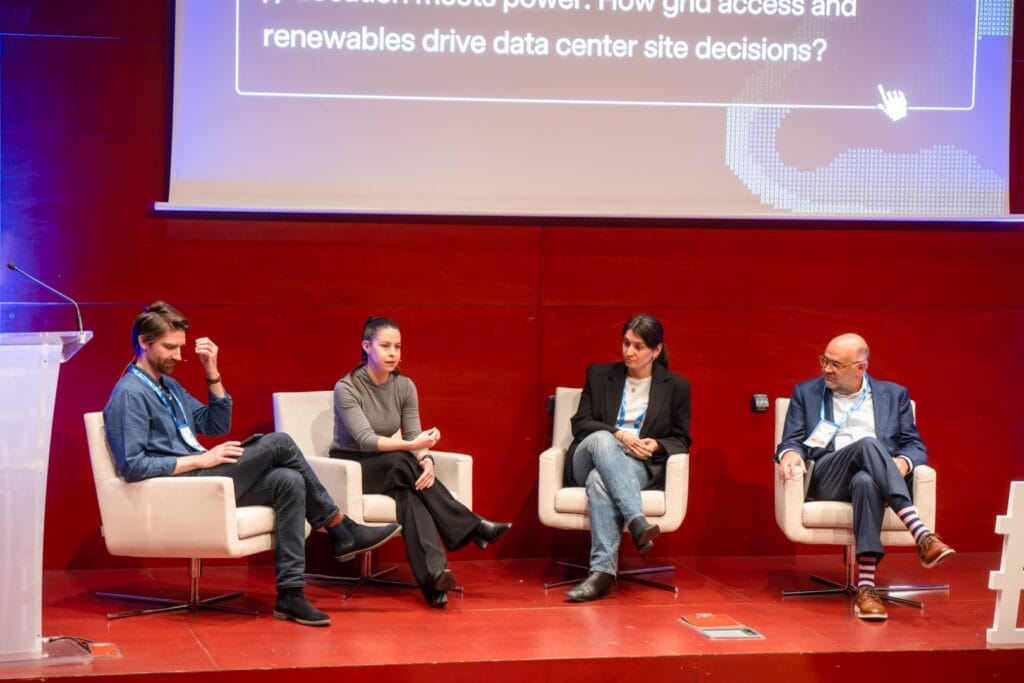
Speakers of the panel on Compute stage during Energy Tech Summit 2026
How the bottleneck got worse
Giangrosso had spent four years developing data centers, and described the change in concrete terms.
Four years ago, a 50 or 60 megawatt site could get connected within a year with the right agreements and environmental certification. Now, with sites exceeding 100 megawatts and both utilities and communities pushing back, that process takes four or five years.
The financial terms changed too. Utilities now ask for millions upfront simply to begin the process. Where developers once paid on connection, they may now be asked for tens of millions in advance.
Consequently, bring your own power has become the operating assumption in the US, which is pushing developers toward gas turbines and on-site generation. Giangrosso has advocated on-site generation for years, though he was blunt that the current implementation is not the right way to do it.
His comparison for how fast sentiment moves was apt. Two years ago nobody wanted liquid cooling; now it is the greatest thing since sliced bread. On-site generation is following the same curve from never to necessary.
Mezossy-Dona added the grid’s side of the negotiation. A connection has to work for both parties: the data center needs sufficient quality power, while the grid needs assurance the facility will not introduce instability and will behave as a good energy citizen. Grids are hitting constraints in many places, partly from the energy transition rather than data centers alone, so requirements are getting stricter for anyone connecting – generation or load alike.
What happened to renewables as a siting driver
Munné Collado described a shift over her three years at the company. Early conversations were about where to shift cloud compute to reach data centers with a larger renewable share, with less attention to cost.
That changed as AI demand grew. Speed of supply became the priority, which pushed operators toward spinning up gas generation to cover demand. The ambition to run data centers sustainably became, in her word, somewhat hidden.
Recent energy security concerns have started reversing that again, because relying on gas means surrendering energy independence. That returns attention to renewables, to power purchase agreements, and to operating a data center as an active grid participant rather than simply a load.
Giangrosso confirmed the pattern from the developer side. His previous team’s entire mantra was sustainable data centers, partnering with renewable providers and siting close to those sources for a fully renewable portfolio. That went out of the window as speed to market overtook everything else – though he expects it to return.
Direct current is part of why. Many renewables are natively DC: solar, wind, and fuel cells running on cleaner energy. A native DC source connects directly to a DC data center, which makes the path from generation to load considerably simpler.
A shifted hierarchy of needs
Mezossy-Dona reframed what renewables now represent. They were a beacon of sustainability. Today they are a route to energy independence and resilience, a way to diversify power sources, and a way to bring your own power.
That changes the design brief. He sees considerably more thought going into data centers that can operate independently of the grid, or at least interact with it such that they sustain themselves for a period – with the grid, in exchange, requiring them to provide support in times of need.
Design options depend heavily on scale. A facility of several hundred megawatts is a different proposition from an edge site of 30 megawatts – which, he noted, used to be a standard data center size. Building your own microgrid with local generation is far easier at the smaller end.
Where hundreds of megawatts are planned, speed to power dominates, which is what brings gas peaker plants into play. Alternatively, direct current designs, hybrid AC and DC facilities, and modular buildings offer different routes – reshaping how the industry thinks about microgrid power systems generally, not just data centers.
Sixty small sites instead of one large one
Giangrosso extended that into the argument at the heart of the session. The design question is not only about the building but about how data centers get delivered at all.
Rather than one 30 megawatt facility, consider thirty one-megawatt facilities, which are far easier to place. They fit into existing colocation sites, cell tower sites, hospitals or manufacturing facilities. Finding one megawatt at a hospital is considerably easier than finding thirty megawatts nearby.
Bulteau put the obvious objection: does that actually reach the capacity the market needs?
Faster, in Giangrosso’s view. Gas turbines currently have lead times of two to three years, so bringing your own power that way means waiting regardless. A modular data center can deploy in six months – and done without backup generation, it may avoid environmental assessment altogether, saving another year.
He gave live examples. In Singapore, where energy constraints mean you must bring your own power, the company is running a proof of concept taking a fuel cell off the DC bus, enabling deployment in the city itself. In the US, another project connects directly to solar and will send energy back to the utility during demand response – making the facility a contributor rather than, as he put it, a suck on the grid. A third is underway in the UK.
Flexibility, in time and in place
Munné Collado traced how flexibility work evolved from EV charging. Early optimization scheduled charging around carbon intensity – charging when solar or wind output peaked. Price volatility then added a second objective: minimizing cost.
The same logic translates directly to data centers not relying solely on power purchase agreements. Both emissions and end-of-month cost become optimizable.
Location-based flexibility is one route. She described work with a hyperscaler where users can be incentivized to choose a different regional data center, reducing emissions and cost.
Temporal flexibility is the other, and the numbers are striking. Running the same cloud job in Portugal at 7am rather than waiting until 1pm can change the emissions by a factor of three, along with the price.
Asked whether data centers might pay for flexibility elsewhere on the grid rather than providing their own, she had not seen it yet but sees the potential – essentially a reward mechanism flowing from data centers to consumers, resembling a virtual power plant.
Giangrosso pointed at the inverse case. When there is too much power – as with Spanish solar – data centers could turn on to absorb it, acting as a load sink and potentially preventing grid incidents.
Munné Collado added the Scottish example, where installed wind can produce up to 10 gigawatts against transmission lines that carry only 7. Curtailing that electricity to ramp up something else is precisely the waste that better orchestration could redirect toward useful load.
Can a data center become a grid asset?
Mezossy-Dona thought so, while cautioning that the process is early. The question is incentives and mandates, because data centers are currently rushing for capacity and thinking about themselves rather than the grid. If grid operators specify what they require in order to permit a connection, that changes everything – and any genuinely interconnected future requires symbiosis between the two.
Munné Collado offered a historical parallel worth remembering. During her PhD there was widespread panic that the grid could not absorb electric vehicles if Europe switched from diesel. EV adoption has continued rising, and nobody discusses that concern now.
What the current panic actually reflects is that the grid has never been managed the way it now must be. Previously it was passive: large generation, large consumption. Now anyone can be both consumer and producer.
Data centers today are treated as massive loads with one job. That does not have to be the case, she argued. Grid requirements could specify that a facility must be able to act as backup when the operator needs it, and must be curtailable in the way wind assets already are.
Bulteau added a financial angle. Grids have needed enormous investment for years as infrastructure ages. Data center demand may be the thing that finally brings that capital – potentially by requiring operators to contribute to the upgrades they depend on.
Does climate data belong in siting decisions?
An audience question asked whether climate data will become a required input for location planning.
It already is, Giangrosso answered, which is why the Nordics are attractive: cooler locations need less energy for cooling. Developers likewise avoid areas prone to severe storms or flooding.
The more interesting use, though, is ongoing rather than one-off. Climate data typically informs the siting decision and is never consulted again. Used continuously, it enables planning: knowing cloudy weather is coming means ensuring batteries are charged, or shifting load elsewhere. Knowing a major storm is approaching means moving critical workloads before power becomes uncertain.
Munné Collado gave a live example from northern Norway, where a large data center is being sited partly because the location is expected to stay cold – though that creates a secondary requirement for new transmission connecting the north of the country to the south.
She also described a project forecasting energy emergency alerts for a data center provider, so they can shift load ahead of a heat wave rather than adding strain to the grid. That kind of innovation, she noted, concerns how you operate a facility rather than only where you place it.
Is there unused capacity already?
The final question was the sharpest. Given how much attention goes to building new generation, is there substantial unused network capacity – at power producing sites or industrial sites that already have land access and permitting?
Mezossy-Dona said availability has two axes: location and time. Excess capacity genuinely exists, yet a data center wanting to run continuously may not accept the power peaks that come with it. Even so, he wants critical examination of grid pockets where underutilization exists, including industrial units not using their full allocation.
Giangrosso answered with the arithmetic that closed the session. Looking for 60 megawatts in one location, you will not find it. Looking for sixty one-megawatt pockets, you can find those all day – at healthcare facilities, manufacturing sites, cell towers, colocation, and telco facilities that are largely empty since copper was retired. Plenty of location and plenty of available power, unused.
Mezossy-Dona closed on efficiency. Reducing losses across the system and inside existing facilities can unlock multiple percentage points, which across a fleet becomes significant. The capacity is partly there – but realizing it requires thinking seriously about power systems design.
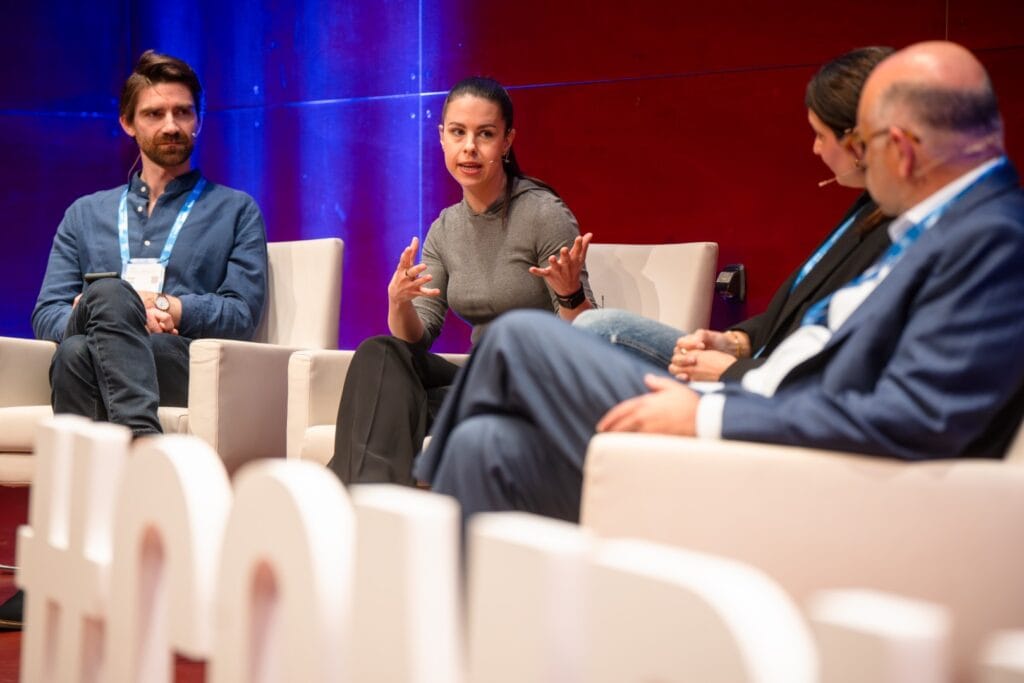
Luca Mezossy-Dona, Co-Founder and CGO of IONATE speaking at Compute Stage during Energy Tech Summit 2026
Takeaway
The most useful idea in this panel inverts how the industry usually frames scale. Everyone accepts that grid access is the binding constraint on data center siting, and most responses to that treat it as a procurement problem: bring your own power, wait for a turbine, pay the utility upfront. The alternative argued here is architectural. Sixty one-megawatt sites can be placed where sixty megawatts cannot, deployed in months rather than years, and often without environmental assessment. That trades operational complexity for speed – and it turns the flexibility conversation from something a data center might eventually offer the grid into something the design assumes from the start.
Compute Summit Stage 2027 returns with more conversations like this one.