
Running a data center at 53 degrees, financing wastewater plants for captive demand, and why nobody on the panel wanted to talk about space.
Derek Brooks, Principal at 2150, opened with the scale of the problem. Data center water consumption is a limiting factor alongside power. The panel brought a technologist, an institutional financier, and an investor together around the same question: can data centers become water neutral?
Who Was on Stage
Marc O’Regan is Chief Technology Officer for Europe, the Middle East and Africa at Dell Technologies, with a background in supercomputing and distributed architectures.
Nachiketa Sharma works at J.P. Morgan on climate tech innovation, investments, and partnerships, mobilizing institutional capital and building strategic partnerships.
Gerald Loo is an investor in sustainable solutions and decarbonization technologies. He was previously part of the founding investment team at a London growth equity fund covering physical assets, including the data center value chain.
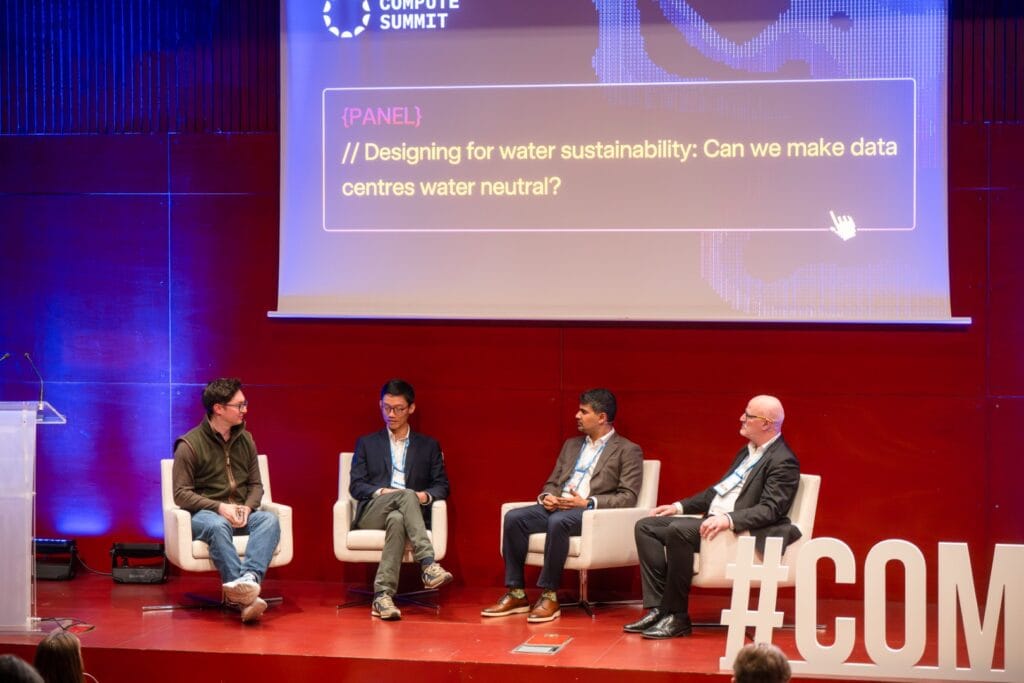
Panel speakers of Compute Stage during Energy Tech Summit 2026
The Heat Problem Underneath the Water Problem
O’Regan reframed the question before answering it. Heat management has occupied him for more than two decades, since building supercomputers means solving three things in order: speed, parallelization, and energy consumption.
The scale has shifted dramatically. Fifteen years ago, engineers might cap a rack at 8 kilowatts. Today, the largest data centers run into hundreds of megawatts.
Crucially, he pushed back on the assumption that AI causes the heat. AI workloads pour through the compute, certainly. What actually generates the heat is the compute itself, the chillers, and the surrounding data center ecosystem.
Water is where the industry has landed as an answer, and O’Regan was explicit that he considers this an interim solution. Dell works across immersion systems, running water over pipes on the compute planar itself, and chiller design. At the same time, the company asks a more fundamental question: should water be near a data center at all, if data centers can avoid it?
He illustrated the risk with something that had happened that morning. Setting a glass of water down near the sound engineer’s laptop provoked immediate alarm. Now scale that from one chip to hundreds of thousands, and the consequences of something going wrong become considerable.
Where the Money Is Going
Sharma divided the landscape in two. First, cooling technologies: direct-to-chip, immersion, hybrid systems, and a comeback for refrigerant-based approaches. Second, water management more broadly, covering wastewater treatment, recycling, and upcycling.
Funding is flowing into all of them, which he read as a healthy sign. He put year-over-year increases in funding at roughly 40 to 45%, across both equity raises and actual deployment contracts.
What determines which technology wins in a given case, he added, is the specific data center. It comes down to where it sits, what permitting requires, and what government will realistically approve, since water usage has become a politically charged topic.
Running the Data Center at 53 Degrees
Asked how retrofitting differs from new builds, O’Regan described work on a hyperscale project he’d worked on years ago. The answer began at component level.
The team measured everything, stripped out components they didn’t need, and concentrated on density. That meant packing considerably more processing units into each machine, then scaling jobs across them.
The efficiency gained at the engineering table produced the more consequential result. Because they designed the compute for it, the team could raise the ambient temperature of the data center to between 45 and 53 degrees Celsius, and hold it there. That meant shutting down the chillers and cooling systems that consume enormous amounts of energy.
That’s a shift from a typical ambient temperature of around 23 or 24 degrees. It’s sustainable for a substantial portion of the year, and it addresses cost, energy, and heat simultaneously.
He also pointed to heat reuse, describing a Dublin facility where the operation pipes heat out of the building and uses it to purify drinking water for surrounding communities.
Most organizations, he argued, aren’t examining that level of detail. Yet the question of whether engineers can reverse the problem at compute level — running not merely tolerably, but optimally, at high ambient temperature — changes everything downstream. Add reducing the concrete in the building and densifying the compute, and you approach a full system redesign.
Why the Best Technology May Not Win
Loo described a sector attracting capital across the whole spectrum, with considerable entrepreneurial activity at early venture stage.
Growth and scale-up investors, however, concentrate on the most de-risked and proven levers — those already deployed in the field. In practice, that means displacing traditional air cooling and evaporation methods through immersion, direct-to-chip, and closed loop systems.
His more interesting observation concerned infrastructure. Water treatment and transmission networks across Europe and North America are mature legacy systems with severe financing needs. Not every regulated utility or municipality has the balance sheet to build at the speed data center ambitions require.
Consequently, private equity providers have started stepping in. They now fund the development and construction of wastewater treatment plants and downstream infrastructure for captive data center demand — a relatively recent feature of the financing landscape, Loo said.
On what makes a company financeable, he was blunt about a common misconception. This is a hardware play, and in scaling hardware, the best technology doesn’t necessarily win the market.
What investors look for instead is the player with the most units already deployed. They want to see operating data, operating hours, and proof the company achieved the unit economics it promised, delivered on time and on budget. Those are the factors that de-risk a company and lower the cost of capital for later investors.
Brooks agreed, adding the early-stage version of the same point. You can get genuinely excited about strong techno-economics. But if the technology hasn’t run live in the field for two or three years, and if the materials to build at scale aren’t there, it isn’t yet valuable to anyone on the ground.
What a Lender Now Asks About
Sharma described substantial infrastructure capital and strategic activity entering the space, with strategics working alongside earlier-stage companies they wouldn’t traditionally have engaged.
The evaluation criteria have shifted accordingly. Financing data centers always turned on reliability and power usage effectiveness. Now water usage matters too — what the plan is, and how it complies with regulation.
The EU has introduced disclosure requirements covering water usage effectiveness, with some US states following. Importantly, Sharma noted the gap between commitment and verification. Publishing a number is one thing; a lender carries risk, so the bank works with third-party auditors to verify those claims independently.
Regulation Is Arriving, Late
Asked whether current water regulation is enough, Loo said regulators are finally crystallizing around what good looks like.
The shift is from voluntary water accounting toward mandatory reporting. Under newer nature-related disclosure frameworks, companies above a certain size must report in detail on water withdrawals, recycling ratios, and downstream metrics. He expects the broader trend — improved transparency, standardization, and accountability — to continue.
O’Regan welcomed it, while noting how recently it was absent altogether. Whether water is safe enough today is one question. Whether it remains so three to five years out, given where the investment and the buildings are going, is a different one entirely.
Where Data Centers Get Built Next
Brooks asked about location, raising cold regions, underwater sites, and orbit. O’Regan reframed it as four questions: where we build, how we build, why we build, and for whom.
On where, the economics are stark. He cited an electricity cost of around 24 pence per kilowatt hour in the UK, against roughly 2 cents in Norway — a difference large enough to relocate a facility on its own. Free air cooling remains the de facto approach, but as capacity scales, it will no longer suffice, which is what pushes the industry toward water.
The “For Whom” Question
The “for whom” question is where his argument became more interesting, because he thinks it changes the shape of the buildings entirely.
Industry analysts, he said, expect workloads to move toward the edge, where events actually happen. A round trip to a data center, let alone a public cloud platform, incurs meaningful latency. For inference workloads, where people expect immediate performance, that simply won’t suffice.
If a large majority of new digital services end up at the edge, that’s where the compute goes. That means an architecture problem, a latency problem, and a sovereignty problem all arrive together.
On sovereignty, O’Regan drew a distinction he considers underexamined. Is your data safe? Any hyperscaler will answer that all day. The better questions are different: is your information safe, is your metadata safe, and are the patterns you’re creating and observing safe too?
Underwater, and Why Not Space
Sharma was direct on orbital data centers: interesting, but far out for an institutional investor. Scientists writing about it describe substantial challenges still to overcome.
Underwater is different. Trials have been successful, and his team is already receiving financing proposals for underwater data center projects. Notably, he flagged a growing body of operating data emerging from China, alongside earlier Western projects. If he had to name one major trend for the next five years, underwater is what he’d pick.
O’Regan agreed on China, adding an observation about openness. Chinese models are largely open source, while Western equivalents stay closed and proprietary — a contrast he finds genuinely interesting.
On space, he offered his standard even-handed answer: he can give ten reasons to consider it, and fifteen to twenty not to. Computers cause heat, and heat doesn’t behave well in space, so trapped heat becomes yours to deal with in a contained environment. Orbital debris can damage the facility. Building and running costs are substantial. And sovereignty returns as the closing objection: if we can’t resolve it on land, how would we resolve it in lawless space?
Aquatic deployment, by contrast, is something Dell has worked on for years. That includes underwater testing off Scotland and Ireland, plus a hybrid platform off the coast of California that drew most of its power from tidal energy, with the remainder from the local grid.
That connects to modular and micro data centers, which the company has been building for years. Distributing lights-out facilities across deserts or far northern regions takes advantage of natural cooling to bring ambient temperature where it needs to be, while consuming considerably less power by design.
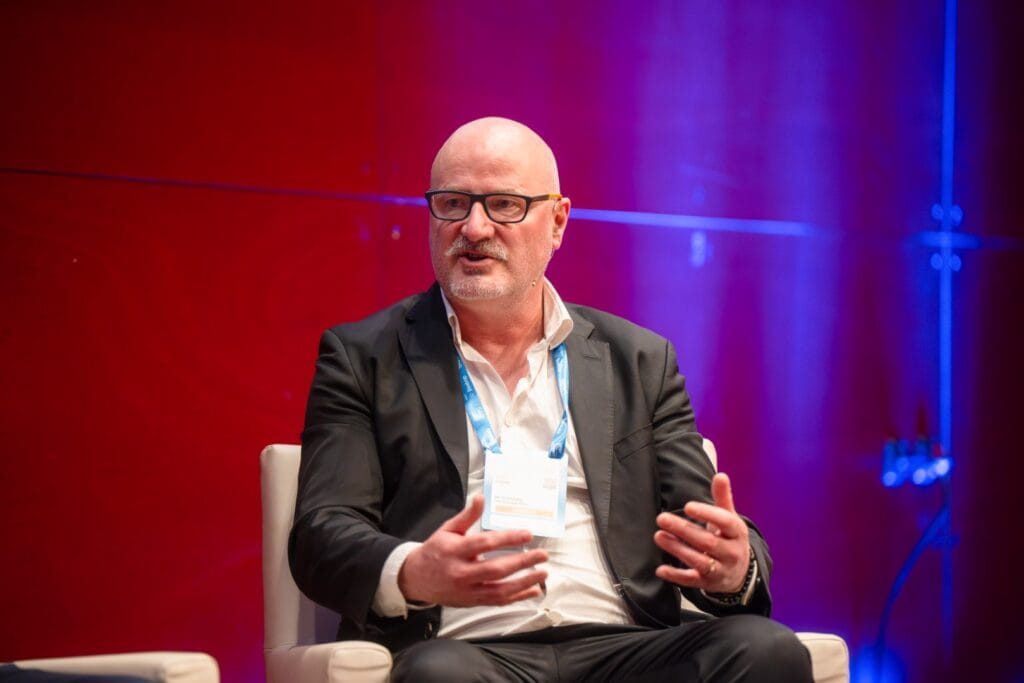
Marc O’Regan is Chief Technology Officer for Europe, the Middle East and Africa at Dell Technologies during the session
Takeaway
Brooks closed by pointing out that a panel organizers had billed as being about water had become a conversation about full-stack infrastructure change. That’s the honest conclusion. Data center water use is a symptom of heat. Heat, in turn, is a symptom of compute density. And compute density is a consequence of decisions engineers make at the chip and rack level, long before anyone specifies a cooling system.
Every genuine solution on this panel worked upstream of the water: designing compute that runs at 53 degrees, densifying racks, reusing waste heat, or relocating the building somewhere the climate does the work. Water neutrality, on this evidence, isn’t a plumbing problem.
Compute Summit Stage 2027 returns with more conversations like this one.