
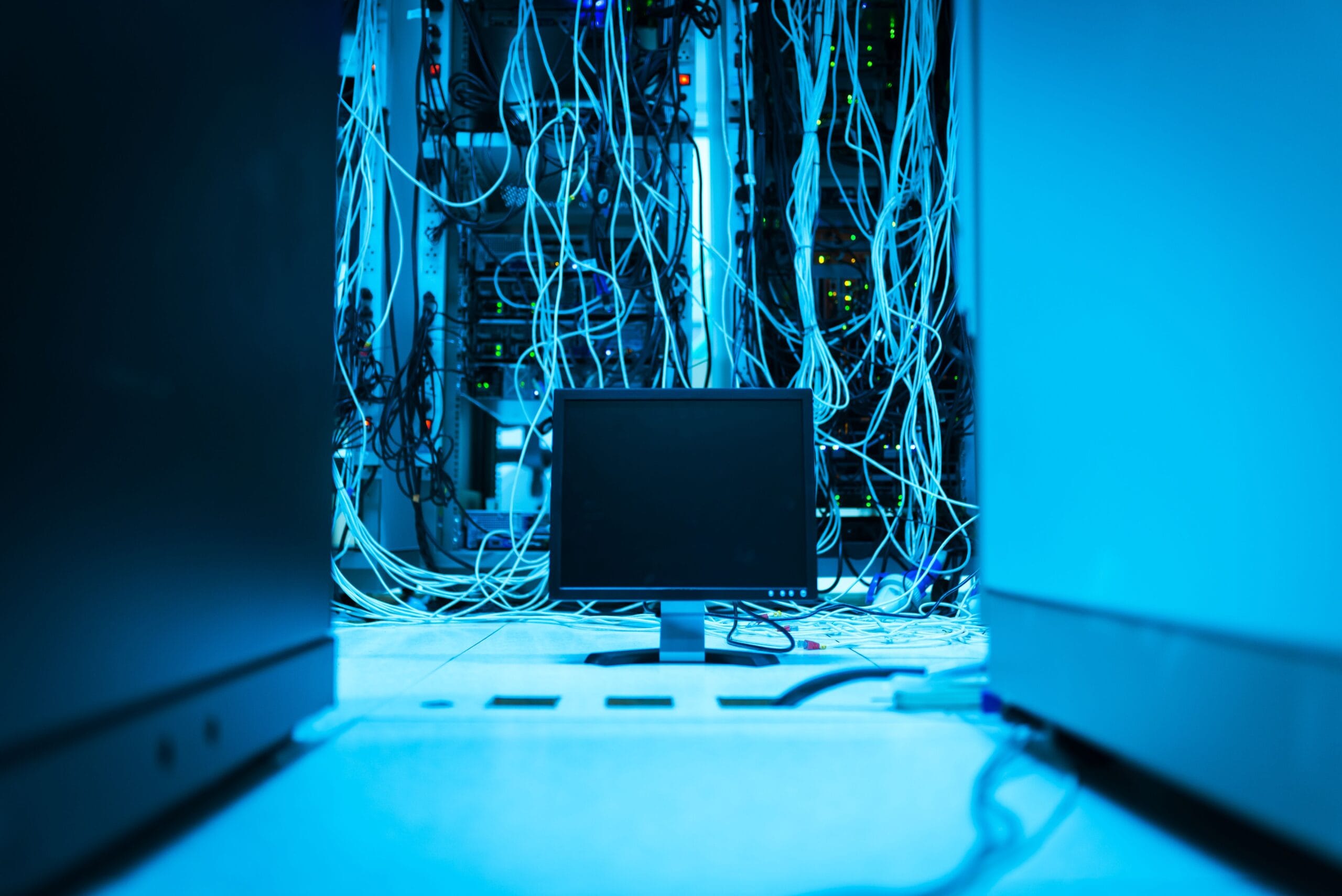
A two-megawatt data center that fits on a stage, and the argument that inference cannot be served from 5,000 miles away.
Henry Daunert, Founder and CEO at OnValue Technology, opened with the forecast the whole session circled. His panel took the question of what compute infrastructure has to look like to absorb that.
Who was on stage
Mart Duitemeijer works on commercial development at VEIR, a Series B startup that has raised 150 million to date and makes superconducting power delivery systems – power cables ten times smaller than an equivalent copper conductor or bus bar. Before VEIR he worked on European electricity market design and spent time at MIT studying new energy technologies.
Peter Hannaford is CEO at EdgeNebula, and has been in the industry, as he put it, since before data centers were called data centers. His previous company built some of the largest facilities in Paris, Amsterdam, Prague and London before being acquired. EdgeNebula now builds AI infrastructure from existing resources – stranded power and redundant real estate – creating a network of core and edge sites that deliver AI where the people are.
Marc O’Regan is Chief Technology Officer for Europe, the Middle East and Africa at Dell Technologies.
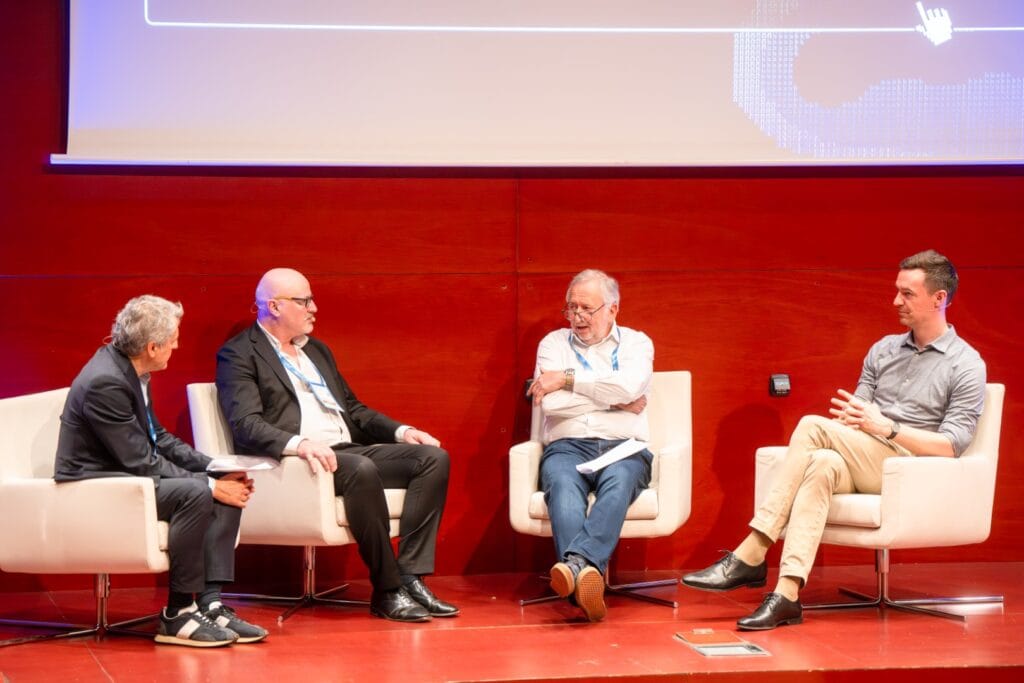
Session panelists at Compute stage during Energy Tech Summit 2026
Why copper becomes the constraint
Duitemeijer connected the capacity forecast to a physical limit. Much of that growth means moving toward high density racks, and the industry is heading for an 800 volt DC ecosystem. Even then, he argued, copper becomes prohibitive in those designs.
The sustainability argument he made is one the sector rarely discusses. Moving large amounts of power around a data center requires a massive trench filled with specialized thermal concrete. Shrink that trench by a factor of ten or twenty and you achieve a fivefold reduction in the cement-related impact, with a similar benefit from reducing copper by 95% in power distribution.
Those are scope 2 and 3 emissions rather than operational ones – the embodied impact of building the facility at all, which grows directly with the amount of material each rack requires.
Latency, and where the event happens
O’Regan framed the siting question around what he called centers of data rather than data centers. Power needs to be where the AI is, which means where the event happens, where the people are, and where the processes run.
Putting compute close to the event, then landing a small language model or agents on top of that architecture, cuts the round trip substantially while giving the compute the energy it needs locally.
Inference cannot come from 5,000 miles away
Hannaford accepted the capacity number and questioned the delivery model, which was the pivot of the session.
If around 75% of that capacity goes to inference, is inference best delivered from a hyperscale facility 5,000 miles away? It simply does not make sense.
Hardware is shrinking accordingly. With the newest racks approaching 250 kilowatts each, Hannaford pointed out that a two megawatt data center could fit on the stage they were standing on. Large hyperscale facilities, in his view, are not the only answer.
O’Regan supported the point with the semiconductor trajectory: process nodes have moved from 65 nanometres down to 2 over roughly a decade. Everything is getting smaller, and smaller means more energy efficient.
Even so, he was careful about what edge does not replace. Data centers must still host AI workloads that are not time-critical, plus traditional workloads that are not going away. Mainframes are still running. So are databases and data repositories holding the real-world information that processes depend on.
Latency is a spectrum
Daunert asked whether the market will segment by application – autonomous vehicles and surgical robotics demanding metro proximity, while enterprise software tolerates cheaper remote locations.
Hannaford agreed, with a qualification worth keeping. If you need low latency, your compute must sit where the workload is. However, few applications genuinely need sub-ten-millisecond response outside trading and systems with no human intervention.
“Latency is a spectrum,” he said. You might need 250 milliseconds rather than sub-millisecond, and where you sit on that spectrum determines where you deploy the compute.
Duitemeijer added the timing dimension from VEIR’s market. Most compute being built today serves AI training – around 75% of new load in the US. That model flips, in his company’s expectation, around the early 2030s, when inference demand pulls facilities toward urban centers.
Classical, quantum and optical, side by side
O’Regan described a computing landscape that will not consolidate onto one architecture. Systems built decades ago still run alongside things launched months ago.
Quantum illustrates the point. Behind the cryogenic chandelier everyone photographs sit classical systems and subsystems that actually drive it. Quantum computing works on the mathematics of quantum mechanics, whereas classical computing works in binary – so something must translate between them.
His analogy: relating directly to a quantum computer would be like delivering his talk in Irish, with nobody in the room able to follow. Classical computing is the interpreter.
Beyond that, he expects optical computing using light diffraction to transmit information, plus neuromorphic architecture – with compute constructs placed where they belong. Nobody will drop a GPU onto a sensor or a storage array beside a camera. What goes out there is an edge device with a level of intelligence, connected across a mesh.
He also flagged research interest in domain-specific silicon: a single chip carrying multiple vendors’ engines, where you address the silicon corresponding to the application you need.
Every watt comes out as heat
Asked about behind-the-meter data centers and why so few exist despite abundant renewables, Hannaford reframed the criticism entirely.
People complain about how much electricity data centers consume. Yet every watt entering a data center comes out as heat, which means the waste is the heat rather than the electricity.
In the middle of a desert there is little to do with gigawatts of heat except release it. In metro areas, however, it can be reused – which is why EdgeNebula designs for connection to district heating networks or swimming pools. His argument is that the industry should focus on reusing that energy rather than on the headline consumption figure.
Why the grid still wins on cost
Duitemeijer gave the most useful answer on behind-the-meter economics, and it was not the one the framing invited.
Interesting technologies are emerging – long-duration batteries contracted by hyperscalers, solar-plus-battery combinations – and gas turbines remain one of the hottest commodities in the market.
What overrides that arithmetic is speed. Time to energization is currently worth more than a two or three times cost increase, because the race to develop the best models rewards whoever gets there first. So the honest answer is double-sided: grid economics are hard to beat, but faster routes to market exist for those who need them.
On storage, he expects batteries to matter increasingly for grid flexibility. Data centers currently demand too much reliability to provide it, yet a battery that can push power back to the grid turns the facility into an asset that supplies flexibility rather than only consuming.
The move to 800 volt DC
Asked about direct current, Duitemeijer described chip vendors, hyperscalers and neo clouds all driving toward an 800 volt DC architecture – which VEIR considers necessary if you want more power in a confined space.
The interesting part is how equipment manufacturers respond. High efficiency bus bars are in development, which as a startup gives VEIR room to move faster than an incumbent OEM.
There is debate about timing. Even so, Duitemeijer was confident that the first DC-based architectures come online by 2028 or 2029.
Sovereignty, and what hyperscalers cannot offer
O’Regan returned to governance, which he thinks the industry underweights. Hyperscalers offer on-premise variants, yet those arrive with the provider’s own control plane.
Consequently, localization of data, true sovereignty and ownership of information and patterns become significant problems. Building edge capability connected directly to the core, with governance and policy built in, addresses that differently.
The shift he expects is substantial. If a large majority of workloads sit in the data center today, a considerable share moves outward toward the edge – which returns the conversation to power. That capacity has to come from somewhere, and fossil supply is finite regardless of anyone’s position on climate. Renewables will play a major part, though which renewable depends entirely on geography: solar suits some regions, wind others.
He also named the shift in corporate priorities. Sustainability topped every CEO agenda five or six years ago and no longer does.
Duitemeijer offered the more optimistic reading. These are waves, and sustainability has been absorbed into affordability and resilience. Historically, the technologies that won on sustainability grounds were also the economically viable ones – which is why he expects the pendulum to swing back.
AI as a utility
Hannaford’s framing for why any of this matters was that AI becomes a utility, like water or gas – everywhere, used by everyone. The question is how that gets delivered, and delivering it through large hyperscale facilities alone is not credible.
His analogy came from mobile telephony. Early networks used one mast broadcasting as far as possible, until somebody had the idea of distributing coverage into cells that hand off as you move. He expects distributed AI compute to follow the same path.
The application layer follows too. The first iPhone launched with a handful of apps and now supports millions. He expects a similar proliferation of AI applications – and somebody will have to manage them, everywhere.
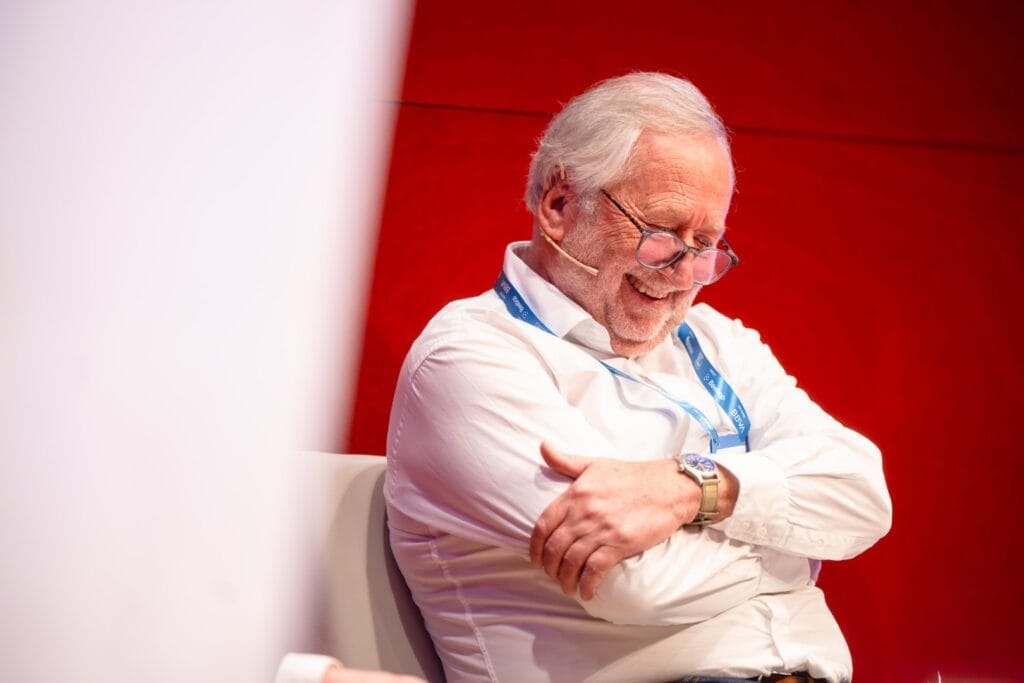
Peter Hannaford, CEO of EdgeNebula during the panel at Compute stage
Closing statements
Duitemeijer: we have not seen half of it. AI models will change the world, and so will the architectures underneath them – solid state devices, superconductors, new types of breaker – developing at a pace nobody has seen before.
Hannaford was blunter: “We need to rebuild the internet.” It was not built for what the industry is now attempting.
O’Regan settled between the two. Augmenting it is unavoidable, rebuilding arguably so. Either way, architecture demands careful thought and better understanding, in a world changing very quickly.
Takeaway
The through-line of this panel is that a capacity forecast is not a building plan. Everyone accepted the projected growth in compute infrastructure. What they disputed is the shape it takes – and the argument for distribution rested on three independent constraints arriving at the same answer. Latency makes remote inference unworkable. Copper and concrete make dense racks expensive before a single watt is consumed. And sovereignty makes somebody else’s control plane unacceptable for a growing set of workloads. Hannaford’s cell tower analogy is the one to keep: the industry built the biggest possible mast first, and then discovered that distribution was the better architecture all along.
Compute Summit Stage 2027 returns with more conversations like this one. Find out more at computesummit.com