

Two founders and two investors on why the modeling is no longer the hard part, and why insurers still aren’t moving.
Heat, storm, fire, drought and flood keep arriving. The once-in-a-century event that insurers and asset owners historically priced against now shows up with something closer to annual regularity. That was the premise Greg Wasserman, Head of Private Climate Investing at Wellington, put to the panel he chaired at Energy Tech Summit 2026. If the historical models are broken, and he thought the answer was clearly yes, is climate risk simply unpriceable?
Until recently, he said, the answer was probably yes. Better data, better analytics and a cohort of funded companies have changed that. Climate risk software can price the exposure now, and infrastructure, assets and operations can be planned around the number. The session was about what still stands in the way.
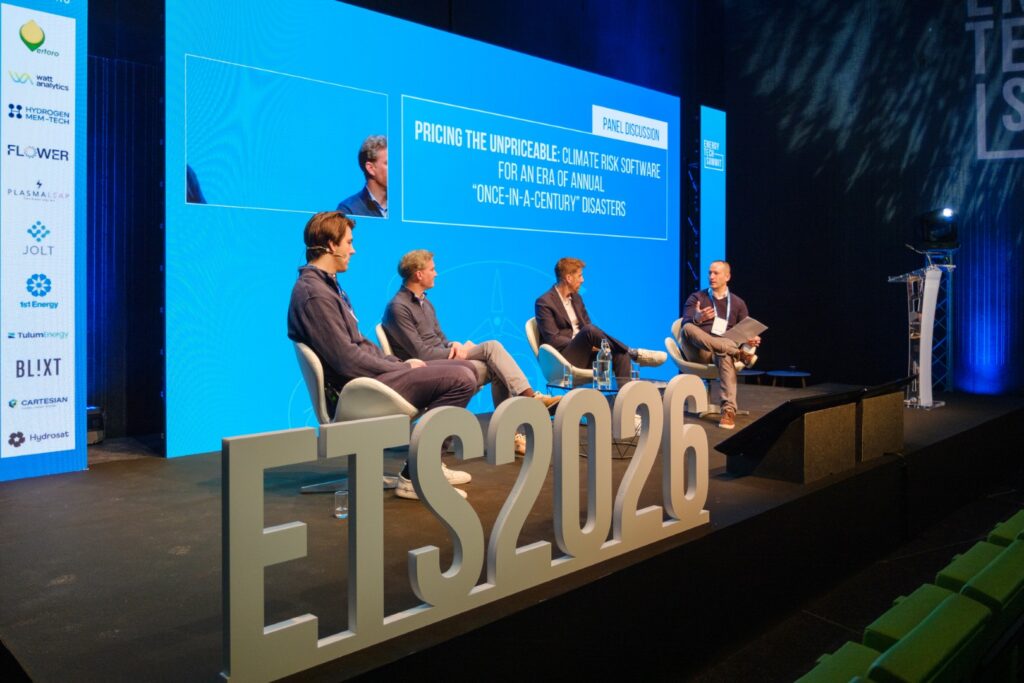
Panelists with Greg Wasserman, Head of Private Climate Investing at Wellington speaking
What climate risk assessment actually measures
Dr. Alejandro Marti is CEO and co-founder of Mitiga Solutions, a Barcelona-based climate tech. The company models physical climate risk to the built environment – wildfire, flood, severe convective storms – on climate rather than weather timescales. Its focus is critical infrastructure, from energy to telecommunications and construction.
His definition was narrow on purpose. Climate risk is the probability of an event happening within a period of time, expressed as return periods. One in two years, one in five, one in ten, one in twenty. Add the damage that event causes and the loss attached to it.
What sells the number, though, is not the number. “Models don’t drive decisions,” Marti said. “Confidence does.” That is why he argued for being transparent about uncertainty rather than hiding it. Many people read a stated uncertainty as a weakness in the model. He thinks the opposite is true. If you tell someone the flood risk to their house is 73 and say nothing about the error bars, it could be 73 plus or minus 73. That is the same as flipping a coin. Give them the 73 and the plus or minus 10, and they can build contingencies around it.
The last step is the one that matters commercially. Climate risk is not only climate risk, he said. It is financial risk, and it has to sit inside opex and capex decisions to be worth anything.
The operational side: the model has to work on the day
Viktor Gauk, CFO and Managing Director of OroraTech, comes at the same problem from the other end of the timeline. OroraTech operates a satellite network detecting thermal anomalies, wildfires among them. It also measures sea surface temperature and derives analytics from it, serving critical infrastructure providers, emergency services and utilities.
Disaster management, in his description, runs in three phases: preparation, action, and post-event assessment. Models belong to the first phase, but they are judged in the second. “You can run as best models as you can,” he said, “but if the day comes when the flood, the fire appears, the model needs to be working.” Prove that once and you have the trust of the people doing the operational work.
He was frank about what that trust is up against. On one side sits a startup arriving with AI and a new way of modeling. On the other sit what he called the silverbacks, people who have held the knowledge for 30 or 40 years and are being asked to rely on something they have never used. That cycle usually takes at least a year, long enough for a season to deliver the proof points during a real event.
What actually stops customers from buying climate risk software
Asked what the real barrier is on a sales call, Marti said the market has passed an inflection point, arguably one with no return. Climate risk now sits inside the top five priorities at C-level. Buyers know it carries a financial impact. They do not know when it lands, only that it might, or that it already has.
The underlying science, he said, is generally accepted as long as you are transparent about your assumptions. The friction comes when the model has to become a financial decision. Mitiga’s answer is a metric it calls climate value at risk. It takes the probability of the event and translates it into asset vulnerability – not just the percentage of the asset that becomes unavailable, but the downstream effect on operations and business interruption.
That is the work he thinks the sector still has to finish: giving clients financial metrics they can attach an ROI to. “At the end of the day it’s all about being able to either make more money or lose less money.”
Wasserman pushed on whether companies only act after being hit. Mostly yes, Marti said, but it is changing. Companies that have taken a loss understand what investing in resilience buys them. He framed the pitch around concentration: 10% of events cause 90% of the damage. Climate risk therefore cannot be planned on a four-year cycle that moves with one legislature or another.
Reporting and disclosure requirements have helped, if imperfectly. A sustainability lead ticks the box and the document exists. Still, once the report says an event could happen, the risk owner who did nothing about it can no longer say they did not know. “So that conversation is changing a little bit,” he said, “but there is still a lot of work to be done.”
The investor’s filter: who cares now, and why
Nigel McCleave is a Partner at Lightrock, a London-headquartered growth equity investor in Series B and later companies. His first observation was about the word climate itself. It is a convenient label, but not a hugely functional one for the people who own budgets, unless someone is specifically paying for a climate agenda.
He noted, without much enthusiasm for the fact, that plenty of software companies now word their contracts in Europe and in various US states specifically to avoid the words ESG or climate. “Which is crazy, but anyway, it’s a world we live in.”
His filter follows from that. The world is full of people wanting to do the right thing and build companies that solve real problems. It is markedly less full of decision makers at potential clients willing to spend part of a budget on those problems. So the question he asks is who actually cares now, and why. Revenue is the first proxy. He then goes further: is the internal sponsor a decision maker, or do they still need to get someone else to buy in?
Companies with good products have come and gone in this space, he said, because they solved a problem that sat about 10 years in the future in a corporate purchaser’s mind. Sentiment also shifts with the country and the organization. He mentioned a wind investment that would be performing very differently had an election gone another way.
Wasserman offered the counterargument. Climate risk analytics should be the part of the sector most immune to politics, because it is not about what you believe. It is about the fire outside. McCleave agreed it is not purely political, then made the sharper point. Even a climate-convinced person inside a corporation may not see how the spend affects the P&L in the reporting period they are judged on. The strongest thing a company in this space can show, he said, is a customer saying they changed a specific process because of the data they were given.
What AI changes, and what it doesn’t
McCleave framed AI as both a tailwind and a threat. It lets you draw insights from data more intuitively and more quickly. As a result, either these companies generate far more insight per unit of resource, or their clients start doing more themselves with the data they are handed.
The mitigation, and the potential moat, is data quality. Insights are not much use without good data underneath them. Proprietary collection is the strongest position. The next tier matters as well: bringing in third-party data and packaging it so AI can process it efficiently. So much of AI today, in his view, is built on poor data.
Gauk placed his own company at the first stage of that curve. AI currently helps process proprietary data faster, build more robust models and build trust in the analytics. The shift he is waiting for is decision-making, which still sits at a human level for a reason. Deciding whether the left side of a street or the right side burns carries consequences somebody has to own. That is exactly where he expects the development to go, taking the decision on behalf of the person sitting there and reducing false calls. Even so, he was clear that the industry is not there yet.
Marti was the most skeptical, and started with the label again. If climate is a buzzword, AI is the next one over. His companies have used AI for a decade – machine learning, transfer learning, neural networks – long before the term came to mean conversational models and agents.
His objection is structural. AI learns from the past, and in climate modeling the past is exactly what stopped working. Taking the last 10 or 100 years of data to predict the next 10 does not hold. AI is useful for optimization, for computational speed, and for pulling retrievals out of data you could not otherwise reach. It is not going to replace the science underneath.
The insurance problem
The frustration Wasserman kept returning to was insurance. The asset owner holds the risk: the corporate, the operator, the homeowner. The entity best positioned to price that risk ought to be the insurer or the bank, because both are making a coverage or lending decision around it. That, he said, is what everyone believes until they spend time inside climate risk analytics.
Gauk’s experience matches. Insurers are hesitant to change models, habits and prediction methods. OroraTech has talked to many of them about improving models with proprietary and real-time data. The pattern he sees is a preference for leaving the model alone rather than improving it and charging a higher premium for something not previously insured. His hope is that better real-time data eventually forces the rethink.
Marti went further, with an apology in advance to anyone in the room from the industry. Insurance is a sector that likes to think it is ahead of the game and is well behind it. The joke the panel had shared beforehand: the insurance sector would rather be collectively wrong than individually right. If you are not underwriting this risk, I am not underwriting this risk.
His view is that property and casualty divisions are not sustainable without changing how they look at risk. Repricing an entire market because one tropical cyclone happened tells you nothing about whether there will be more or fewer cyclones. Parametric insurance is one of the more promising routes out. He noted, drily, that he said the same thing five years ago and is still hoping.
Wasserman closed the thread on the asymmetry underneath it all. Insurers can reprice every year. The homeowner owns the house until they can sell it, and the company that builds a manufacturing plant owns that decision for 50 years.
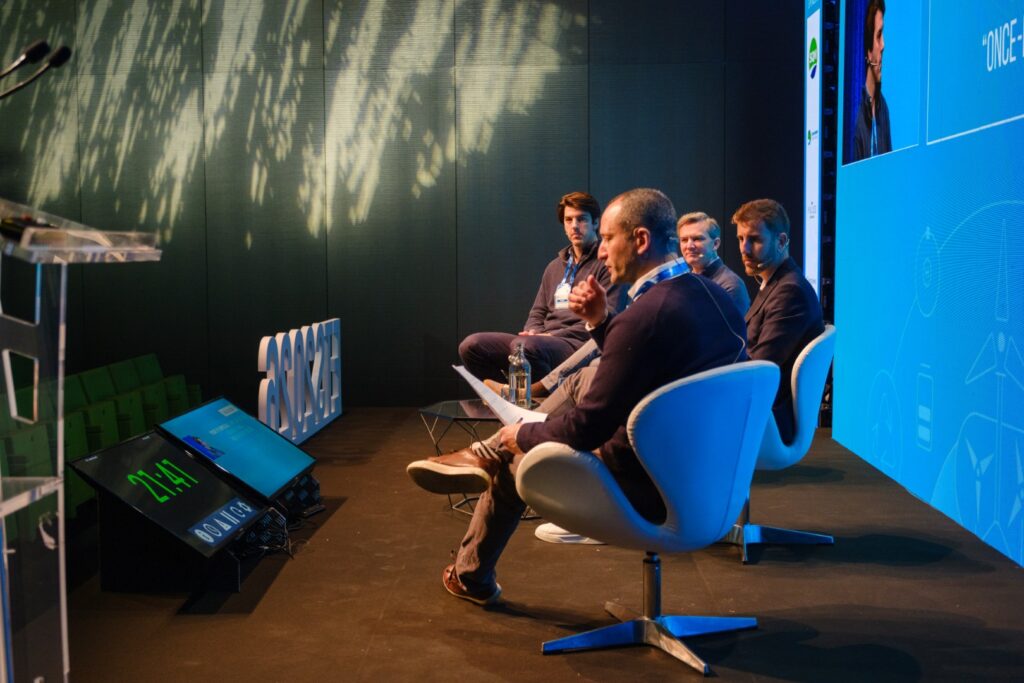
Panelists with Greg Wasserman, Head of Private Climate Investing at Wellington speaking
Takeaway
The panel was billed as pricing the unpriceable, and the answer that emerged is that the pricing is no longer the hard part. The models exist, the uncertainty can be quantified, and satellite and proprietary data are making both sharper. The bottleneck has moved to the buyer. A risk that plays out over decades has to fit inside a reporting period, a budget line and, eventually, an underwriting model that has not changed much in years. The climate risk software companies that break through are the ones that can point to a customer who changed a process because of the number.
Energy Tech Summit 2027 returns to Bilbao on April 7–8, with more conversations like this one.