
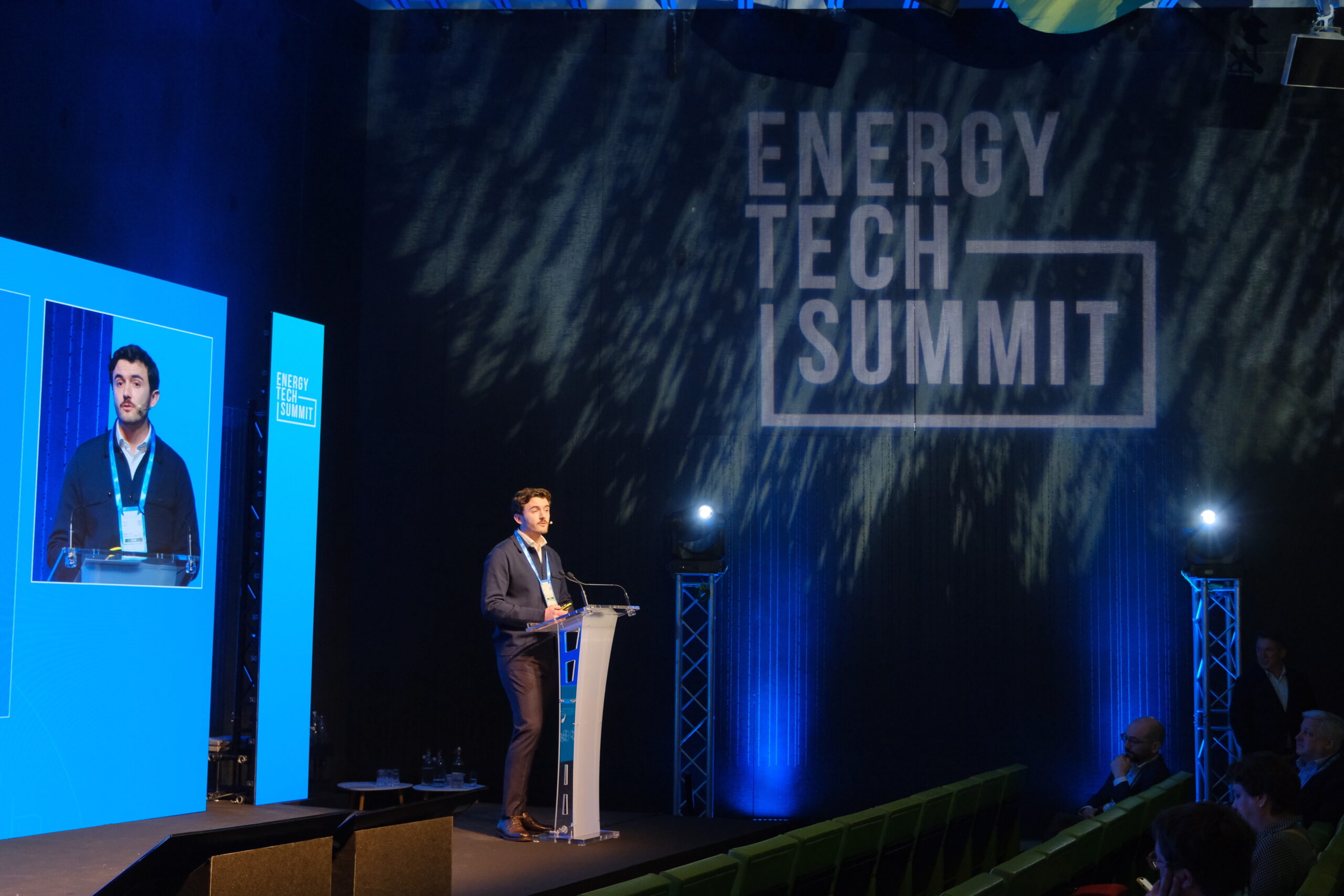
Guarantees of origin, environmental DNA, heat pumps and billing systems: the software layer of the energy transition, pitched in three minutes each.
The Climate Software X track brought together climate software startups building the platforms that power, measure and transact the climate economy. The rules matched every other track: three minutes to pitch, a hard interruption if the clock ran over, then two minutes of jury questions. Below is what each company said on stage, in pitching order.
DEC Energy
Nicola Scarinzi, CEO and co-founder, started with the mechanics of corporate green energy. An industrial consumer buys gray energy from its supplier by default. The only way to make that consumption renewable is to match it with green certificates, known as guarantees of origin.
Two instruments exist for that, and Scarinzi had a problem with both. Buying guarantees of origin directly means a recurring and volatile cost, and it is mostly a market tool without strong environmental impact. Meanwhile, a power purchase agreement means a binding, long-duration contract for energy and certificates together at a set price, which he called very risky in procurement.
DEC Energy’s alternative
DEC Energy’s alternative lets companies contract active solar assets across Europe. The renting company receives every certificate those assets generate for the next 10 years at no cost, plus a share of the profits the assets produce. The energy is sold, and the cash is partially distributed back. In effect, the company keeps buying gray energy and simply self-produces the certificates instead of purchasing them. “We transform what nowadays is a recurrent cost,” Scarinzi said, “into a profit.”
Supply comes from a network of utilities and independent power producers. Their assets go through due diligence before being offered to the renting company.
Traction and jury questions
On traction, Scarinzi pointed to one deal closed with a Swiss bank, with an upsell to three more solar assets in Switzerland underway, plus 30 megawatts of orders in Italy from four large industrial companies. He put expected revenue from those four deals at €500k by the end of 2026, €150k of it by the end of the first half. A seed round of around €1.5 million was planned to follow.
A juror asked about the sales cycle. The first deals took 12 months, but the timeline is shortening: the first Italian order took nine months, and the next looked likely to close in one or two. The process runs from energy and sustainability managers up through the CFO and the legal office. Scarinzi flagged an unusual advantage here: “Our product is loved by the CFOs,” which is not typical for this category. That leaves the energy and sustainability managers as the people who need to sponsor it internally.
On the ideal customer profile, he split it in two. Large industrial consumers – steel, chemicals, food and packaging – buy it for the energy cost reduction, usually the second, third or fourth line on the P&L. The Swiss bank, however, bought it for a different reason. For them, committing to specific solar assets and anticipating cash flow to producers is a more qualitative and more communicable claim than buying certificates.
EarthScan Energy, by Mitiga Solutions
Natalia Adler, Chief Solutions Officer, opened with the spending gap. Europe will spend almost €600 billion on clean energy over the next four years. Her point was that the problem is structural rather than financial: all of that infrastructure has to live alongside a rising number of physical climate risks. By Mitiga’s calculations, half of a company’s renewable energy investments could be wiped out by climate variability alone.
The traditional method for assessing those investments looks backward, counting flood and wildfire events over the last 30 years and projecting forward. With climate change, Adler said, the past is no longer an indication of the future.
What EarthScan Energy does
EarthScan Energy is Mitiga’s translation of high-resolution climate models for the energy sector, built on the platform the company already runs for the built environment. It models more than 40 climate metrics relevant to PV and wind assets at high resolution worldwide. It also answers what the risk costs: degradation, damage, and how much power production is at stake between now and 2050.
The work was validated against one of the world’s largest renewable energy companies at 92% accuracy compared with their ground station data. Adler also listed the company’s credentials. It won the EIC Accelerator this year, worth €8.4 million in equity and grant. It was the first spin-off of Spain’s National Supercomputing Center. Additionally, it has been ranked the number one startup for climate physical risk in Europe two years running, and number two in the world. Behind it, she noted, is a team with more women than men.
Go-to-market and traction
Go-to-market is multi-channel, combining direct sales with a partnership model, and revenue comes from the platform and an API. Asked about commercial traction, Adler said the client base runs across financial institutions, asset managers, banks, insurance and infrastructure, with energy the first asset-specific vertical the company is targeting with this product.
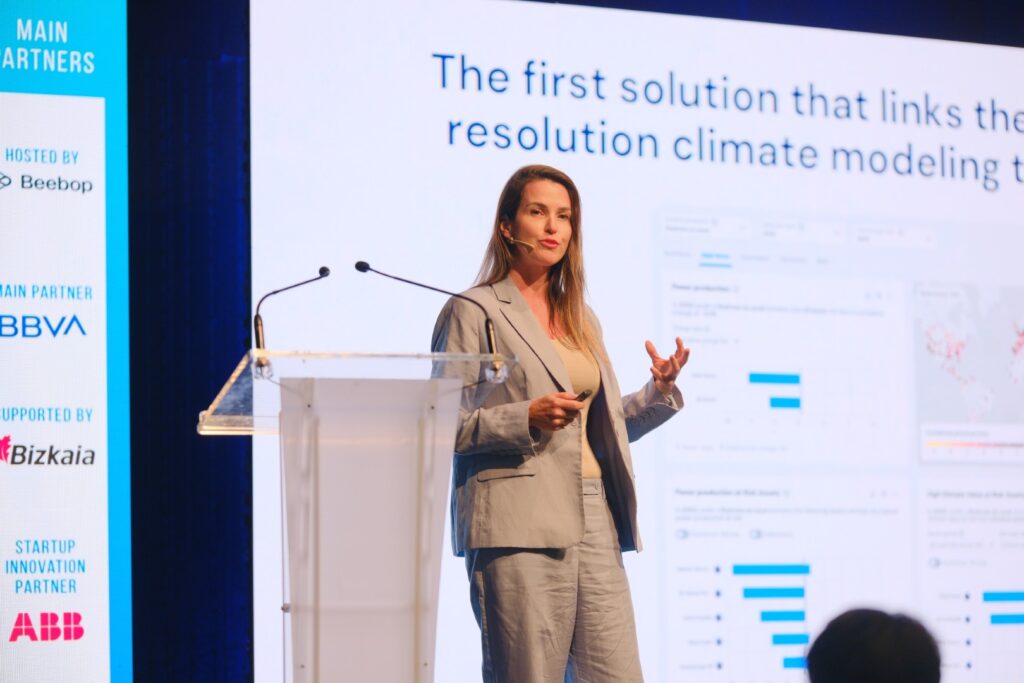
Natalia Adler, Chief Solutions Officer of EarthScan Energy (by Mitiga Solution) pitching at Energy Tech Challengers 2026
Energus Inovacijos
Povilas Šidlauskas, founder, made the case that buildings remain the least digitalized sector of daily life, despite wasting enormous amounts of energy and money. His company is building a cloud-based, AI-powered energy management platform that brings energy, control engineering and data systems into one place.
The ambition he stated was deliberately large: to become for buildings what Microsoft Windows is for computers. Accordingly, the platform is built to fit different users – top-level managers, engineers, building operators and grid operators – working in one shared ecosystem.
Background and expansion plans
The idea came out of more than 11 years working as energy partners for clients across the Baltic region, and Šidlauskas was raising €3 million to take it further. Today the company operates in the Baltics, with plans to expand across Europe starting from Scandinavia and Eastern Europe.
Pressed on whether the product is only about savings, Šidlauskas said the ecosystem goes further. It covers control of the building’s systems, monitoring, databases, integration with business management systems, forecasting models, and connection through to grid trading.
The founding story question drew the most concrete answer of his slot. He already runs a business of around 200 people with an annual turnover of almost €20 million, and has worked in energy efficiency for more than 15 years. Having tried many vendors’ solutions, he found that each solved only part of the problem. So, four years ago, the company decided to build one product covering building control end to end.
NatureMetrics
Caitlin Brown, Head of Strategic Innovation, opened with a concession. “For decades, we’ve asked businesses to care about nature. It hasn’t worked.” Wildlife populations are down 73% since 1970, she said, while $7 trillion a year in negative subsidies continues to incentivize degradation. Meanwhile, $44 trillion of global GDP depends on nature being healthy.
She brought the point back to the sector in the room: you cannot generate power, transport fuel or provide water without nature. Timber, soil stability, climate regulation and water availability all improve in healthy ecosystems, all are deteriorating, and almost none of that risk is priced into capital allocation or day-to-day decisions.
The eDNA method
So the question she posed was not how to make businesses care, but how to help them price it in. NatureMetrics does that by helping companies value nature as infrastructure, as supplier and as asset.
The method is environmental DNA. Every living thing leaves genetic traces as it moves through a landscape. NatureMetrics takes a small sample of air, water or soil, sequences it in its labs, and within days knows which species are present and how healthy the system is. Species are nature’s early warning system, Brown said, responding to stress months before it shows up in financial performance. As a result, eDNA captures that signal far faster and more cheaply than conventional surveys.
That data is mapped site by site and species by species, then combined with remote sensing, bioacoustics and camera traps. It is delivered in one platform as what she called auditable, decision-ready, finance-grade output. She was listing the company’s scale – 600 clients across 117 countries, 65 new platform releases in 2025 – when the timer cut her off.
On regulation and revenue
Asked about regulation, Brown drew a clear line. Many nature tech companies respond purely through the regulatory lens, providing rapid metrics for disclosure and compliance. “It is important, but it ultimately is tickboxing,” she said, adding that she has yet to see a company use that data in a decision-useful way. At NatureMetrics, disclosure is treated as a byproduct instead. Clients spend their budget on risk and resilience management, and the disclosure report comes from pressing a button rather than months of work ending in a static PDF.
On revenue, she said the company closed a Series B in January 2025, is not yet profitable, and has set a target of doubling last year’s revenue to €11 million. Acquisition options are also being examined to consolidate the company’s position.
NOX Energy
Axelle Moortgat, co-founder and CEO, started by pointing at everyone else. Every booth and every panel is about flexibility, virtual power plants and trading electricity on energy markets. NOX is facing the same opportunity, but took a different bet: the most overlooked asset in someone’s basement, the heat pump.
The company tracks real-time energy prices and trades residential heat pumps on the electricity market. Every minute it predicts what is coming, mirrors reality with a digital twin, and places the right bids automatically.
The business model
The commercial twist is that NOX does not sell the energy. Instead, it sells the software that makes the trading possible. Utilities use it to turn their customers’ devices into active market players, paying a platform fee per month plus a fee per connected asset. In return, they get an additional revenue stream, new customers and lower churn. “Who wouldn’t want to sign up with a utility that gives you free software that actually pays you back,” Moortgat asked.
The company is live with two energy utilities, integrated in their apps and visible to 150,000 customers across four countries, and is actively managing 3,500 heat pumps. It is also integrating into manufacturers’ own apps so users can activate NOX from the heat pump app itself. It is live with a first manufacturer covering access to 3,000 heat pumps, and piloting with all the major ones.
Two co-founders started the company two years ago, straight out of university. Since then, it has been through a top New York accelerator, raised €1 million in pre-seed and built an engineering team. Solar panels, batteries and EVs are next.
Jury questions on defensibility
The jury pushed twice on defensibility. On competition, Moortgat named one similar player in the Nordics that has already been acquired. She expects more competition long term from virtual power plants in EVs and batteries, but sees heat pumps as the wedge into utilities and multi-asset as the follow-on.
On the technology, the answer was more specific. Heat pumps are considerably harder than other assets, because you have to build a thermal model of the house, whether well insulated or badly. API agreements with solar and battery manufacturers are easy, by contrast. With heat pump OEMs it takes a year, because you have to prove you are not damaging the pump, not running too many cycles, and not breaking comfort for the resident. That, she said, is roughly a year’s head start on anyone who starts now.
Pricing is a monthly platform fee plus a monthly fee per connected heat pump, in two variants. It is cheaper if the utility trades itself using NOX’s thermal models, and more expensive if NOX runs the optimization.
Perse
Vikesh Sachdeva, co-founder and Chief Strategy Officer, framed Perse around a problem that sits underneath everyone else’s. Plenty of companies are doing optimization, he said, but the data has to be right before anything built on top of it can work.
What Perse built is a single view of the UK energy ecosystem. It connects to every data source in the country for every building, from meters down to individual assets, grid points, satellite imagery and building fabric. None of those are free datasets. Rather, they are proprietary, which made the challenge as much legal and contractual as technical.
The open energy layer
Having solved the data problem first, the company describes what it created as the open energy layer for the UK, the equivalent of open banking. Application builders using it do not have to negotiate individual data contracts or handle GDPR and consent themselves, because it comes from one common place.
There are four core products. Profiles sell the raw data, used for reporting, customer bases, energy management, trading and switching. Processed data sells the output rather than the input, across energy procurement, flexibility, EV charging, optimization and recommendations for solar or heat pumps, generated in real time. Beyond that sit transactions, borrowing the open banking model again, and an analytics layer. Customers come from energy, property and finance.
Asked how Perse would compete in Europe against players who have already collected data there, Sachdeva pointed away from the data itself. Instead, he argued, the differentiation lies in the legal frameworks the company has built and the way it gives secure access at batch and at scale.
QUIXOTIC
Omar Sequera, co-founder and co-CEO, opened by acknowledging that nobody can pronounce the name. Then he explained the product plainly: an ERP for energy utilities, currently retailers only, handling billing and payments.
His thesis is that the oligopoly in energy is mirrored in energy software, where a handful of large vendors hold the most ambitious projects and the most customers. QUIXOTIC built billing software meant to serve small utilities and large ones with the same product.
Sorting the competition
He sorted the competition into three types. First, in-house development takes too long. He described a utility with 600 employees, 100 of them developers, and asked whether that makes sense for a company that is not a software company. Second, in-house builds on top of SAP or Salesforce add expensive platforms and expensive rates, and are still slow. The third and biggest challenge is legacy energy software. The screenshots he showed, he pointed out, are not from the 1980s. They are live today, typically local and around 30 years old.
Pricing scales with the number of modules and the size of the utility, starting around €10k when a utility is getting going. The largest accounts today sit at roughly €250k and €270k in recurring revenue, and Sequera expects the €500k range as more modules ship. Billing simple B2C index and fixed products is something anyone can do, he argued. The difficulty appears instead with solar, decentralized supply and complex multi-meter B2B.
Growth and a warning against legacy software
In four years, the company is about to touch €1 million in recurring revenue, is present in Germany and is choosing its next market. He drew the contrast with the incumbents deliberately. They have raised hundreds of millions; QUIXOTIC has raised under €2 million plus grants. His closing line was a warning against legacy software, delivered through a Microsoft Word mascot: say no to Clippy.
On sales cycles, Sequera was candid that the sample is too small to be meaningful. Six to 12 months across roughly three large deals, one of which closed in three months and another in nine or ten. More than 30 smaller customers move faster.
The use case question produced the best story of his slot. A customer arrived two years ago already running Salesforce, SAP and a large consultancy, and had been told a product it wanted would take nine months. QUIXOTIC works from a catalog of around 200 products that combine flexibly, using formulas rather than code. As a result, the customer was testing in market with sales teams in three weeks. That account started as a €60k ticket and is now one of the largest on the books.
UpGrid AG
Hagen Lihl, CEO, framed the shift first. Energy is moving from a centralized system dominated by large utilities to a decentralized one in which individuals, SMEs and municipalities become producers. Millions of assets are connecting to the grid, and the resulting complexity needs new tools. UpGrid is building what he called the operating system for decentralized energy markets.
Centralized energy, in his description, is opaque. Nobody really understands what they pay, fees accumulate, and the utility in the middle takes a large share of the revenue. UpGrid’s transaction infrastructure, by contrast, connects producers directly with consumers, so producers earn more and consumers save.
Numbers behind the pitch
He had numbers to back it up. One municipality using the platform increased self-consumption by almost 200,000 kilowatt hours, enough to power 80 homes, and saved roughly €30k a year. This year the rollout extends to the whole community, buying up to 1.3 million kilowatt hours from local producers and generating close to €120k in additional value that goes back into the community.
The product itself is a modular platform integrating energy, tariff and billing data. It handles contracting and legal work and manages payments and billing, giving partners the full stack they need for peer-to-peer trading or energy sharing.
The company finished its first year with more than €100k in topline, has over 100 energy communities on the platform and added more than 2,000 user registrations in about four months. It works exclusively with the largest installer in Switzerland and counts major utilities and real estate developers among its partners. Lihl spent a decade in finance. His co-founders are a serial renewable energy entrepreneur and a former principal engineer at N26 and Personio who led teams of up to 80 engineers. A convertible was closing that month, with a term sheet signed for a follow-on equity round.
Expansion and competition
Asked about expansion beyond a Swiss market with its own peculiarities, Lihl said EU legislation now mandates energy sharing in every member state. Spain and Italy are interesting, Germany goes live mid-2026, and how attractive each market is depends on details like smart meter penetration. Poland and the Netherlands are coming online too, with maturity expected around 2028.
On competition, most of it comes from Austria, the most mature market in the space. Players there tend to be hardware or manufacturer specific, or they fragment the market by offering marketplaces. UpGrid, however, works with solar contractors, installers, utilities and its own end customers to build a single large energy community and a flywheel effect, specifically to avoid that fragmentation.
A final question asked how the platform actually increases self-consumption. Any kilowatt hour shared within an energy community counts, Lihl explained. For example, a municipality with panels on a hospital roof and none on a school can share across both.
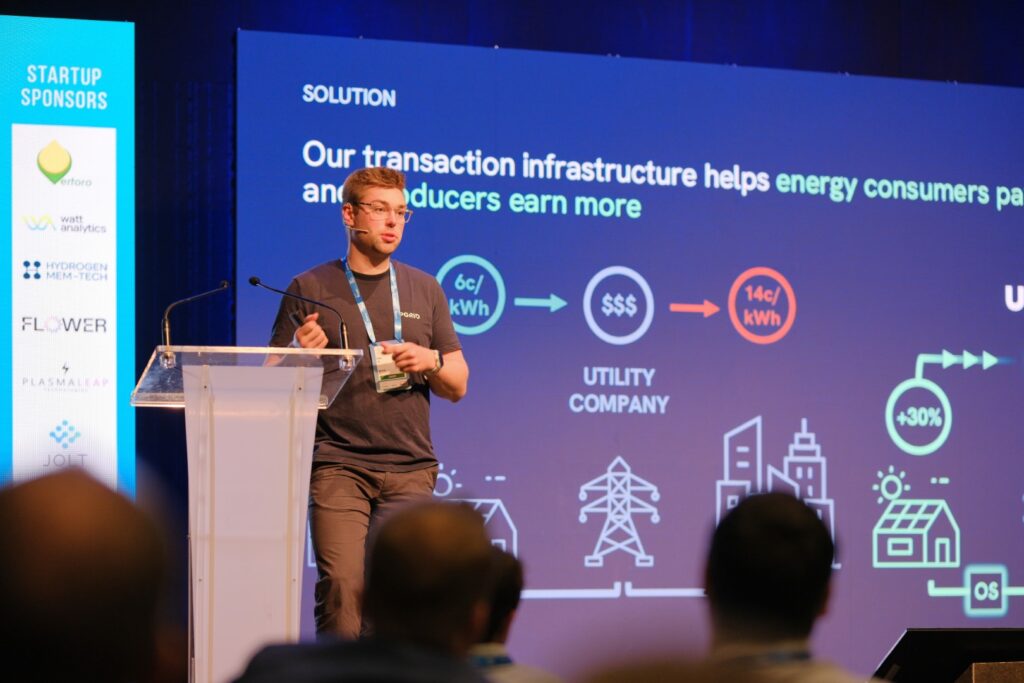
Hagen Lihl, CEO of UpGrid AG pitching at Energy Tech Challengers 2026
Takeaway
The Climate Software X track showed how much of the energy transition now runs on unglamorous infrastructure: certificates, billing systems, data layers, thermal models of houses, genetic traces in soil samples. None of it generates a single megawatt, yet all of it decides whether megawatts get financed, traded, insured or wasted. The recurring theme across the jury questions was the same one: not whether the software works, but how long it takes a utility, a bank or an industrial buyer to say yes to it.
Energy Tech Challengers returns at Energy Tech Summit 2027 in Bilbao, April 7–8. Do you want to watch the next generation of energy startups pitch live, or take the stage yourself?