

Future of Materials & Manufacturing track pitches of 2026
Cement made from CO2, lab-grown exotic leather, and ceramics replacing glass fiber in AI hardware – what advanced materials startups pitched at the Future of Materials and Manufacturing track.
The morning session of Energy Tech Challengers turned to materials, and to what industry actually builds with. On stage: startups reinventing concrete, battery anodes, circuit boards and luxury leather. Each founder had three minutes to make the case to the jury.
Here’s what happened on stage.
Co-reactive – turning CO2 into carbon-negative building materials
Concrete is the second most used material on Earth after water, Co-reactive co-founder and CCO Willi Peter reminded the room. Its key ingredient, cement, drives 8% of global CO2 emissions. Moreover, with carbon pricing, he said, cement production costs are set to double within a decade.
The industry’s default fixes fall short, Peter argued. Carbon capture adds cost and a waste stream, while alternative raw materials are shrinking in supply. Co-reactive instead mineralizes CO2 into the product itself – from cement plants, other point sources, or direct air capture. The result is a cement substitute that binds 330 kg of CO2 per ton, with no loss of strength.
He listed the proof points: a prototype with over 900 operating hours, customers testing the material, and a 1,000-ton demonstration plant expected to produce by July 2026. A financed 10,000-ton commercial first-of-a-kind follows at a steel site.
Pressed on cost by Prelude Ventures, Peter gave the curve. Production costs run 2x cement at demo scale, reach parity at the first commercial plant, and land 50% cheaper at industrial scale. The long-term model is licensing. Its IP is a continuous tubular reactor designed for volume, whereas competitors scale batch autoclaves.
Concrete4change – flue gas and gypsum waste, turned into cleaner concrete and fertilizer
Concrete4change (currently Vateris) founder and CEO Sid Pourfalah targets construction and chemicals together, or 25% of global emissions. He set strict design rules first: no adoption cost, no price premium, no feedstock limits.
The process takes raw flue gas straight from cement plants, energy or refineries. No purified, liquefied CO2 is needed, a capability Pourfalah called rare. It then reacts that gas with calcium-rich waste like gypsum. Out come two products: a stable reactivated calcium carbonate for construction, and a fertilizer.
His numbers: concrete gets 20–30% cleaner at neutral cost, with better mechanical properties. The fertilizer is 20–30% cleaner at market price, and purer, which supports a premium. In addition, each ton of the construction product locks away about 500 kg of CO2.
Cura Climate – splitting limestone before it ever hits the kiln
Cement’s emissions problem sits in the rock itself, Cura Climate COO and co-founder Sabrina Scott explained. Heat limestone, and the CO2 mineralized inside it escapes. That’s why electrification can’t fix cement. It also explains why the industry’s bet on capture retrofits could cost billions and triple cement prices.
Cura’s alternative is pre-calcination capture. Its electrochemical technology splits limestone into pure CO2 and decarbonized lime before it reaches the kiln. Standard feedstocks go in, standard building materials come out – up to 85% decarbonization, third-party validated.
Then came the roadmap. Cura has already built a mini pilot, and an $8 million seed raise will deploy a 100-ton-per-year pilot with partners in Alberta. A 30,000-ton commercial unit follows by 2028 through a JV, then deployment with cement operations in 2029. Six MOUs are signed across the value chain.
On the business model, Scott told the jury Cura will scale through JVs first, then become an equipment manufacturer and licensor. The customers, meanwhile, keep the CO2.
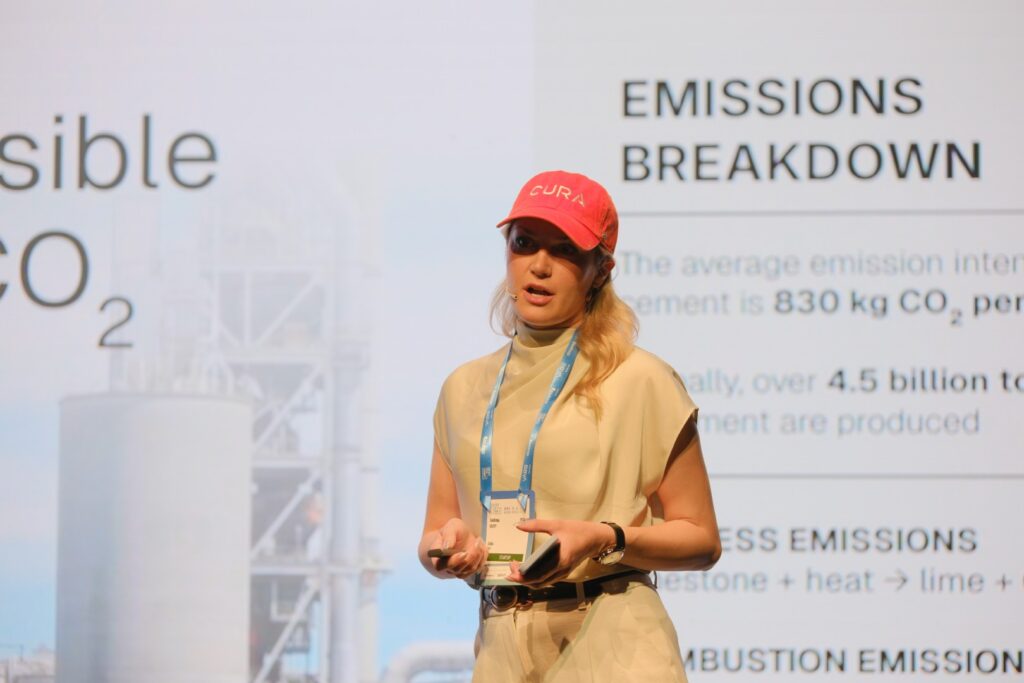
Sabrina Scott, COO & Co-Founder of Cura Climate
Flexiramics – the ceramic fabric under the next generation of chips
“Most people think that 5G and AI devices are limited by chips. They are not,” Flexiramics CEO Andy Wynn told the room. “They’re limited by the material underneath them.” Glass fiber reinforces circuit boards, but it traps heat and loses signal at high frequencies. Wynn priced that problem at $60 billion in wasted energy.
Flexiramics replaces the glass with flexible ceramic fiber fabric: 75% less signal loss and five times better heat dissipation. Better still, it is a drop-in swap. PCB makers buy a Flexiramics roll instead of a glass roll, on the same production line. Glass, he added, is stuck in a supply bottleneck anyway.
The go-to-market starts where value is highest, in AI hardware. Pilot production is underway, with 360+ prospects in the pipeline, five letters of intent and early revenue. The entry point is the $500 million high-frequency slice of a $5 billion market.
Asked how the ceramics are made, Wynn described a sol-gel route at about 30% lower cost than glass fiber, priced at parity. The company is raising €16 million to scale and finish customer qualification. The efficiency prize: 30% less cooling energy loss.
Floatech – 100% silicon anodes for the post-graphite battery
The bottleneck in electrification is the anode, Floatech CEO Fernando Celaya Prieto told the jury. It stores the energy, it’s made of graphite, and graphite sits on the EU’s critical raw materials list.
Floatech’s patented material is 100% silicon, with ten times graphite’s storage capacity. A porous nanostructure solves silicon’s classic failure mode. The process, he stressed, is built for kiloton-scale manufacturing, unlike competitors’ chemical vapor deposition, which “grows atom by atom… very good for quality, but not feasible for capacity.” A Madrid plant already processes one megawatt hour per year for six customers on three continents.
JPMorgan’s juror then asked the obvious question. If graphite is such a problem, why is silicon still only about 5% of the market? Qualification takes time and the market is conservative, Celaya Prieto answered. However, solid-state batteries can’t use graphite, and McKinsey’s roadmap puts silicon and lithium-metal anodes as the standard by 2030–2035, in a market growing 28% a year toward $50 billion.
Floatech is a 10-person team at TRL 6 moving to TRL 8, targeting commercialization in 2029. For now, it is seeking a VC for its round.
Layrr – fixing data center heat at the atomic scale
The number one inefficiency in data centers is heat, Layrr CTO Dr. Vicky Broadley told the room. Data centers lose 30% of their energy to it, and GPUs get throttled because of it.
The culprit is the thermal interface material between chip and cooling: powders in polymers. Heat travels as phonons, Broadley explained, and “phonons don’t like interfaces.” They scatter at every powder-polymer boundary, which traps the heat. Layrr therefore coats commodity powders with nano-films that bridge that boundary, improving thermal conductivity by orders of magnitude.
Asked how hard the coating is to produce, Broadley – a 20-year thin-film veteran – pointed to the underlying process. Physical vapor deposition is already proven and scaled: “We’re not having to solve those problems.” Layrr’s IP is in applying it to powders with conformal, controlled coatings.
The model slots into existing supply chains. Layrr supplies coated powders, OEMs make the materials, and chip makers buy them. The target is a $2 billion high-end segment of a $30 billion market, with additive manufacturing and batteries next.
Lenera – lab-grown exotic leather for luxury’s supply problem
More than 2 million animals die each year to supply the luxury industry, Lenera CEO and co-founder Maria Joao Gonçalves Maia told the room. On top of that, the exotic leather those brands depend on comes with three-year lead times, logistical hurdles and volatile imports.
Lenera’s answer is what she called the first species-agnostic skin platform: lab-grown skin that reproduces different animals’ microstructure and mechanics. Crucially, it enters the brands’ existing tanning cycle as a drop-in raw material. The luxury houses themselves set that requirement, she explained, because tanning is where they customize.
The gains she cited: supply time down from three years to one month, and at least 75% lower energy costs. Asked about consumer appetite for synthetics in prestige goods, Gonçalves Maia relayed the brands’ own feedback. Every alternative so far failed because it didn’t age well or perform mechanically – “on the market there are no alternatives.”
Lenera is in conversations with six of the top ten luxury brands, has delivered paid samples, and is structuring multi-stage agreements. The model starts with selling skins, then shifts to manufacturing-as-a-service in decentralized 5,000-square-meter units. The raise: €1.8 million toward a 2027 commercial launch, at price parity with natural skin.
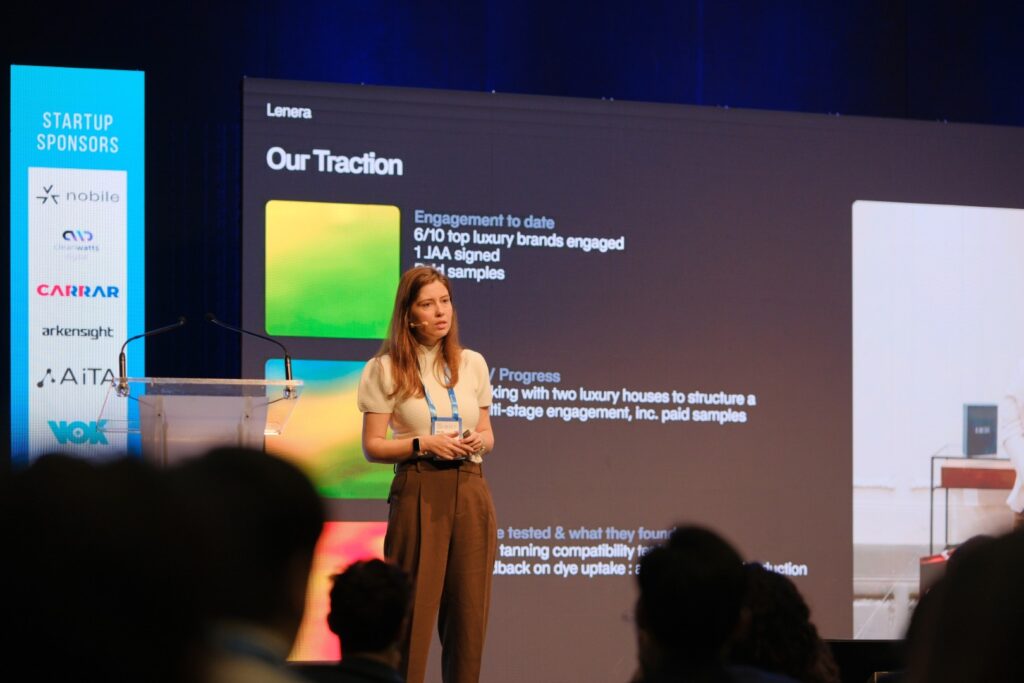
Maria Joao Gonçalves Maia, CEO & Co-Founder of Lenera
VSPARTICLE – material synthesis for the AI age
VSPARTICLE CEO Aaike van Vugt closed the session with the morning’s biggest frame, quoting the “country of geniuses in a data center” line.
His core statistic: humans have discovered less than 1% of all inorganic materials. The other 99% stays locked, van Vugt said, because every existing synthesis method was optimized for one application – none designed for AI. Connect AI to them, and it explores only a fragment of the space.
Unlocking the rest takes precision, speed and reproducibility – “a completely different topic, I can talk to you for hours” – plus a path from self-driving labs to mass production, because model data only becomes value when a product ships.
VSPARTICLE spent seven years building that synthesis. Its systems ship to top institutes building self-driving labs – generating millions in revenue that van Vugt frames as marketing, since every discovery validates the platform. He cited a partnership with Meta on large open experimental datasets and OEM work in gas sensors and electrolyzers, with the real revenue ahead in series production.
The takeaway
Every pitch on this track circled the same truth: the energy transition is constrained by matter – what cement, anodes, circuit boards and interfaces are physically made of. The message from Bilbao: the periodic table still has room to compete in.
Energy Tech Challengers returns at Energy Tech Summit 2027 in Bilbao, April 7–8. Want to watch the next generation of energy startups pitch live – or take the stage yourself? Secure your pass.