

Climate Hardware X track pitches of 2026
Truck-sized nuclear reactors, jet fuel made from air, and battery graphite grown from CO2 – what founders pitched at the Climate Hardware X track that closed day one in Bilbao.
Day one of Energy Tech Challengers 2026 in Bilbao ended with hardware: the machines, materials and infrastructure of deep decarbonization. As with every track, founders got three minutes on the clock and the jury got two – and the moderator kept both honest.
Here’s what happened on stage.
Blykalla – nuclear power plants that fit on a truck
Blykalla CEO Jacob Stedman opened with a quiz drawn from the book How Big Things Get Done. What share of billion-dollar giga-projects – power plants, bridges, Olympic villages – finish on time and on budget? The audience guessed zero. In fact, the answer is 8% – and just 1% if you count realized economic benefits.
“That’s why we don’t build big things. We build small things,” Stedman said. Blykalla’s reactors stand five meters tall. The company builds them in a factory, then ships them to site by truck. According to Stedman, that cuts nuclear costs in half and build time from seven years to two.
The coolant is liquid lead – “the best radiation shield known to humanity,” Stedman told the jury, pointing to the apron at a dentist’s X-ray. As a result, the design stays genuinely compact. “Many SMRs aren’t really small nor modular. It’s an open secret in this industry.” The fuel cycle is closed, so the company reuses spent fuel rather than burying it.
Stedman also cited an OECD assessment that ranks Blykalla the most advanced player in Europe among modern designs. Uniper is an investor, and it hosts a non-nuclear test facility at its plant site in Sweden. Meanwhile, Blykalla plans a US demonstration reactor within two years, licensable in months under the new American regime. The company is now raising a $150 million Series B. First customers? Hyperscalers, Stedman said – “much more appetite than utilities.”
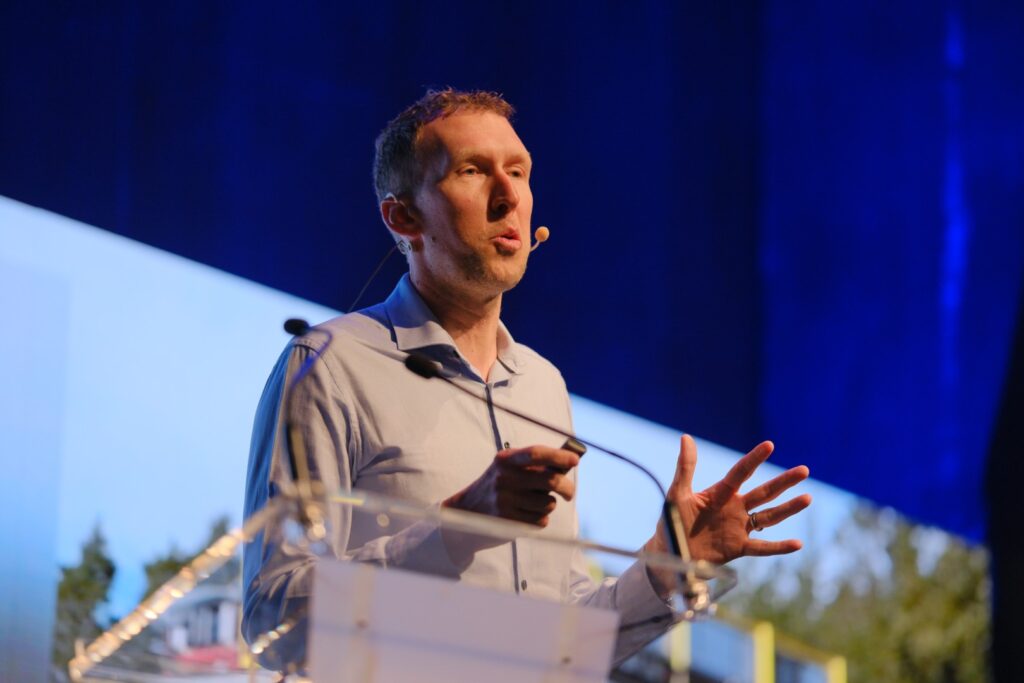
Jacob Stedman, CEO of Blykalla
CERT Systems – jet fuel and plastics made from CO2
CERT Systems CEO Alex Ip opened by implicating his audience: most of them flew into the conference, and aviation – can’t simply electrify.
Every sustainable aviation fuel pathway has a catch, Ip argued: cooking oil and biomass run out of feedstock, and converting CO2 usually demands capital-hungry Fischer-Tropsch plants. CERT’s route – ethylene-to-jet – uses direct CO2 electrolysis to turn CO2, water and electricity into ethylene, then standard conversion into jet fuel. Capture and conversion happen in one step, with no hydrogen or biomass inputs, avoiding up to five tons of CO2 per ton of ethylene.
The Toronto company ran its first air-to-ethylene pilot last year, and Ip projects costs below other SAF pathways – and below fossil jet fuel once EU and UK mandate penalties bite.
Ethylene doubles as a hedge: a $200 billion market feeding plastics and textiles, where a German cosmetics maker is already interested in sustainable packaging. With former Carbon Engineering and CarbonCure executives on the team, CERT is raising a $3.5 million seed.
Hephae Energy Technology – drilling tools for superhot rock geothermal
Superhot rock geothermal has a missing piece, Hephae co-founder and CEO Steve Krase told the room. Developers like Fervo Energy have proven you don’t need steam reservoirs – just heat. However, the tools to place wells kilometers underground top out around 200°C. And the economics live in the heat: drilling into 250°C rock instead of 200°C cuts energy costs in half.
Krase then announced the barrier broken. Hephae’s Pandora 210 is a robotic system that sits behind the drill bit, and it survives 230°C, with a path to 300°C by 2030. Young engineers in Bilbao designed it “from a blank sheet of paper,” backed by a Houston team with decades of downhole experience. In addition, developers save an estimated $1 million per well by skipping cooling techniques. The tool was set to deploy live for Fervo at Cape Station in Utah the week after the pitch.
At the event, Krase said Hephae had raised $13 million and was raising a $6 million Series A toward cash-flow break-even in Q1 2027. For now, the company sells on a rental model, he admitted, because “our customers just don’t have any cash” in a depressed US drilling market.
His long game: next-generation geothermal bigger than oil and gas drilling by 2040, and over $2 billion in annual revenue by 2035 at a 35% market share.
Hydrogen Mem-Tech – the purification layer for the hydrogen economy
Hydrogen has a purity problem, Hydrogen Mem-Tech CEO Hanne Martinussen told the jury. Whether it comes from methanol, ammonia, biogas or natural gas, it is rarely clean enough for its end use. Her Trondheim-based company has therefore planted itself in exactly that gap.
The product is a thin palladium membrane that lets hydrogen through and blocks everything else. Palladium’s 100% hydrogen selectivity has been known for decades, Martinussen said. What’s new is industrializing it into a compact, modular product, patented broadly and piloted with customers.
Asked what sets it apart, she named three things: a passive system with almost no maintenance, fuel-cell-grade purity, and flat membranes that pack neatly into containers. The use cases run from refineries to ships that reform methanol on board, purifying the hydrogen before it reaches the fuel cell.
Besides the technology, sales run through system integrators, EPC contractors and technology providers. To accelerate them, the company is raising €5 million.
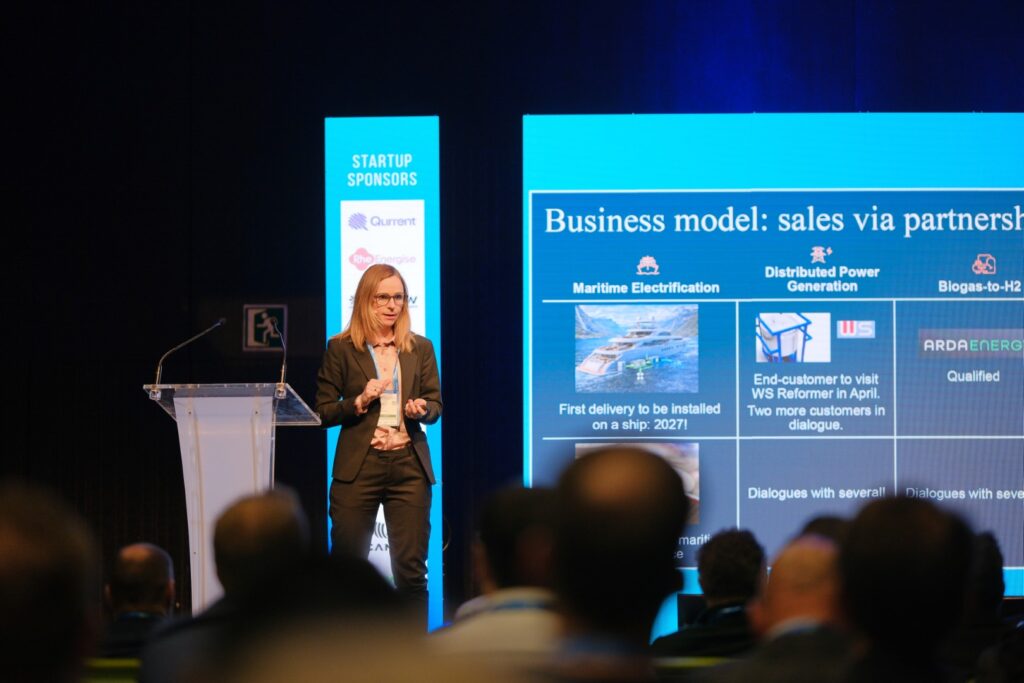
Hanne Martinussen, CEO of Hydrogen Mem-Tech
Sandcatch Solutions – “the efficient shoveling company”
“We are the efficient shoveling company,” Sandcatch Solutions CEO Cecilie Drange announced. It was the most self-aware positioning of the day, and the moderator thanked her for making the room smile.
The problem is real money. In short, grit builds up inside biogas digesters until plants shut down for weeks, with no production and no revenue. Drange put the loss across Europe at roughly €500 million.
Sandcatch’s fix comes from oil and gas. Coil tubing methods have worked on live wells for decades, and they now remove grit without stopping production. “We have validated the methodology, the physics. We know this works,” she said. Still, the challenge now is scaling. So far, the company has its first repeat customer and an international pipeline.
The team pairs offshore oil and gas engineers with operators who are farmers – “people who have real-life experience.” The measured impact: 20% more gas, 50% less waste to landfill, from infrastructure that already exists. A €4 million raise is opening to scale the fleet across Europe. Units cost about €2 million and pay back in 14–18 months.
Sweetch Energy – baseload clean power from where rivers meet the sea
Every time a river meets the sea, energy is released – in every delta and estuary on Earth. The physics has been known for decades, Sweetch Energy’s then-CEO Nicolas Heuzé told the room. The economics, however, never worked. “This is the gap that we’re bridging.”
The French company employs 60 people and has raised €32 million, with a round of up to €40 million in preparation. Its INOD technology combines internally developed biosourced nanomaterials with a novel osmotic stack design, protected across 14 patent families.
Furthermore, a demonstrator runs in the south of France. Heuzé was candid about its purpose: learning to operate an osmotic power plant across different rivers and water types. “Obviously we’re learning – it’s not working always as we expect. But so far so good.” A pre-commercial project follows by 2028, then first commercial deployment by 2029–2030.
The prize he cited: 300 gigawatts deployable worldwide, untapped purely on cost. The target is €100 per megawatt hour at the first commercial plant, falling with scale. Moreover, all the water used flows straight back to the river.
Tokamak Energy – fusion, with profitable stops along the way
Dr. David Kingham, founder and senior advisor at Tokamak Energy, pitched to a very specific investor: one who believes in fusion but hates its timelines, risk and capital appetite. His offer – “an unbeatable offer,” he called it – is a company monetizing fusion’s enabling technologies now.
He listed the credentials: a compact fusion reactor that hit plasma temperatures over 100 million degrees, a $52 million research contract from the US Department of Energy and UK government, and record-breaking high-temperature superconducting magnets.
So why does a company with 300 employees and 400 patents still call itself a startup, the jury asked. “It feels like a startup,” Kingham said. The company was pre-revenue two years ago, then made a few million euros last year, and projects €30 million this year – “a very difficult but very rapid transition from investor-funded R&D to products for customers.”
Notably, the magnets sell far beyond fusion. Applications include life-science instruments with a major Japanese partner, superconducting power transmission for data centers, electric aircraft work with Airbus, and a DARPA submarine propulsion project with General Atomics. The split, per Kingham: investors fund the superconducting business, while governments, as customers, fund the fusion research.
UP Catalyst – battery graphite grown from CO2
Everybody talks about lithium, UP Catalyst CEO Rait Maasikas told the room. But the single largest component of a battery is graphite: 25% of its weight, 40% of its carbon footprint, and over 90% of it from China. “We’re scaling our energy transition on a material we don’t control.”
The Estonian company’s answer is molten salt electrolysis. The process turns captured CO2 into battery-grade graphite and carbon nanotubes. It runs at 600–800°C against roughly 3,000°C for conventional production – lower temperature, lower energy, lower cost. It also tolerates less-concentrated CO2 and, at scale, delivers a carbon-negative product.
“It’s not anymore a lab project,” Maasikas said. A pilot facility runs in Tallinn, battery-grade graphite is validated, and more than 60 samples have shipped to customers.
On the jury’s pricing question, he was blunt. Graphite is a commodity, and UP Catalyst can match the Chinese price. CO2 costs less than petroleum coke unit for unit, and the low-temperature process wins on energy. A €10 million Series A is in preparation.

The takeaway: what these climate hardware startups share
Climate Hardware X made one case from many angles: the energy transition is a manufacturing story. In other words, reactors come from factories, fuels from electrolyzers, graphite from flue gas. Software optimizes the transition. Hardware, meanwhile, is the transition.
Energy Tech Challengers returns at Energy Tech Summit 2027 in Bilbao, April 7–8. Want to watch the next generation of climate hardware startups pitch live – or take the stage yourself?