
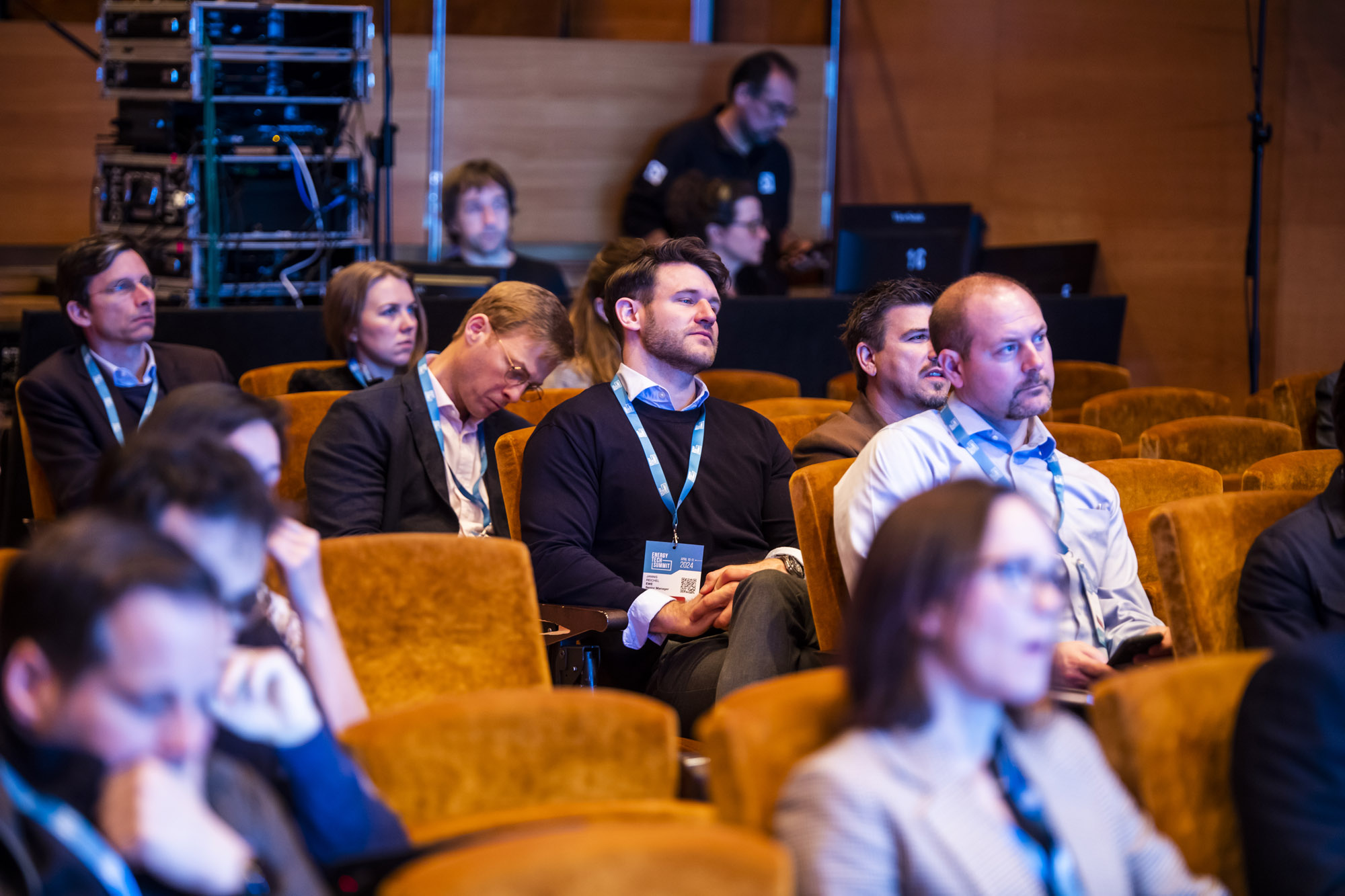
A thermal battery company and a climate tech investor explained what it will take to make energy infrastructure flexible enough for a changing climate.
Replacing fossil power with wind and solar means energy systems must become far more adaptive. At Energy Tech Summit, a panel explored how hardware such as thermal energy storage, combined with smart software and patient capital, can help infrastructure keep up with climate and energy challenges.
Felix Ferstl, Principal at Ananda Ventures, moderated the discussion. He was joined by Simen Bomnes Valåmo, Director of Market Intelligence at Kyoto Group, and Christophe Defert, Head of Climate Technology Investments at HSBC Asset Management.
Thermal energy storage for industrial heat
Kyoto Group, a Norwegian company, decarbonizes industrial heat. Its thermal battery, the Heatcube, charges with renewable power whenever it is available. It then discharges as steam or other heat whenever a factory needs it.
That solves two problems at once, Valåmo explained. First, intermittent renewables are replacing flexible fossil generation, so the power system needs new sources of flexibility. Second, heat accounts for around half of global energy consumption, and most of it still comes from fossil fuels. Electrifying heat therefore has to happen in a flexible way.
Today, Kyoto Group focuses on steam. Typical customers include food producers, pulp and paper mills, chemical plants and steelmakers.
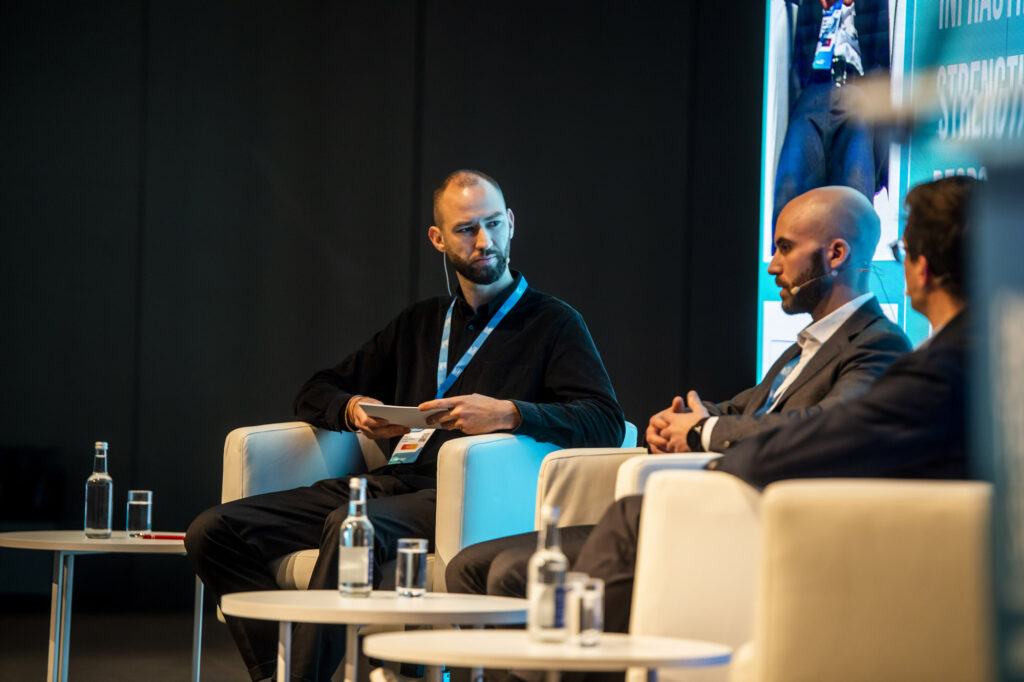
Felix Ferstl, Principal, Ananda Ventures GmbH moderating the panel
Where software meets infrastructure
Defert brought an investor’s view. HSBC Asset Management set up a growth equity and venture strategy in climate, investing across North America and greater Europe, including Israel. Its focus covers the energy transition and mobility, sustainable supply chains and climate risk management.
He first entered the sector two decades ago, when he watched the UK’s largest coal producer move to biomass. What excites him now is that “we are playing at the intersection of infrastructure” and software. In other words, energy remains capital-intensive, but today “all this infrastructure is connected.”
As a result, he sees opportunities in both hardware businesses and software that optimizes infrastructure. Without solar and wind reaching today’s scale, many of these newer technologies would not be possible.
Adapting to a changing climate
Ferstl noted that adaptation is part of the picture too. Ananda Ventures, for example, has invested in technology that helps predict wildfires and protect power lines.
For Defert, adaptation looks different in every industry. Crop and flood insurers, for instance, face business models that change with the climate. Consequently, they are turning to tools such as geospatial imagery to assess risk.
He also sees whole new markets emerging, such as voluntary carbon markets. Today, those trades are mostly bilateral. However, anyone from the energy industry knows that bilateral deals tend to evolve into PPAs and then into marketplaces. Carbon markets could follow the same path, which makes early entry interesting.
What drives demand for industrial heat storage
Kyoto Group was founded in 2016 with the idea of connecting solar power and heat. Its thermal battery concept took shape around 2018 and 2019.
Since then, the market has matured slowly. Industrial heat is not well understood, Valåmo said, and engineers are trained to think of heat as combustion rather than electrification.
The energy crisis that followed the cut in Russian gas supply changed that. Suddenly, energy security moved up the agenda, and interest in new solutions rose sharply. Still, power markets and regulation lag behind when it comes to rewarding flexibility. Across many European markets, however, rules and market designs are now starting to make the investment case work.
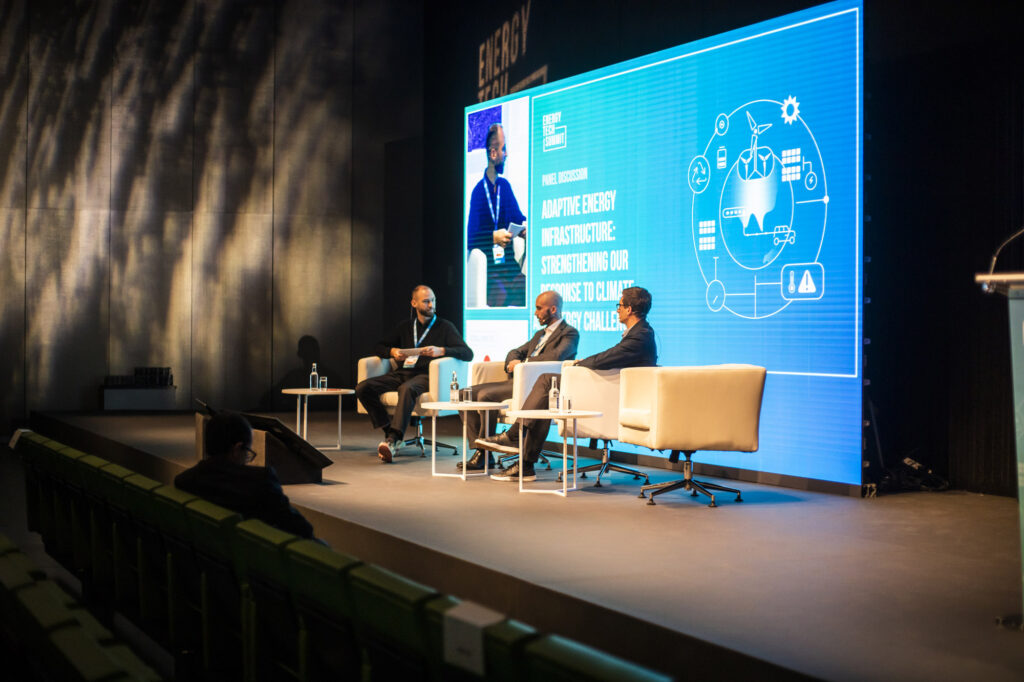
Panelists: Simen Bomnes Valåmo, Director of Market Intelligence at Kyoto Group, Christophe Defert, Head of Climate Technology Investments at HSBC Asset Management and Felix Ferstl, Principal at Ananda Ventures GmbH.
Lessons from clean tech 1.0
Ferstl then asked what climate tech can learn from the first clean tech wave of the 2000s. “It’s a great question how much time do you have,” Defert joked.
He was quick to credit that era. “We might want to thank all the people who are part of clean tech 1.0,” he said, since today’s renewable infrastructure grew out of it. In his view, the main problem was a mismatch “between the capital that was going in and the underlying asset.”
Venture firms backed new solar technologies, but solar behaves like infrastructure. Once a project is built with a fixed PPA, its economics are locked in. Meanwhile, the cost curve keeps falling, so each new project undercuts the last.
Today, solar, wind and, to an extent, lithium-ion batteries are the established building blocks of decarbonization. For the next decade, Defert believes software has a big role in optimizing them, from power grids to supply chains. First-of-a-kind technologies still matter. However, they face a timing challenge, because most venture funds have ten-year lifespans.
Why flexibility needs smart software
Ferstl suggested a layered view: infrastructure first, then software, then new first-of-a-kind hardware built on top. Valåmo agreed that software is a prerequisite. Any storage asset that adds flexibility to the power market must be able to capture value from price volatility or follow a solar or wind profile.
For that reason, Kyoto Group developed an AI-based platform to operate the Heatcube. It also prepares the energy management system to connect with energy traders that optimize flexibility across markets.
Even so, Valåmo expects new hardware to roll out quickly. CO2 reduction targets are approaching fast, and industry needs to act now.
The real bottleneck: customer adoption
For Defert, the biggest obstacle lies elsewhere. “The biggest challenge we have is not the startups,” he said. Instead, “it’s not the investors it’s really the consumers” – meaning the utilities and corporates that buy new technology.
He asked startups in the room “how many have managed to sell their product talking to only one person.” Nobody raised a hand. Corporate sales cycles often run 12 months or more, yet growth investors must return capital to their own investors, including pension funds, within a decade. Therefore, corporate risk appetite largely decides how fast technologies scale.
Kyoto Group addresses part of this with a modular design. Demand varies widely between factories, and even between sites within one company. Local grid capacity and space for solar also differ. A modular Heatcube can target one segment now while learnings and economies of scale gradually lower costs.
Valåmo agreed that customer adoption is a challenge. Many corporates are new to energy markets and need time to understand them. Nonetheless, he sees large companies increasingly acting on their decarbonization strategies.
How finance can help first-of-a-kind projects
What can finance do differently? Defert pointed to more creative funds, such as Just Climate, that mix equity with other types of capital to support first-of-a-kind technologies.
Banks, in his view, need to coordinate better across equity and debt and create more tailored products. Ultimately, “a lot of what we do is a question of timing” – matching the timing of capital with the timing of the technology.
As a growth investor, Defert invests from Series A onwards. “I still believe series a can be a growth investment,” he said. Notably, “we don’t look at profitability.” Instead, HSBC Asset Management looks at revenue growth, capital efficiency and unit economics. Software can reach very high margins, but some hardware also works. One portfolio company in fast EV charging with integrated batteries, for example, reaches around 30% hardware margins.
Making the Heatcube pay
Kyoto Group installed its first Heatcube in Denmark. At the time of the session, a commercial installation was under construction in Hungary. It has since been inaugurated at KALL Ingredients’ corn processing plant.
As a fuel-switching solution, the Heatcube competes with gas and CO2 prices. Nevertheless, Valåmo says Kyoto Group can build “profitable cases” in the right markets by stacking revenue. The Heatcube uses low-cost solar power, captures volatility in wholesale markets and provides ancillary services to grid operators.
One roadblock to remove
To close, Ferstl asked each panelist which barrier they would remove. For Valåmo, it is power market regulation. Today, rules are “based on historical demand profile historical power system,” so they don’t sufficiently reward new flexibility. Adapting them would help electrify industrial heat at scale.
Defert’s answer was short: “customer adoption beyond the pilot.” Running pilots is easy, he said, but commercial rollout is what really matters.
Takeaway
Adaptive energy infrastructure needs three things working together: hardware such as thermal energy storage, software that unlocks flexibility, and capital that matches the timing of new technologies.
Above all, the panel saw customer adoption as the deciding factor. Startups and investors are ready. Now utilities, corporates and regulators need to move beyond pilots.
Secure your pass
Want to meet the investors, founders and corporates building adaptive energy infrastructure? Join us at Energy Tech Summit Europe 2027, the 8th edition, on 7–8 April in Bilbao, Spain.
Passes cost €1,399 until 30 November, then €1,599 from 1 December, €1,799 from 1 February 2027 and €1,999 from 1 March 2027.
Founders can join with the Founder’s Pass for €699. Use code ETS100 for €100 off.