

Two startups and two investors explained how electrochemical pathways could decarbonize aviation and shipping – and why cost and infrastructure will decide the race.
Aviation, shipping and heavy industry all need fuels that batteries alone can’t replace. That is where e-fuels come in. At Energy Tech Summit, a panel explored how electrochemical pathways could turn renewable power into green molecules – and what it will take to make them affordable.
Jonathan Tudor, Investment Partner at Clean Growth Fund, moderated the discussion. He was joined by Dr Frederik Hetsch, Head of Science at Audacy Ventures, Ignacio Echavarría Díaz-Guardamino, CTO and Head of Engineering at Dovetail Electric Aviation, and Mathias Bösl, CEO and Co-Founder of Spark e-Fuels.
Two startups, two investors
The panel brought together two startups and two investors. Clean Growth Fund is a UK investor backing seed and Series A companies in any climate sector. However, each company must have the potential to save at least 100,000 tons of carbon per year.
Dovetail Electric Aviation builds retrofit kits that turn existing aircraft fully electric, with hybrid hydrogen-electric systems planned for the future. Spark e-Fuels, meanwhile, develops conversion technologies for sustainable fuels, especially for aviation. Its processes are load-flexible, so they can cope with fluctuating renewable power and cut costs.
Hetsch represented Audacy Ventures, an early-stage energy tech investor based in Hong Kong. Its portfolio spans Asia-Pacific, Europe and North America, including several companies in sustainable aviation fuel (SAF).
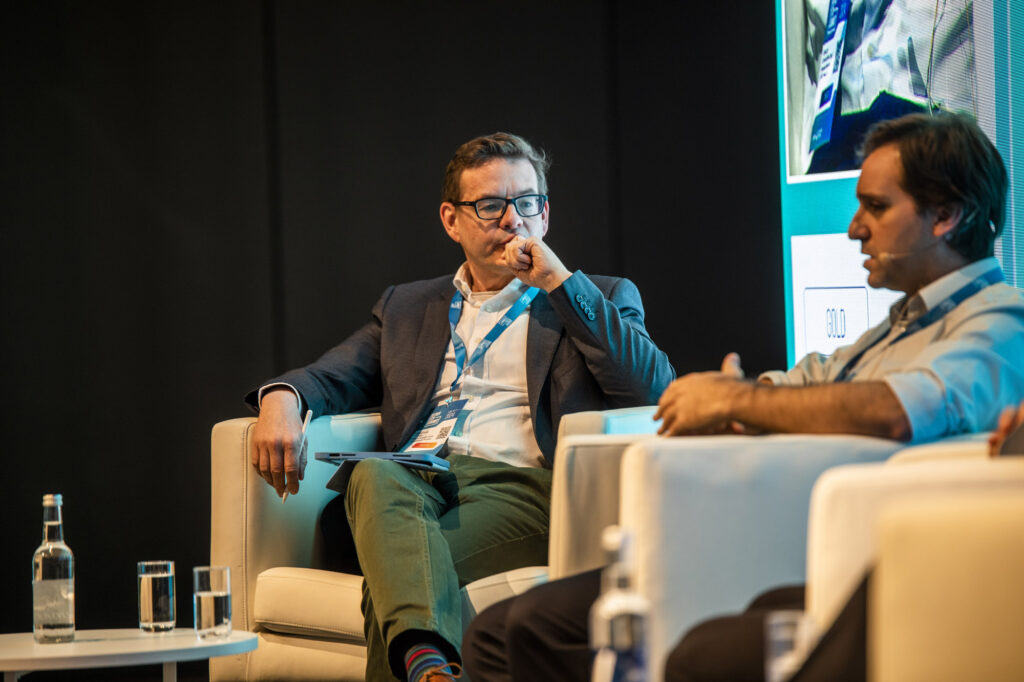
Jonathan Tudor, Investment Partner at Clean Growth Fund, moderating a panel on e-fuels at ETs2024.
What counts as an e-fuel?
Tudor opened with a deceptively simple question: what exactly is an e-fuel? Echavarría answered from an aviation perspective. Short flights could run on batteries, while longer routes may need hydrogen. Yet today’s aircraft will keep flying for decades, so SAF remains essential alongside them.
Bösl offered a narrower definition. For him, e-fuels are usually hydrogen and its derivatives, produced with electricity. That includes methanol for shipping and ammonia, not just aviation fuel. Crucially, the electricity and other inputs must be sustainable, otherwise the whole exercise makes little sense.
Hetsch added that the lines often blur. E-fuels and biofuels overlap, and they may even benefit from each other. In his view, anything that uses electricity to produce an alternative fuel qualifies.
Tudor summed up the challenge. Electrochemical pathways require energy input, whereas fossil fuels mostly need energy to extract. Therefore, “it has to be energy competitive.”
The technologies shaping e-fuels
Next, Bösl mapped out the technology landscape. It all depends on inputs and outputs. Water alone can produce hydrogen, while water plus CO2 can lead to methanol, jet fuel and other hydrocarbons. Ammonia is another possible product.
Innovation is happening at every step. In hydrogen, PEM and alkaline electrolysis are joined by maturing high-temperature and anion exchange membrane technologies. For jet fuel, the route runs from hydrogen to syngas, then to hydrocarbons and finally to jet fuel.
Along the way, better catalysts improve conversion and efficiency. Similarly, new reactor designs cut capex and raise efficiency. Most of these processes still rely on thermochemistry, the proven workhorse of the chemical industry.
Electrochemical routes for converting CO2 are emerging, but yields remain low and scalability is uncertain. Plasma reactors are another frontier, though they mostly produce very short hydrocarbons so far. For Bösl, the goal is clear: “it’s not to have the best technology but it’s to have really the technology that works and is able to scale.”
Revolution or evolution?
Hetsch divided the field into two camps. Revolutionary technologies, such as plasma-based chemistry, could transform how green methanol and ammonia are made. For instance, he pointed to PlasmaLeap from Australia. Still, from an investment perspective, they remain early and high-risk.
Evolutionary steps are just as important. Wind and solar have driven the biggest cost declines, but their output is intermittent. Chemical processes, by contrast, usually need stable conditions. Consequently, companies like Spark that can run on fluctuating power address a fundamental problem.
In the end, “it’s basically all about the inputs,” Hetsch said. Cheap electricity, efficient electrolyzers and affordable CO2 are all essential. Biogenic CO2 from biomethane plants is one promising source.
Policy support, from the IRA in the US to the European Green Deal, is also helping. The next step is bankability. Ultimately, projects need to reach the point where banks can provide most of the financing as debt.
Bringing down the cost of e-fuels
Cost remains the central hurdle. As Echavarría put it, “if you have a fuel which is really good but it’s three times as expensive people would just not buy it.”
SAF has a major advantage: it works as a drop-in fuel. Aircraft and logistics stay the same, so airlines can switch easily once prices get close to fossil kerosene. Hydrogen, meanwhile, will need cheap green production plus new airport infrastructure for storage, transport and quick refueling.
Tudor raised a timing problem. Airlines are ordering planes today that arrive in six or seven years and then fly for decades. Echavarría agreed that drop-in SAF solves part of that. Still, airlines must plan for hydrogen now, because “things need to move now in order to have planes flying in 30 years with alternative fuels.”
Bösl estimated that e-SAF currently costs around four to five times more than fossil jet fuel. In his view, falling electricity and capex costs could bring that down to roughly 1.5 to two times the fossil price. At that level, e-fuels compete with fossil fuels plus carbon prices.
Until then, regulation bridges the gap. Under the EU’s ReFuelEU Aviation rules, SAF must reach 70% of aviation fuel by 2050, with e-SAF rising to 35%. As a result, buying SAF can work out cheaper for airlines than paying penalties for fossil fuel.
Long-term cost reduction, Bösl added, depends on cheap renewable inputs, efficient processes and standardization. Instead of reengineering every plant, developers should build the same design repeatedly. In his words, “you want to repetitively deploy and deploy and deploy.”
Reusing existing infrastructure
Tudor then asked what infrastructure could be repurposed. Hetsch pointed to a lesson from the hydrogen hype: vehicles and fuel cells arrived before the fuel did.
Drop-in aviation fuels avoid that trap, because they use existing infrastructure. Spark has worked with Rolls-Royce to certify its SAF for engines. In a heavily regulated industry, meeting established fuel specifications is relatively straightforward.
Shipping is different. Methanol and ammonia need new engines, so shipowners hedge with dual-fuel engines that can still run on conventional bunker fuel. Refueling is also concentrated in a few hubs, such as Singapore. Those hubs don’t always have cheap electricity, water or CO2 for producing green methanol.
For aviation, hydrogen raises its own challenges. Natural gas pipelines could carry hydrogen, but they don’t usually reach airports. Moreover, hydrogen’s volume is the problem rather than its energy density. As Echavarría put it, “you need to basically make the aircraft half hydrogen and then half people.”
Answering the naysayers
Finally, Tudor raised a common criticism: that batteries and new fuels carry so much embedded carbon they could end up worse than hydrocarbons.
Bösl argued that we need to “look at the full picture,” including biodiversity. Mining practices for materials such as cobalt in catalysts need improvement. Even so, full life cycle assessments for e-fuels remain positive, from building wind and solar farms to using the fuel.
Echavarría highlighted a key difference. “Hydrocarbon you burn it and that’s it it’s in the air you cannot take it back,” he said. Batteries, by contrast, can have a second life. Aviation batteries retired below 90% capacity can move into ground storage and later be recycled. According to Echavarría, Redwood Materials has shown that up to 95% of a battery cell can be recycled.
Hetsch framed it as a question of alternatives. “None of these are perfect for sure,” he admitted. However, “the world is not going to stop flying or it’s not going to stop shipping.” Until a breakthrough such as fusion arrives, “the best option we have today is working on these technologies that at least reduce” emissions.
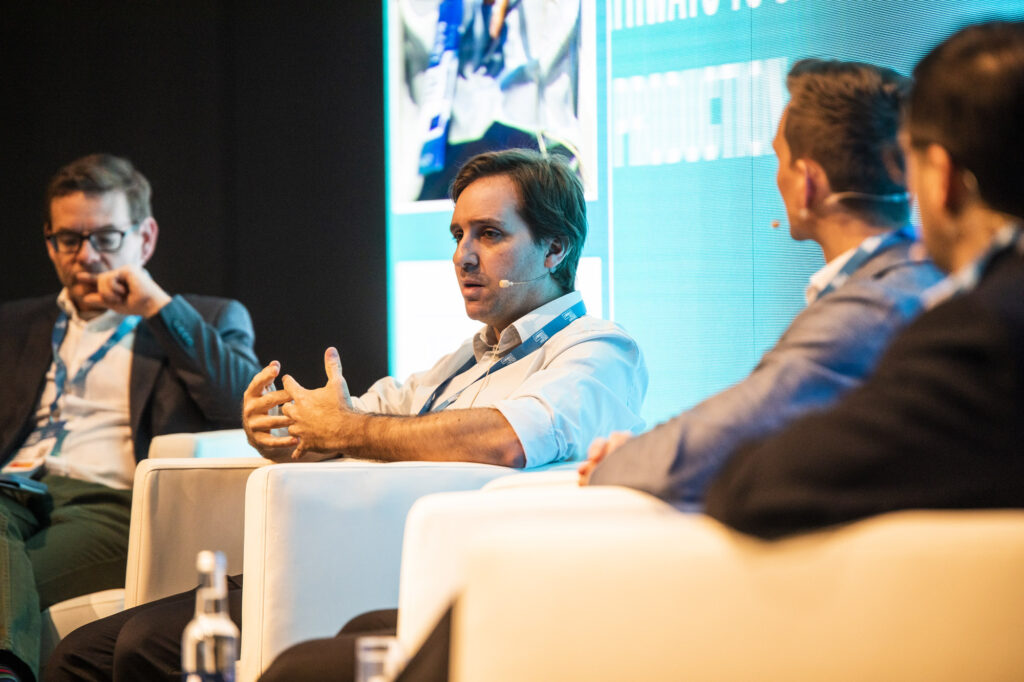
Ignacio Echavarria Diaz-Guardamino, CTO / Head of Engineering at Dovetail Electric Aviation sharing insights on stage.
Takeaway
E-fuels won’t win on technology alone. They need cheap renewable inputs, processes that can handle intermittent power, standardized plants and policies that create early demand.
Drop-in SAF offers the fastest route, because it reuses existing aircraft and infrastructure. As Tudor concluded, that reuse means “there’s hope yet that we could get there quicker than we think.”
Secure your pass
Want to meet the founders and investors building the future of green molecules? Join us at Energy Tech Summit Europe 2027, the 8th edition, on 7–8 April in Bilbao, Spain.
Passes cost €1,399 until 30 November, then €1,599 from 1 December, €1,799 from 1 February 2027 and €1,999 from 1 March 2027.
Founders can join with the Founder’s Pass for €699. Use code ETS100 for €100 off.