

Aviation is one of the hardest sectors to decarbonize – and one of the busiest for policy, offtake deals and new technology.
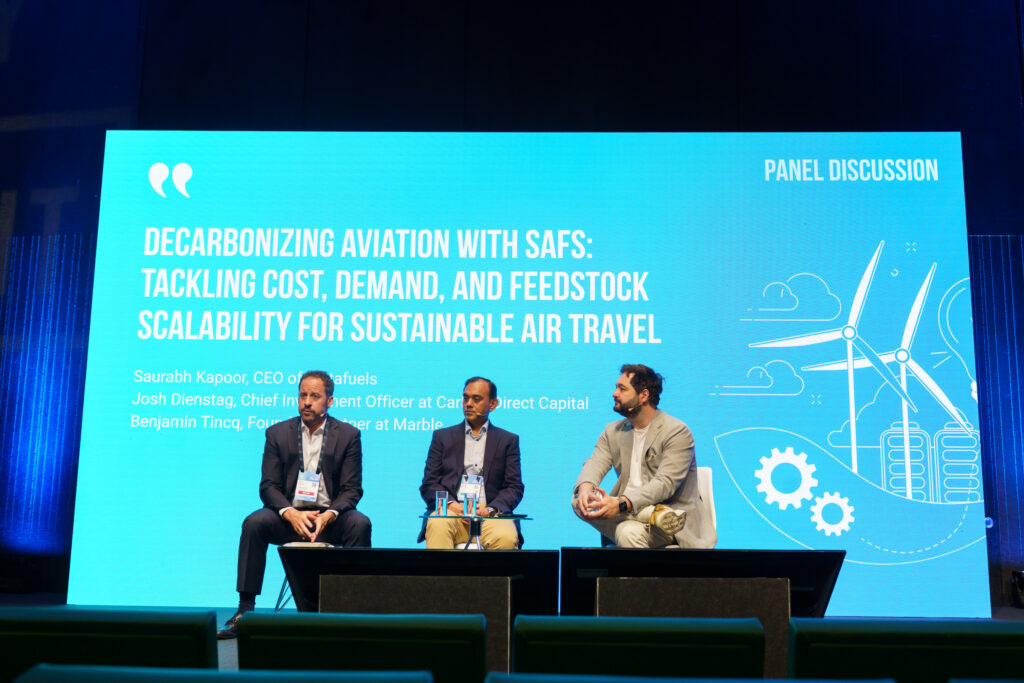
Aviation is notoriously hard to decarbonize. Yet sustainable aviation fuel (SAF) is drawing growing activity on demand, policy and technology. At Energy Tech Summit, Benjamin Tincq, Founding Partner at Marble, moderated a panel on what it will take to scale it. He was joined by Josh Dienstag, Chief Investment Officer at Carbon Direct Capital, and Saurabh Kapoor, CEO of Metafuels.
Mandates, not pledges, drive sustainable aviation fuel demand
Dienstag began with the size of the gap. Airlines buy around 80 billion gallons of jet fuel a year, and only about 0.1% of it is sustainable. Demand, he explained, comes through two channels: voluntary commitments and compliance obligations. Of the two, compliance is where the momentum is.
The UK mandate shows why. It sets explicit blending targets and charges a penalty on non-compliant fuel. Targets start at 10% by 2030, and non-compliance can cost around $23 a gallon, against roughly $3 for fossil jet fuel. As a result, airlines have a clear economic reason to pay more than fossil fuel but less than the penalty. The UK also caps HEFA, the fats-and-oils pathway, which steers buyers toward e-fuels and Fischer-Tropsch fuels.
Kapoor sees the same pattern in talks with airlines worldwide. Many companies set ambitious targets, only to dilute them later. Real action happens where mandates exist, including the EU, Switzerland and the UK. Elsewhere, “it’s all a lot of talking but less action”.
He praised the EU’s design. The EU mandate starts with a 2% blend. At that level, “2% is not going to change something in your balance sheet”, yet it primes the industry for later projects. Because the obligation falls on fuel suppliers, some airlines sit tight. Others, such as IAG, KLM and Lufthansa, are building long-term supply relationships to protect their license to operate. Dienstag’s own test is simpler: “show me the contracts”. IAG, for example, has signed long-term offtake agreements with Twelve and Infinium worth hundreds of millions of dollars.
What SAF costs – and who pays
Prices remain largely confidential, but the logic is clear. SAF is supply-constrained, so it clears well above fossil jet fuel and below the penalty. Dienstag pointed to anecdotal evidence of double-digit dollars per gallon, with production costs of roughly $5–12 a gallon depending on location, policy and technology. Over time, he expects the whole market to move down the cost curve.
Kapoor added that Europe has already decided to decarbonize aviation, and it offers enough regulatory clarity to invest. Metafuels therefore aims to be the lowest-cost producer while making the most of scarce sustainable feedstocks. Airlines, he noted, accept high prices today but want proof of where costs are heading. Dienstag agreed: carriers are effectively buying their way down the cost curve alongside suppliers.
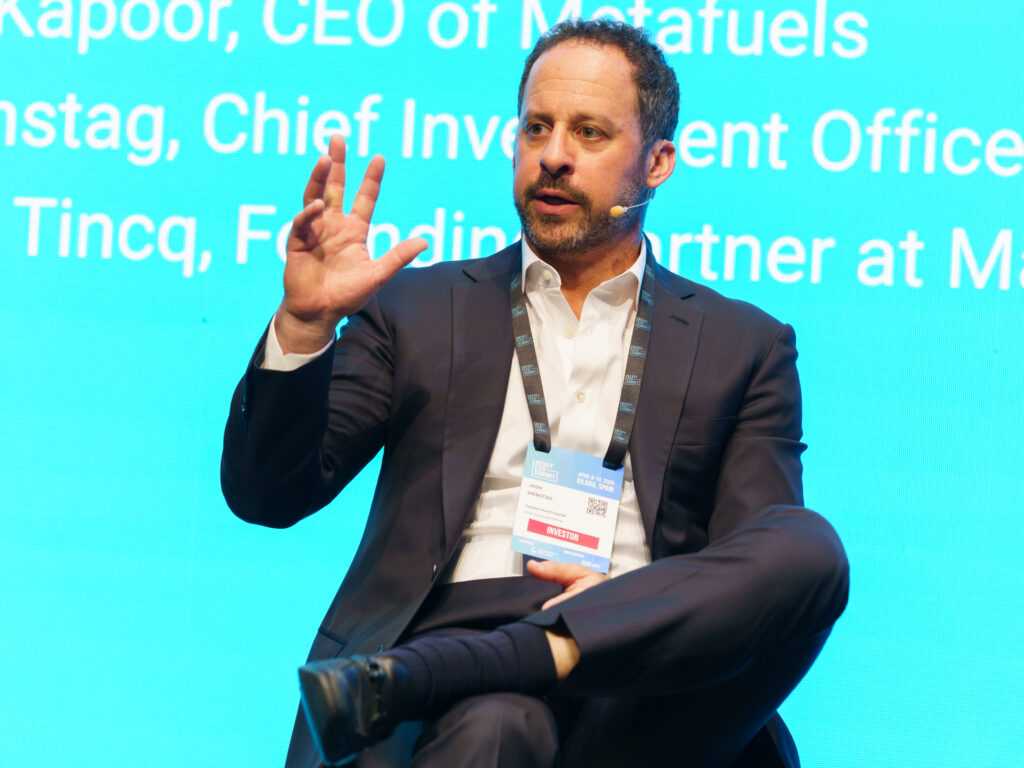
Josh Dienstag, Chief Investment Officer at Carbon Direct Capital
Four pathways and how to judge them
SAF is a drop-in fuel, made either from biological inputs or from hydrogen and captured CO2. Dienstag outlined four established routes: HEFA, Fischer-Tropsch from waste or biomass, alcohol-to-jet and power-to-liquids. Carbon Direct Capital focuses on the last three, since fats and oils are limited and raise climate justice concerns. He also offered a warning about pitches: “every early stage startup has an incentive to quote the lowest possible cost of production”. Engineering studies need to validate those claims.
When assessing pathways, he ranks technology readiness first. Infinium, he said, may not be the lowest-cost producer on paper: “It doesn’t matter. They can actually deliver it.” Cost of production comes second. Carbon intensity comes third, because “Not all fuels are created equal”. As an investor, he also weighs valuation and governance.
Kapoor explained why Metafuels chose methanol-to-jet. The premise is that e-fuels and biofuels belong where no better option exists. In his words, “what you can electrify you should electrify”, with hydrogen next and liquid fuels last. Metafuels turns around 85% of its output into SAF, so little carbon and hydrogen go to low-value byproducts. Methanol is also a liquid that already ships globally. Consequently, it can be made wherever sustainable carbon and renewable power exist, then converted at larger aviation hubs.
Location follows cost and policy
Asked about regional pathways, Dienstag called it “pure pragmatism”. Producers need abundant feedstock, cheap renewables and favorable policy. Several of the largest SAF plants are in the United States, supported by federal production credits. Still, “there’s no patriotism to that”: if policies change, operators will relocate.
Kapoor challenged calls for energy independence in fuel production. Europe already imports fossil kerosene, so building power-to-liquid plants where electricity is expensive makes little sense. For first-of-a-kind plants, regulatory certainty and simple construction come first. Later projects can be more global, including hub-and-spoke models. Metafuels’ Rotterdam project, for instance, will convert methanol shipped from North America into SAF.
Solving the first-of-a-kind problem
Dienstag framed first-of-a-kind plants as a good problem to have, since SAF demand barely existed a few years earlier. These projects carry high, binary risk before a final investment decision, along with low returns, so few investors want them. Once second plants are proven, however, capital becomes far easier to find. He sees three outcomes today. Technology companies raise venture rounds to build their own plants, independent developers struggle to raise dedicated capital, and some projects simply don’t happen. The first route works best, even though it funds low-return projects with expensive venture money.
Metafuels follows a de-risked playbook. The team designed backward from full-scale plants to its demo unit, which runs from a tank of methanol to a tank of jet fuel. Its flagship 10-tons-per-day project in the Port of Rotterdam is due to start production in mid-2028, running mainly on bio-methanol before switching to e-methanol. Kapoor prioritizes simplicity, warning that “there are many projects who look like super optimum on PowerPoint”. Meanwhile, he involves future second-plant partners early. Against the backdrop of European mandates, he argued, “it’s actually possible to have a profitable first of a kind project in Europe”.
What could transform SAF
Kapoor wants long-term regulatory certainty, in Europe and beyond. He also wants improvements across the value chain, from electrochemical methanol production to more efficient electrolyzers. Tincq pointed to new feedstocks such as low-cost methanol and geological hydrogen.
Dienstag, however, was clear: “I don’t think the bottleneck here is a technology problem.” Instead, the constraint is cost of capital. He wants infrastructure and private equity investors to fund second-of-a-kind projects. Brookfield and TPG have already made commitments of this kind. Extra revenue, such as selling Scope 3 attributes alongside fuel, helps too, because “it’s making the projects more fundable”.
In the audience Q&A, Dienstag estimated that a greenfield SAF plant costs from hundreds of millions of dollars up to a billion. Kapoor said Metafuels would need renewable electricity at around €30–40 per MWh to match fossil kerosene. For him, competition for methanol isn’t the issue: “Methanol is just an energy carrier for us.” The real competition is for renewable electricity and sustainable carbon.
Takeaway
Sustainable aviation fuel has moved from a niche into a market shaped by mandates and long-term offtakes. The next test is building the first commercial plants and lowering the cost of capital. In other words, technology is not the bottleneck – bankable projects, stable policy and patient capital are.
Secure your pass
Want to meet the investors and founders scaling low-carbon fuels? Join founders, investors and corporates at Energy Tech Summit Europe 2027 in Bilbao, April 7–8. Founder’s Pass: €699.