
Greenwood-Power’s CTO explained why accurate measurement in substations is the first step towards a truly smart grid.
Rooftop solar, wind farms and EV chargers are turning distribution grids into two-way systems. Yet many utilities still can’t see what is happening in their own medium- and low-voltage networks. At Energy Tech Summit, Carina Lehmal, CTO of Greenwood-Power, explained why accurate measurement is the foundation of every smart grid.
What makes a grid smart
Lehmal began with the basics. A smart grid represents the next generation of the power system. It integrates advanced technologies to improve efficiency, reliability and sustainability. Unlike a traditional grid, it uses digital communication and control systems to connect in real time – for example, to prevent blackouts or forecast problems.
Traditionally, large power plants controlled voltage and frequency, and power flowed one way to consumers. Wind and solar have changed that. Generation now sits in medium- and low-voltage networks, and consumers have become prosumers who both use and produce energy.
As a result, power can flow in both directions, and the distribution grid has become “a black box” for utilities. To control it, they need to build a full measurement chain.
Inside the measurement chain
Understanding that chain shows where funding, policy and product development should go, Lehmal said. It has three main links.
First, a sensor collects the signals – mainly voltage and current, from which frequency can also be derived. Next, a data acquisition system applies algorithms, such as filtering, to extract the relevant data. Finally, that data flows into the utility’s SCADA system or a cloud-based platform.
Utilities rarely use just one system, so sensors must work with many. Quality matters too. If the sensor measures poorly, every later step – including any AI analysis – produces the wrong results.
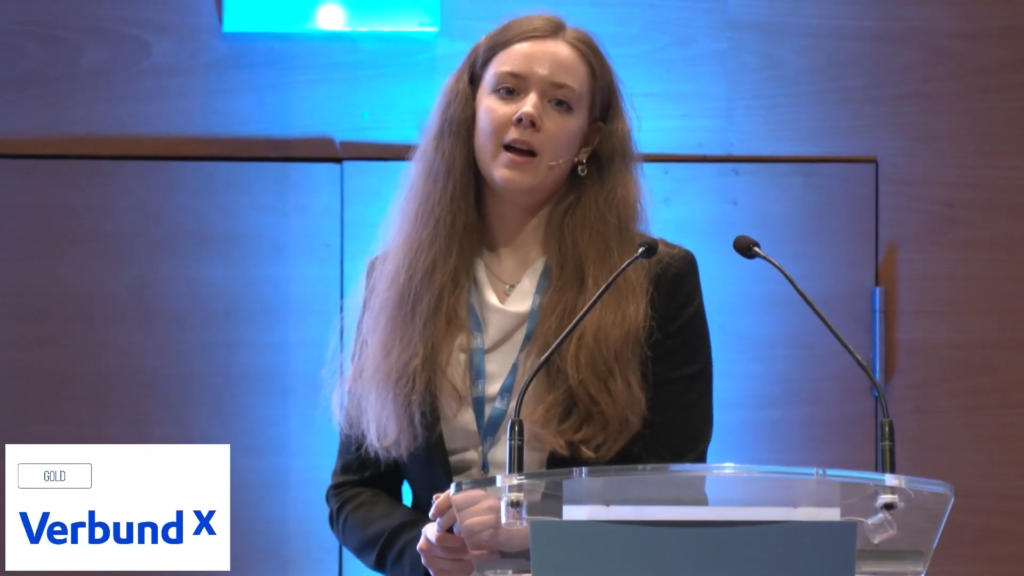
Carina Lehmal, CTO of Greenwood-power
Inside the measurement chain
Understanding that chain shows where funding, policy and product development should go, Lehmal said. It has three main links.
First, a sensor collects the signals – mainly voltage and current, from which frequency can also be derived. Next, a data acquisition system applies algorithms, such as filtering, to extract the relevant data. Finally, that data flows into the utility’s SCADA system or a cloud-based platform.
Utilities rarely use just one system, so sensors must work with many. Quality matters too. If the sensor measures poorly, every later step – including any AI analysis – produces the wrong results.
The scale of the smart grid challenge
The numbers are striking. Lehmal estimated that Europe has around three million substations. Fully digitalizing each one requires roughly 15 sensors, which adds up to more than 40 million sensors for Europe alone. Studies suggest digitalizing around a quarter of substations, which would still mean more than ten million sensors.
That raises practical questions beyond funding: who will produce the sensors, where the resources will come from and who will install them.
What a smart grid sensor needs
Lehmal set out a wish list. Sensors must be compact, because substations have limited space and rebuilding them is expensive. Installation must be quick and plug-and-play, since time in the field costs money. And, crucially, they must be cost-effective, or the smart grid won’t be feasible.
Technical requirements add to the list. Sensors need the right accuracy class for metering and billing, and the right protection class to prevent transformer overloads. They must also resist interference from neighboring phases, cope with small differences in installation and handle harmonics created by solar and wind inverters.
Only sensors that meet all these requirements make advanced functions possible. Predictive maintenance can then forecast outages, fault detection can locate problems and grid optimization can integrate weather-dependent renewables safely.
Where the money should go
Data security, interoperability, scalability and workforce skills remain challenges. Still, Lehmal sees them as opportunities for innovation. Greenwood-Power makes non-conventional voltage and current sensors for air-insulated and gas-insulated switchgear as well as outdoor applications.
Her conclusion was clear. A smart grid needs sensors, data acquisition and SCADA or cloud systems working together. Therefore, funding should flow into utility capex and into sensor research.
Takeaway
The smart grid starts with measurement. Without accurate, robust sensors in substations, utilities can’t see bidirectional power flows, predict faults or integrate more renewables.
Digitalizing even a share of Europe’s substations means deploying millions of sensors – a major challenge for utilities, manufacturers and policymakers, but also a major opportunity.
Secure your pass
Want to meet the innovators building smarter grids? Join us at Energy Tech Summit 2027, the 8th edition, on 7–8 April in Bilbao, Spain.
Passes cost €1,399 until 30 November, then €1,599 from 1 December, €1,799 from 1 February 2027 and €1,999 from 1 March 2027.
Founders can join with the Founder’s Pass for €699. Use code ETS100 for €100 off.