

A grid software founder, a data expert and a solar design engineer explained why the shift to millions of small assets needs better data and smarter networks.
The energy system is moving from a few hundred large power plants to millions of small, distributed assets. That shift brings huge opportunities, but also a flood of data and complexity. At Energy Tech Summit, a panel explored what decentralized energy means for grids, developers and data.
Moritz Belling, Investor at Earlybird, moderated the discussion. “My opinion is the least interesting,” he joked, before handing over to Héctor Lucas Forasté, Pre-Sales Engineer at PVcase, Alberto Méndez Rebollo, CEO and Co-Founder of Plexigrid, and Lacey Montague, Chief Strategy Officer at IMServ.
How the panelists found their way into energy
Montague admitted that “I didn’t decide to go into energy it was an accident.” With a background in accounting, finance and data, she naturally moved into energy tech. She has now worked in the sector for many years, mostly in the UK, and stayed because of the endless opportunities to fix and innovate.
Méndez described two epiphanies. The first led him to study industrial engineering and work in renewables for over a decade. The second came when he asked who would manage all the new decentralized assets. As an electrical engineer, he knew the grid wasn’t ready, so he left to tackle the problem.
Lucas Forasté began in solar research, working on modules and recycling, before moving into project design and management. At PVcase, he now helps engineers design solar projects more easily.

Héctor Lucas Forasté from PVcase, Alberto Méndez Rebollo from Plexigrid, Lacey Montague from IMServ, and Moritz Belling from Earlybird talk about the rise of these trends and their transformative impact on energy landscapes.
From centralized power to millions of assets
Méndez explained the scale of the change. The 20th-century system relied on large, controllable, mostly fossil plants with predictable one-way power flows. The energy transition is the opposite: millions of small, weather-dependent assets, bidirectional flows and prosumers feeding power back into the grid.
Will the system become fully decentralized? Not quite. “For the most it’ll be a hybrid,” he said, with the balance varying by country.
Montague agreed. In her view, decentralization should go as far as needed, balanced against affordability, security, available resources and consumer engagement – all within regulation and politics.
Why decentralized energy needs strong foundations
Montague described the UK as being in a “weird place.” When she joined the industry, it felt slow and resistant to change. Now, many innovators are trying new ideas, but they often have to work around broken systems and missing regulation.
That isn’t sustainable, she argued. Data is a good example. If five innovative companies each collect and clean the same data separately, then “the consumer paid for that data five times.” For that reason, she believes the next step is to stabilize the foundations and improve collaboration across the value chain.
The data challenge in solar development
Lucas Forasté sees similar issues in solar. Designing a project involves many parties, from internal teams to third parties. Each handover means adapting data so others can understand it, and information gets lost along the way. That adds hours, costs and inefficiency.
The grid as the biggest bottleneck
For Méndez, the grid is now the central problem. “The grid is already the largest bottleneck of energy transition,” he said, causing curtailment, connection queues and project delays.
He believes the energy sector should “learn from telecom,” which moved from analog copper lines to digital networks. Distribution grids, by contrast, have mostly added more copper. Transmission operators already have real-time visibility over a few thousand nodes. Distribution networks, however, have millions of nodes, from solar panels to EVs and heat pumps, yet operators have very limited visibility below medium voltage.
Software that delivers real-time visibility, analytics and access to flexibility is therefore the missing link, Méndez said.
A “migraine” for grid operators
Are distribution system operators aware of the urgency? It depends. “I call this a migraine of the grid,” Méndez said – the more solar panels, heat pumps and EVs, the worse the headache.
Operators in places like Norway, where electrification is far advanced, have already had to act. Others, such as in Poland, are only starting to see problems. California, in his view, is a perfect storm: a very advanced energy transition combined with slow-moving grid operators.
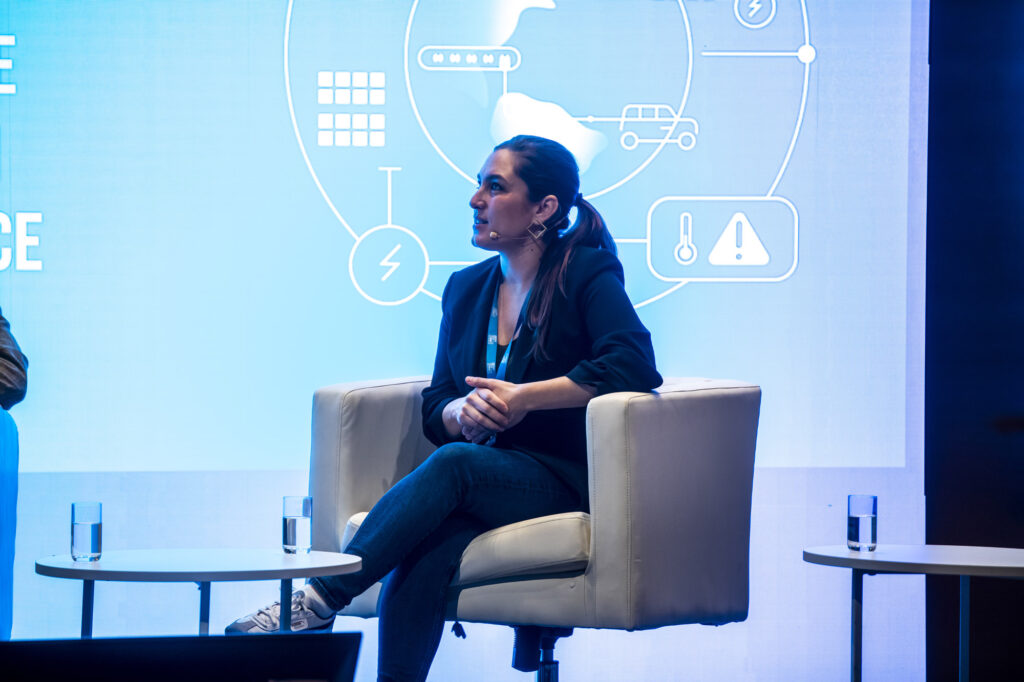
Lacey Montague from IMServ
Getting the data right
Montague noted that the UK differs from much of Europe. Network operators install connections but don’t own the meters, which sit with retailers. Meters moving between suppliers created a data mess.
Accessing data requires many costly hoops, which acts as a barrier to innovation. IMServ, a metering and data agent, collects, validates and cleans data for the industry. Many business customers even come to it directly to get their own data, because utilities lack easy ways to share it.
Network operators also need better regional data. Therefore, Montague argued for more joined-up foundations – even if “more centralized” is “a bad word to some people in the innovation space.”
Lucas Forasté added that good data quality must start at the very beginning of a project. He recalled a past project where missing information about underground pipes led the team to hit one during installation. Small gaps can scale into big problems.
Energy communities and energy sharing
An audience member asked about energy communities. Méndez believes fully off-grid communities are rarely efficient, given the storage needed to survive long cold, dark periods. Instead, he sees energy communities working best within a connected, hybrid system.
He gave an example from Seville. On summer afternoons, solar panels are curtailed because of overvoltage, while nearby EVs wait for cheaper charging and air conditioning runs in offices. With the right intelligence, operators could match those needs. In other words, “problem plus problem equal solution.”
Montague added a perspective “at the risk of being cliche American.” People who want energy independence should be free to pursue it. However, the industry must communicate better, since many consumers don’t even know what decentralization means.
Takeaway
Decentralized energy is a radical shift in how power systems work. Millions of small assets can make grids cleaner and more resilient, but only with real-time visibility, good data and smarter coordination.
The panel’s message was clear: invest in grid intelligence, fix the data foundations and design collaboration into the system from the start.
Secure your pass
Want to meet the innovators building the decentralized energy system? Join us at Energy Tech Summit Europe 2027, the 8th edition, on 7–8 April in Bilbao, Spain.
Passes cost €1,399 until 30 November, then €1,599 from 1 December, €1,799 from 1 February 2027 and €1,999 from 1 March 2027.
Founders can join with the Founder’s Pass for €699. Use code ETS100 for €100 off.