
A robot that can do backflips still cannot fold laundry. Four operators and investors on what automation genuinely solves in the field.
Robotics in energy infrastructure has moved quickly from demonstration to deployment, so Hans Middelthon, Managing Director for Europe at Aramco Ventures, opened by promising a debate rather than a showcase. The panel brought together an investor with two portfolio companies on stage, plus three founders building robots, software and automated construction systems.
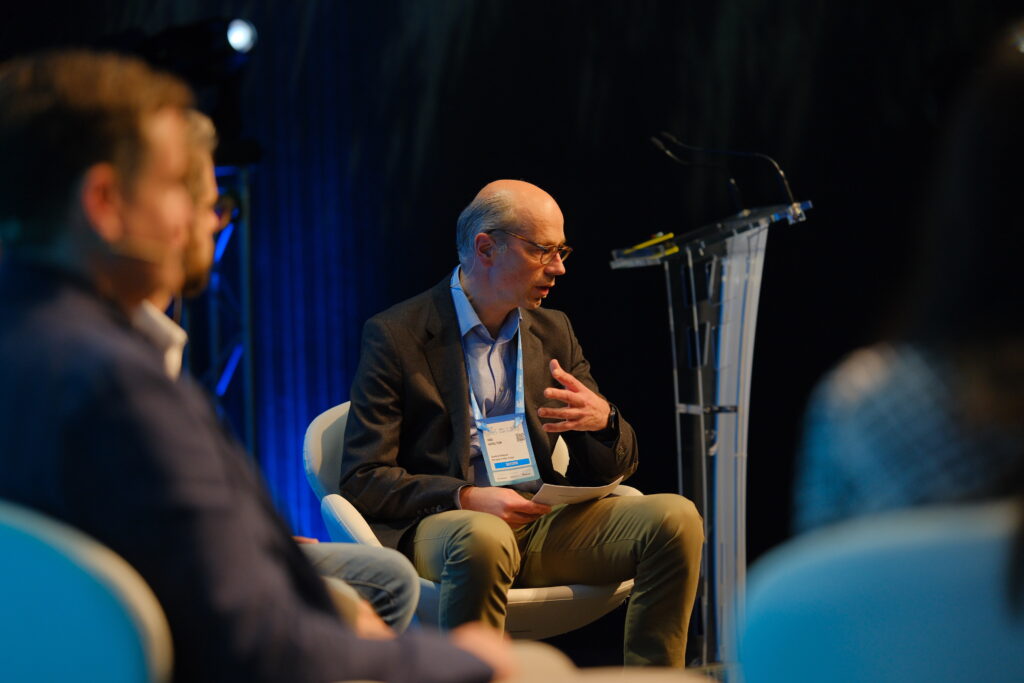
Insights shared by Hans Middelthon, Managing Director for Europe at Aramco Ventures during a panel session at Energy Tech Summit.
Who was on stage
Cindi Bough is Managing Director at Climate Investment, which invests across venture capital and equity stages globally. The firm cares deeply about greenhouse gas reductions across its portfolio, while also delivering value to its limited partners.
Matt Campbell is CEO and Co-Founder of Terabase Energy, which runs an integrated platform combining software, AI and robotics to design, build and operate solar power plants. Consequently, the company spends much of its time on physical robotics in outdoor conditions.
Dr. Péter Fankhauser is Co-Founder and CEO of ANYbotics, which builds industrial inspection solutions around autonomous mobile robots. Notably, those robots have four legs, because industrial sites involve confined spaces and stairs. Once installed, they repeat their tasks without further programming.
The robots carry visual, thermographic, acoustic and gas detection sensors, and all that data is then processed with AI and delivered through fleet management interfaces. Because ANYbotics builds the full stack, customers get higher uptime, less exposure to hazardous situations and better insight into their assets.
Marc Dassler is CEO and Co-Founder of Energy Robotics, which makes software running across various robots and drones. His reasoning is that critical infrastructure needs more than one robot capability, so the platform combines several into a single system giving a full view of a refinery, offshore rig or power plant.
Furthermore, the company layers AI on top so operators can talk to the system naturally. If a data point is missing, an operator asks for it, and the robot deploys, collects and returns with it. Because the platform is hardware agnostic, deployments can use whichever robots are available in a given region.
Automating construction in the mud
Campbell showed what outdoor robotics looks like in practice. On a gigawatt-scale solar farm, Terabase deploys mobile factories that set up in four hours and use robots for tasks people do today: unloading panels, fixing them to steel structures and cabling them together.
Meanwhile, other pieces are still in testing. He showed an autonomous delivery vehicle trialled the previous week – essentially an outdoor version of a warehouse AGV, moving two-tonne structures with a safety driver aboard.
He also demonstrated physical AI performing millimetre-precision work, fixing structures to foundation posts. However, he was candid about the difficulty. Leaving the comfort of a factory for the mud is, in his words, a non-trivial challenge.
Humanity’s last physical exam
Middelthon opened the debate with the obvious provocation: will robots take over the world? Campbell’s short answer was no. His long answer split into three categories.
First, the technical question. Can a robot do what a person does? In AI, he noted, we have benchmark exams to measure progress. Therefore robotics needs something similar, and he was writing what he called humanity’s last physical exam.
The examples make the point. A robot should be able to fix a high voltage power line in a rainstorm. It should be able to thread a needle, or paint on a grain of rice. Although we see viral videos of martial arts and backflips, the same machines cannot fold laundry. “How is it going to change a tire on a car in a thunderstorm?” he asked. AI will give robots a far better brain, yet the dexterity of the human hand remains extremely difficult to match.
Second, the economic question. A friend’s company built robots that picked strawberries better than anyone, and picked a billion of them. Nevertheless, it could not compete with expensive Californian labour, because the robot cost more. People underestimate this, he argued. Humanoids will be expensive, and fine motor humanoids especially so, which may make many applications infeasible for a long time.
Third, the social question. Do we actually want the robot doing it? He cited a talk where a prominent AI executive described visiting a coffee shop staffed by a robot barista and hating the experience. If even he misses the barista, Campbell suggested, most people probably do too. Consequently, the human element of many jobs will persist for a long while.
Robots as workforce amplifiers
Fankhauser built on that with a description of what robots currently are. Today, they function as assistants. You tell them exactly what to do, and they repeat it precisely. However, they do not understand broader context, and they are poor at critical decisions.
Therefore the goal should not be replicating humans. Instead, he argued for a mixed workforce. Robots go into dangerous environments and remote facilities, carrying sensing capabilities people lack. Meanwhile, humans supply creativity, contextual understanding and the social dimension.
The framing he offered is a tool rather than a replacement: a human workforce amplifier. In future, an operator will not only work on site but will run a fleet of robots, much as developers now run AI agents. As a result, people focus on tasks requiring intuition, creativity and accountability, while robots handle the repetitive, manual and dangerous work.
Is robotics in a bubble?
Bough answered from the investment side, and started with her framework. Climate Investment assesses three things: team, tech and total addressable market. The bubble question, therefore, is really a question about timing.
Historically, robotics is not a new theme at all. Early automata appeared in car manufacturing decades ago, and yet that was not the moment to invest. What changed recently is the blending of software and hardware – the speed at which the brains and the operational system have developed alongside the machine itself.
Because of that convergence, she does not think the sector is hyped. Rather, she thinks this is genuinely the time to invest.
Exits support the thesis, too. Bough pointed to substantial corporate activity. Furthermore, Amazon bought two more robotics startups in the two months before the panel. Investors therefore have a path to scale a company and exit it.
Why Europe needs this more than anyone
Asked where Europe fits, Dassler was blunt: not in pole position. China produces so many humanoid robots that its monthly output roughly matches what the West managed across the entire history of developing them.
Even so, he sees a strong European case, and it rests on demographics rather than technology. He is German, and Germany has the oldest population in Europe. Because that pattern holds across the continent, automation becomes a requirement rather than an ambition.
Geopolitics reinforces it. Europe is no longer on close terms with either the US or China, and yet it still needs these technologies. Consequently, many of Energy Robotics’ customers ask specifically whether the hardware and software originate in Europe, because that is what lets them trust the technology in critical infrastructure.
The capability exists, in his view. European industry has always been strong at developing and building key technology. The open question is political will. Flip-flopping industrial policy on the energy transition, he argued, does not help anyone find a straight path forward. So can Europe do this? Yes. Will it? Probably. Does it have the right economic and political environment? That, ultimately, comes down to political will and money.
The investment thesis, in three macro trends
Bough laid out why industrial robotics suits critical infrastructure now, naming three trends.
First, operational budgets are tight and everyone is hunting savings. Second, the workforce is ageing: she expects around half of oil and gas operations staff to mature out within a decade, with a similar picture in power. Moreover, the infrastructure itself is ageing, particularly in power and utilities, which means more inspection and more maintenance.
Third comes safety. Critical infrastructure work carries genuine danger – electrocution, gas leaks, fire – and some environments are simply too dangerous or inaccessible for people.
Inspection volumes explain the opportunity. Operators in utilities, chemicals and oil and gas perform inspections constantly, checking meters, detecting gas leaks and monitoring equipment. Downtime, as she put it, kills these businesses, so regular inspection has always been a critical and expensive part of operations.
Importantly, her thesis rejects the idea of a single winning form factor. Rolling, two-legged, four-legged and flying robots will all be needed, because industrial use cases remain highly bespoke. Humanoids may find domestic applications, yet industry will keep using different robots for different jobs.
Certification is where she sees defensibility. Both portfolio companies work on robots certified for hazardous classified areas, and those certifications are genuinely hard to obtain – because a robot that fails in the wrong place could trigger a major gas leak.
As for timing, the industry pressure is public. She noted that BP declared in 2025 that it needed to save $1.5 billion in operating expenses, which illustrates the scale of cost pressure driving adoption.
What makes an industrial robot different
Middelthon asked Fankhauser to explain how his robot differs from the well-known yellow quadruped many people have seen.
The answer is industrial exposure. ANYbotics designed for harsh environments from the beginning: offshore conditions, dust, high and low temperatures. The unit is rated for water and dust ingress accordingly.
Beyond that sits certification for explosive atmospheres. In oil and gas, you cannot bring any device that might cause an explosion, because you must assume explosive gases are present. It is stricter than the rule against smoking at a petrol station. Achieving that is genuinely difficult for a machine carrying a large battery, fifteen motors and extensive electronics – and one that must stay light enough to climb stairs.
Therefore this is where Europe can lead. The company now holds dozens of patents on these systems, competing on quality and certification rather than on volume manufacturing.
What physical AI changes
Fankhauser described physical AI as a democratization of robot programming. His own PhD involved the underlying mathematics, and very few companies had the background or the money to do that work.
Now, through deep reinforcement learning, robots learn themselves. Consequently it is not only easier but considerably more reliable, which lets the company extract more from the same hardware.
There is a cost dimension too. Because AI can compensate for imprecision, cheaper components become viable – AI eating into hardware cost.
Looking ahead, world models will give robots contextual understanding, moving them from assistant to proactive agent. Imagine a robot that has seen thousands of facilities, he suggested, and can walk a site advising on failure cases it has encountered elsewhere.
Nevertheless, he was clear that the best model does not win the market. Adoption happens when you understand the problem end to end and guide the customer through it. Funnily enough, many customers want robots without knowing precisely which problem they are solving, which is why the company leans heavily on consultative selling before and after purchase. This is a project rather than a product, and that distinction is what separates a few pilots from real scale.
Winning hearts and minds on the ground
Asked about adoption, Dassler identified it as the whole game. Because barriers kill interest, the system has to be simple enough that no expert is required to get a robot moving.
The top-down approach rarely works. A CEO announcing an automation programme and appointing a vendor usually fails. Instead, you need the people on the ground to want it – to love the robot because it removes a genuine pain point, such as driving out at night in bad weather to check a pump. Now the robot does that, while the operator supervises from the control room.
Trust matters especially in oil and gas, where safety, legal and data considerations each carry veto power. Therefore a company needs internal champions willing to push through problems, plus enough accumulated experience to know what worked and what did not. Only then can deployment scale globally.
His argument for urgency was competitive. Companies that start automating now gain an advantage over those that wait, because latecomers face rivals who have already cut operating costs substantially.
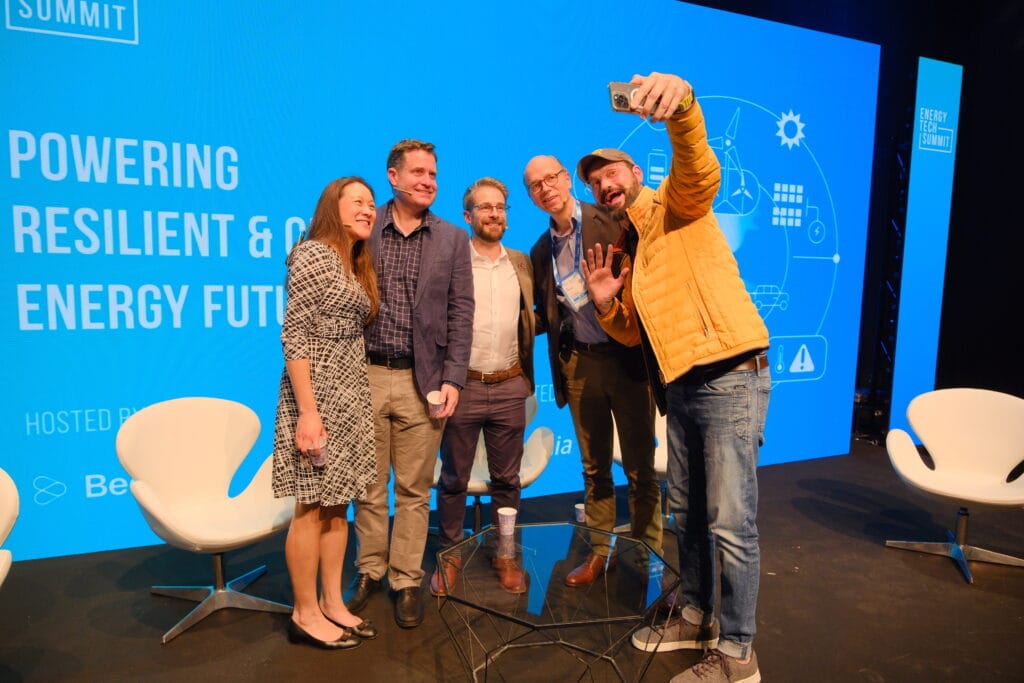
ETS2026 expert speakers after panel discussion on opportunities in robotics.
Does adoption differ by region?
Campbell sees similar interest and similar openness across the US and Europe. European energy companies are pushing aggressively on outdoor construction and operations robotics, and the underlying challenges – labour costs, competitiveness – are the same on both sides.
In the US specifically, interest spans construction and maintenance for the same reasons: labour shortages, rising labour costs and hazardous environments. On the maintenance side it is becoming real, particularly in solar, where cleaning panels and cutting grass are the two largest operating costs. Poor maintenance there has cost insurers tens of millions through fires.
Construction robotics, by contrast, remains early stage. Even so, Campbell argued that the AI brain changes what is possible, opening applications that simply could not be attempted before.
Bough added a structural observation about why adoption stalls. Data privacy expectations are stricter in Europe, certainly. However, the bigger obstacle is organizational.
She described it as a zipper. A business unit has the need. The CIO owns data and IT. A separate robotics group evaluates and selects the technology. Each holds part of the budget, and in many companies these groups barely speak to one another.
Consequently, you can run a successful pilot with an R&D group and never reach the operators. Alternatively, the operators love it and IT blocks it over systems integration. Where operations are tightly integrated and IT is centralized, scaling across geographies happens quickly. Where everything is siloed by operation, approvals take a very long time.
Collaboration, trust and hallucinating robots
Dassler returned to the human question with a warning about AI in safety-critical settings.
The aim, he stressed, is not replacing people. Robots should make work easier so humans focus on complex tasks. His industry describes the target work as dull, dirty and dangerous – precisely the jobs nobody wants.
However, trustworthiness constrains how AI gets used. Large language models hallucinate, and everyone knows it. You emphatically do not want a robot in an oil and gas facility hallucinating a chemical or gas incident, because shutting down operations costs millions.
Therefore the human supervisor stays on top as decision maker. The human factor does not leave this equation, in his view, because trust is built between people. Everything else is a tool, and tools have limits.
Is European capital ready?
Middelthon closed on funding, and the panel was direct about the gap.
Bough suggested financial innovation is needed for working capital, because funding hardware manufacturing with equity is extremely expensive capital. On the broader question, her firm invests globally and looks for the global winner rather than a regional bet. Encouragingly, she sees considerable robotics innovation emerging from European universities, which is drawing global and US capital into the region.
Dassler used the final word to press investors. He compared regional commitment directly: Singapore invested around $1 billion in robotics and AI over two years, while China is investing roughly $20 billion in AI and robotics. Europe has the talent and the manufacturing capability, so what it lacks is willingness to take the risk.
His closing argument was demographic rather than financial. Looking around a room full of young people, he pointed out that in most audiences he addresses, a significant share will leave the workforce within five years. Somebody has to replace them. Otherwise, as he put it, you switch on the light and nothing comes.
Takeaway
This panel was unusually honest about limits. Robots cannot fold laundry, a strawberry-picking robot lost to human labour on cost, and even an AI executive would rather be served coffee by a person. Nevertheless, the case for robotics in energy infrastructure does not depend on any of that being solved. It rests on inspection work that is dull, dirty and dangerous, on assets that are ageing faster than the people who maintain them, and on a European workforce shrinking by millions within a decade. The winning robot, on this evidence, is not the one that does everything. It is the one certified to walk into a place people should not go.
Energy Tech Summit 2027 returns to Bilbao, April 7–8, with more conversations like this one.