

Startups sell sustainability first and price last. Industry buys in exactly the opposite order – and that mismatch is the bottleneck.
Harry Jankola, Commercial Development and Partnerships Manager at XFuel, used his keynote to argue that low-carbon fuels fail commercially for reasons that have nothing to do with chemistry. Most solutions, in his framing, solve one of three requirements while ignoring the other two.
The scale of the transport problem
Jankola opened with the numbers everyone in the room already knew. Transport emits 8.1 gigatons of CO2 equivalent a year, accounts for 15% of global emissions, and that figure is rising.
More striking was the projection he pulled from International Energy Agency data. Oil consumption in shipping and aviation is set to rise by over 60% by 2050 under current policies. It would fall by just 15% if every announced pledge is met fully and on time.
So why is this happening? Electrification simply isn’t viable in these industries today, and the available alternatives fail in one of two ways. Some aren’t drop-in, so they demand trillions in new engines and infrastructure, plus time nobody has. Others are drop-in but far too expensive for mass adoption, costing two, three, four or even six times conventional fossil fuels.
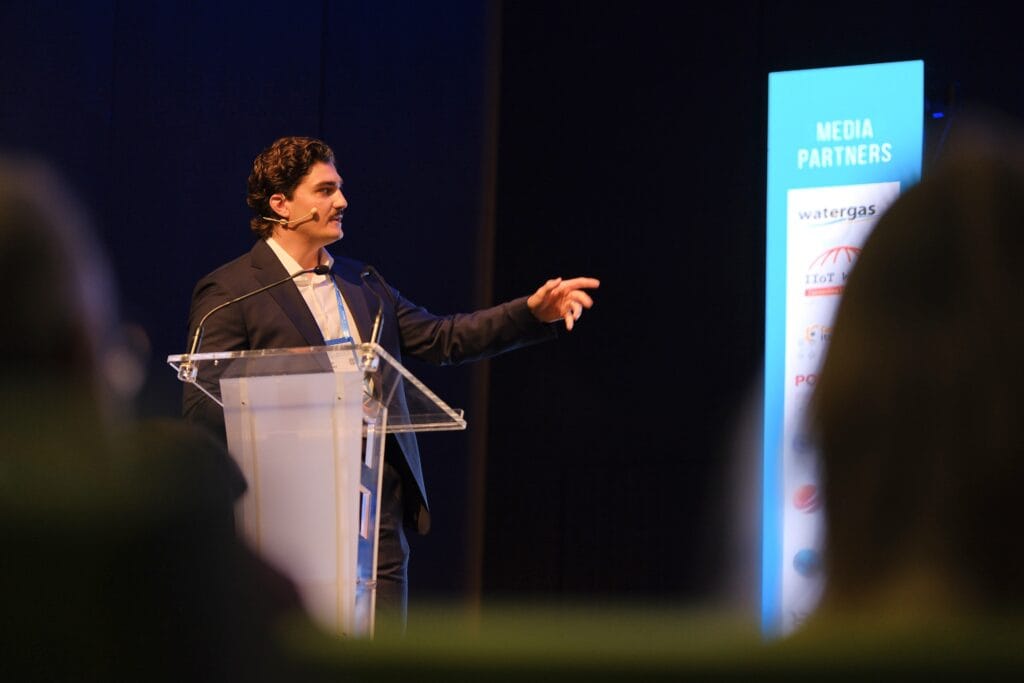
Harry Jankola, Commercial Development and Partnerships Manager at XFuel delivering a keynote on ETS2026 stage.
Three things that have to be true at once
XFuel spent years listening to client pain points and concluded that adoption requires marrying three concepts rather than choosing between them.
First, economic viability. Second, drop-in compatibility with existing engines and infrastructure. Third, sustainability, measured in greenhouse gases actually avoided.
Jankola then borrowed a framing that captured the mismatch neatly. Startups and other first-of-a-kind technology companies typically sell in a particular order of priority: sustainability first, resilience second, with performance and price thrown in afterwards.
Industry wants the exact opposite. Buyers want low cost first, strong performance second, and resilience and sustainability thrown in as a bonus. Products built in the startup order therefore struggle to sell into the industry order.
Two technologies, many waste streams
XFuel works across a wide range of waste streams, producing fuels at different price points with different sustainability benefits. Those inputs include industrial hydrocarbon waste oils, contaminated plastic wastes, waste biomass and agricultural residues.
The company has patented and scaled two technologies. The first, still under development, is mechanical carbon conversion. This low-cost co-processing route takes waste biomass and waste oils and turns them into drop-in marine fuels that are carbon neutral or carbon negative, alongside biochar for carbon removal.
The second is chemical liquid refining, a one-step process that cracks and desulfurizes hydrocarbon liquids back into ultra clean transport fuels for maritime and road use.
Refining shipping’s waste back into shipping’s fuel
Because affordability comes first, XFuel’s initial projects do something deliberately circular: they refine residues generated by the shipping industry to produce fuel for the shipping industry.
What happens to that waste today is instructive. In the best case, waste management companies consolidate it in ports, dewater it and send it for low-value incineration. In the worst case, crews incinerate it on board for no value at all, or dump it illegally.
By diverting that stream instead, XFuel converts up to 90% of it back into fully compliant, on-spec marine distillate fuels, recycling both the hydrogen and the carbon.
Inside the demonstration plant
Jankola showed footage from a pilot run at the company’s newly built demonstration plant, which is fully automated and can produce roughly 100 litres of fuel an hour.
The process starts with a thick, viscous black feedstock. The team first prepares that input alongside the chemical reactants, then removes excess water, since the process requires very low water content.
After dewatering, the on-site laboratory tests a sample for water content and other quality control parameters before the feedstock continues into the process. Finally, the lab tests a sample of the finished product before it ships to clients.
Why zero sustainability premium is the point
The slide Jankola called the crux of his argument concerned project economics rather than emissions.
Even the company’s smallest modular projects deliver considerable greenhouse gas savings, independently validated and expected to meet EU regulations. Crucially, they require zero sustainability premium to be both highly impactful and highly profitable.
That is the whole thesis compressed into one line: to have impact, you have to deliver on sustainability and on economics simultaneously.
Traction: suppliers, offtakes and numbers
On the supply side, XFuel has secured over 100,000 tons a year of feedstock from suppliers looking to valorize their waste. On the demand side, the signal is stronger still: some of the world’s largest shipping companies have signed offtakes worth over €100 million a year.
The performance claims line up against each of the three requirements. On economics, the company produces fuels between 20 and 60% below fossil market pricing, depending on waste type and project deployment costs. On drop-in compatibility, extensive testing, including engine tests, confirms the fuels comply with fossil fuel specifications. On sustainability, validated savings run up to 85% fewer emissions.
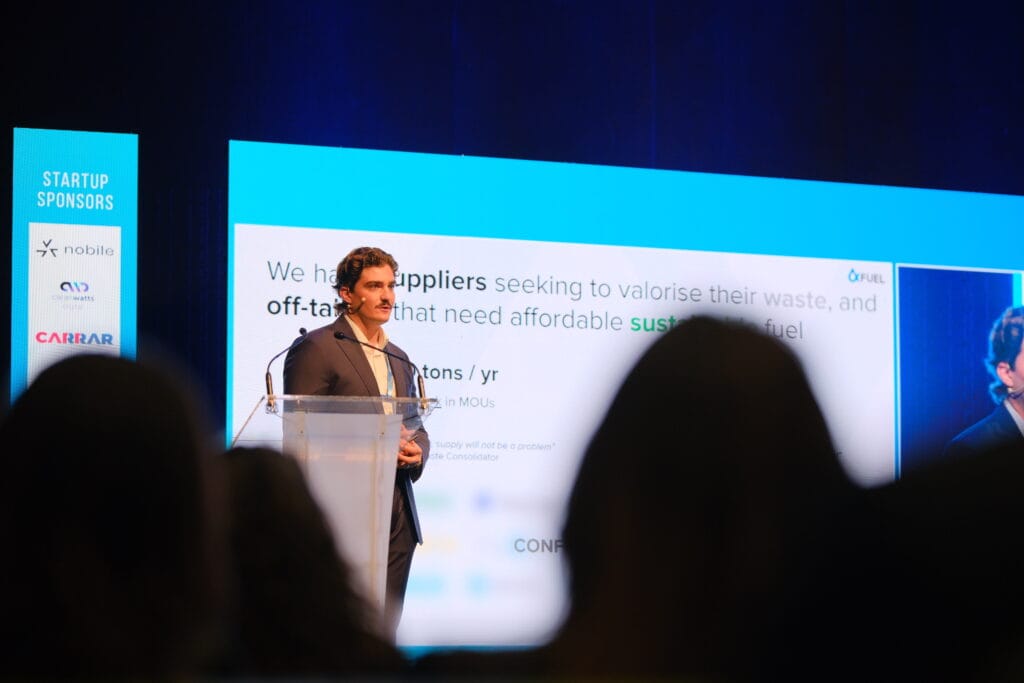
XFuel’s Commercial Development and Partnerships Manager sharing their solutions in Bilbao, Bizkaia, Spain.
What XFuel is looking for
The company’s stated mission is to lead in low-carbon fuels, building, owning and operating its own production plants.
It partners directly with shipping companies and waste management companies alike, closing the loop by turning their waste into value. Jankola closed by inviting project partners, investors and collaborators who share the goal of bringing genuinely affordable low-carbon fuel to market.
Takeaway
Most decarbonization pitches ask a buyer to pay more for a cleaner product. Jankola’s argument inverts that entirely, because his feedstock is a waste stream shipping currently pays to destroy. The fuel undercuts fossil pricing rather than carrying a green premium, and it drops into engines that already exist.
Whether the model scales depends on feedstock availability rather than customer willingness to pay – a considerably better problem to have. The broader lesson is worth keeping: low-carbon fuels that only satisfy the sustainability requirement will keep losing to fuels that satisfy all three.
The keynote stage returns at Energy Tech Summit 2027 in Bilbao, April 7–8.