

Half of global emissions come from heat, and most of it still comes from burning something. Sunmaxx PVT makes the case for a solar module that produces both electricity and warmth.
The heat transition is the part of decarbonization that rarely makes the headlines. Roughly half of global CO2 emissions come from heat, and the overwhelming majority of heat generation still means burning fossil fuel. Wilhelm Stein, CEO of Sunmaxx PVT, took the Energy Tech Summit stage to argue that solving it needs a technology that is economically viable and scalable at the same time – and that the answer is already sitting on rooftops, wasting most of what it collects.
The efficiency argument
Stein’s case starts with a number most people never question. A standard photovoltaic module converts about a fifth of the radiated energy it receives into electricity. Everything else is lost to the environment as heat.
Sunmaxx modules capture that waste heat instead, which lifts total efficiency above 80%. The analogy he drew was with the fossil world, where combined heat and power units replaced simple gas burners for exactly the same reason. Simple PV modules, in his framing, are due the same replacement by dual-use panels.
The differentiator is where the thermal management comes from. The heat exchanger originates in the automotive sector, where it actively cools and heats batteries in electric cars, and Sunmaxx pairs it with current solar cells. Stein claimed the company is the only one worldwide combining mass-production-ready automotive cooling technology with solar cells.
Cooling as a second market
Heat is the headline, but Stein spent time on the reverse case. Cooling is a substantial market on its own, and the PVT approach offers two advantages over conventional air conditioning: it runs silently, and it uses considerably less electricity.
Two modes are available. Active cooling works in combination with a reversed heat pump. Passive cooling radiates heat into the sky as infrared, with no compressor involved at all.

Wilhelm Stein, CEO of Sunmaxx PVT
What a full district retrofit looks like
The strongest part of the pitch was the project detail. It showed the technology working as one component in a system rather than as a standalone product.
The flagship is a sports arena in Vienna, which Stein described as the largest PVT project in Europe. The building sits in the heart of the city beside the football stadium, built to current energy and design standards across a large heated floor area. Its roof carries more than a thousand PVT panels producing electricity alongside low-temperature source heat, which feeds heat pumps that raise the temperature to the level the building actually needs.
Seasonal storage completes the loop. Excess summer heat goes into geothermal probes, then comes back out through the heat pump in winter.
The industrial case, with the honest remainder
The second example was a 1980s automotive facility in southern Germany, retrofitted with over a thousand PVT panels plus seasonal storage and heat pumps. Gas burners were removed entirely.
What made this section credible was Stein’s refusal to claim a clean zero. The retrofit cuts annual emissions substantially, but a remainder stays – and that remainder exists solely because the electricity comes from the grid. Only power purchase agreements from solar and wind close the gap, which is how the facility reaches climate neutrality “without greenwashing.”
The economics carried equal weight. Stein put the levelized cost of heat below what natural gas already costs today, which makes the argument commercial rather than moral.
Production capacity and the market ahead
Stein positioned manufacturing as the moat. The company runs what he called the most advanced and highly automated PVT production line in the world, which gives it a capacity lead and a first-mover advantage it intends to extend.
Distribution runs through partners rather than direct sales, supported by a training centre for wholesalers, system partners, installers and sales partners who then carry the technology into the market.
His market forecast was aggressive: PVT growing faster than solar itself, from an infant market today toward a multi-billion one, with Sunmaxx heading for gigawatt-scale capacity.
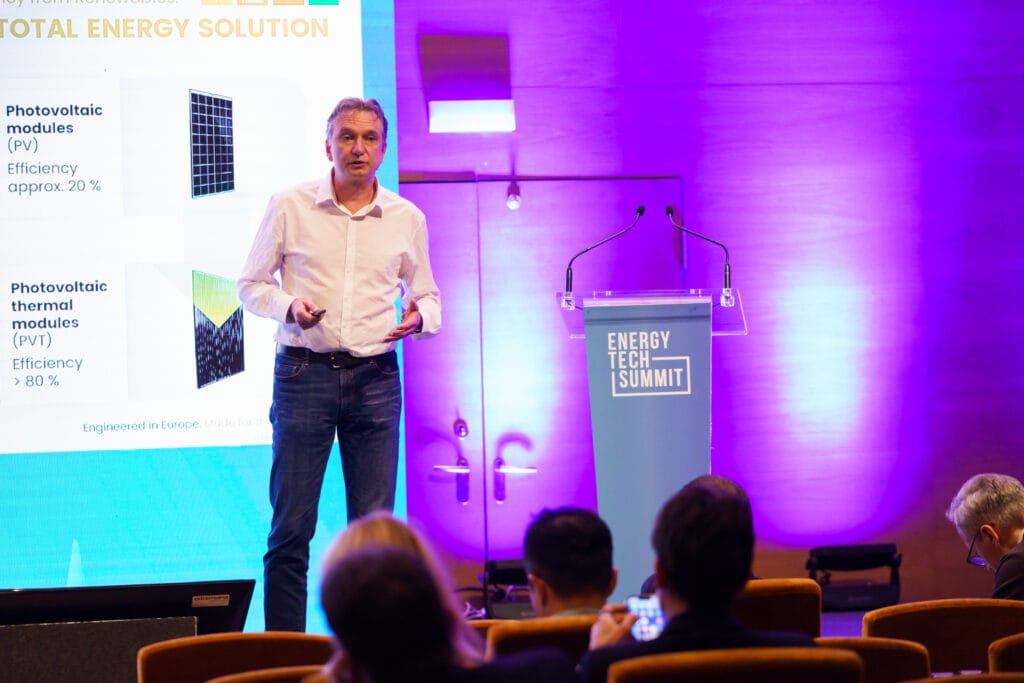
Wilhelm Stein, CEO of Sunmaxx PVT
Takeaway
The heat transition suffers from a framing problem. Clean electricity gets the attention while the larger emissions source keeps burning gas quietly in the background. Stein’s argument is that the fix does not require new roof space or a new asset class. What made the pitch land was the remainder he refused to hide – electrify the heat and the emissions do not vanish, they move to the grid, and only clean supply finishes the job.
Secure your pass
Energy Tech Summit brings together the startups, investors and corporates building the energy transition. Founder’s Pass is €699, fixed.