
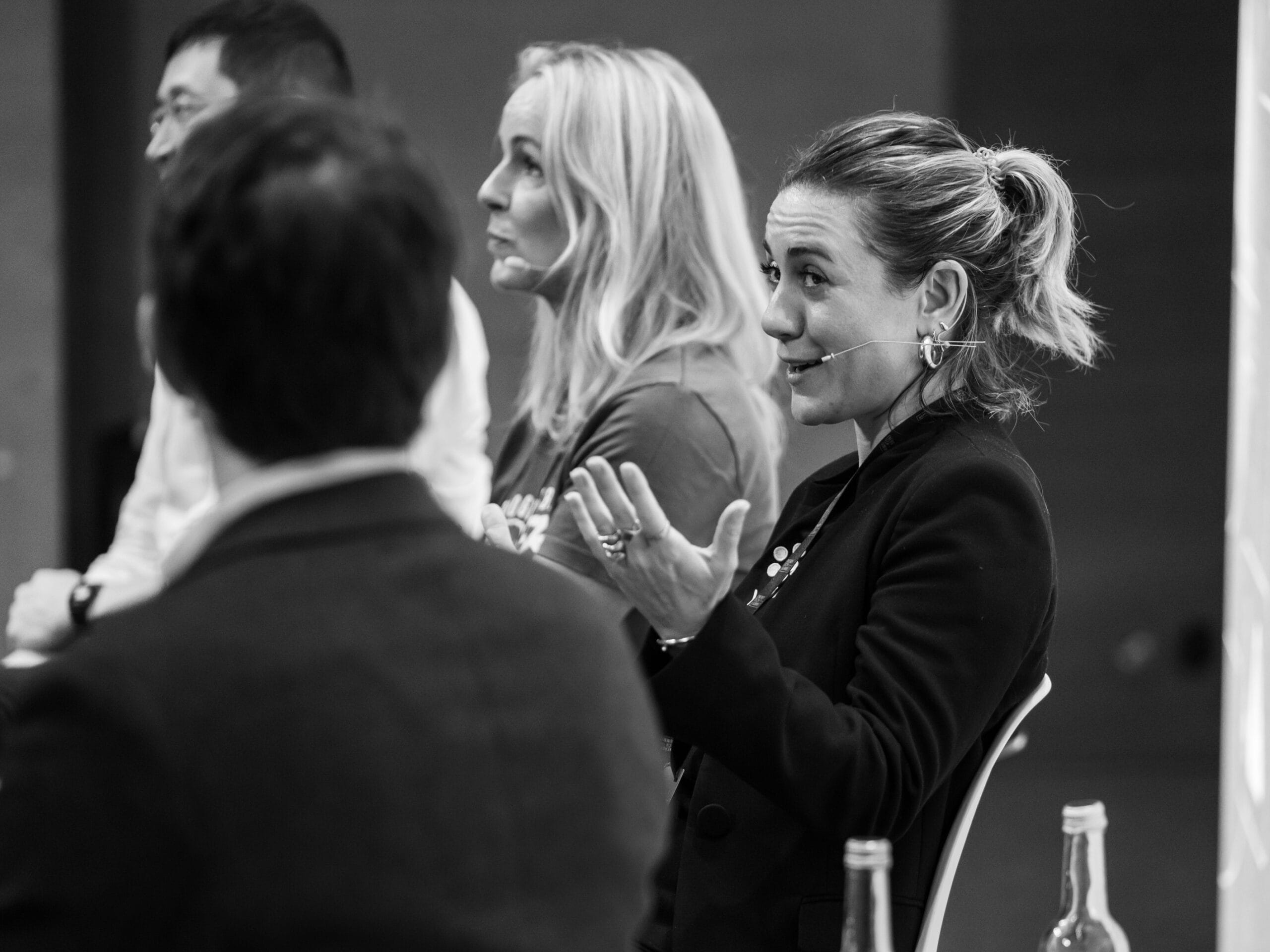
A fusion physicist, a direct air capture chemical engineer and a grid hardware founder run the clock forward fifteen years, then work backwards to what is blocking them today.
Climate tech founders spend most of their time defending timelines. This panel inverted the exercise: start in 2040, describe the company as it should be, then trace back through the standards, targets and partnerships that have to change first. Juan Estalella Giron, Partnerships Manager at Third Derivative, the innovation engine of RMI, moderated – an accelerator that takes companies from early prototypes toward deployment-ready technology.
The three founders sat at deliberately different distances from market.
Three companies, three time horizons
Aurelie Gonzalez co-founded Yama, which develops direct air capture based on pH and temperature swings. Using electrochemistry cuts energy consumption sharply and brings cost within reach of the number the industry treats as the threshold. The company is based in Paris and building its first pilot, moving out of the lab.
Charlotta Holmquist co-founded BLIXT Tech, which builds software-defined power systems in Sweden. In her framing, the company converts the mechanical backbone of the grid into something dynamic, configurable and able to adapt in real time – concretely, solid-state switchgear and voltage conversion.
Rustem Ospanov worked at CERN before concluding that the technologies now exist to make fusion real within a decade. Firefly Fusion combines proven engineering with current science to build a first demonstration reactor in the early 2030s, starting in France.

Charlotta Holmquist, Co-Founder and Chairwoman at BLIXT Tech speaking in a panel
What to stop wasting time on
Gonzalez went first and shortest: stop being impatient, and stop being drawn into speculation about whether the surrounding system will cooperate. Will there be enough renewables? Will the carbon credit market exist? Someone has to remove CO2 regardless. “Just do it.” She called the debate a distraction from the work of getting there.
Holmquist landed in the same place from a different angle. Stop dwelling, stop going back and forth, and accept that disruption makes enemies. The more successful the company becomes, the more resistance it attracts, so trying to keep everyone happy is wasted effort.
Her second answer was personal and drew agreement from the whole panel: stop checking mobile alerts. Her remedy is trekking off-grid in northern Sweden, and the telling detail was her hesitation on the way back, watching the signal bars return and wondering whether to switch the phone off again.
Ospanov, a physicist by training, chose something harder to practise. “Learn how to handle objections better.” Fusion attracts strong opinions, usually some version of it will never happen, and his instinct is to argue the science. The discipline he wants is to extract whatever is genuinely useful in an objection, then move on quickly rather than litigate it.
Estalella Giron offered the accelerator’s version of the same lesson: better a quick no than an eternal maybe.
The systems that have to change
This was the sharpest section, and each founder named a different structural blocker.
For Ospanov it is resistance itself, which he described as close to self-fulfilling. Scepticism about fusion keeps it out of programmes and portfolios, and that absence becomes evidence that it was never viable. His ask was modest: not necessarily investment, but a chance, from people who arrive with preconceived notions.
For Holmquist it is the rulebook. The grid was built more than a century ago, and standards still assume switchgear must be mechanical – including required physical distances between mechanical components. Earlier prototypes had to include mechanical parts that served no function whatsoever, purely to satisfy those standards. The company has since placed its CTO on the working committee for upcoming standards, but as she put it, “we have been waiting for years for the law to catch up with physics.” The communication protocols are a similar era problem: her CTO came from modern data-driven software and now works with protocols that predate the open networks everyone else uses.
For Gonzalez it is how targets are written. Around 80% of emissions sit in scope 3 – which is somebody else’s scope 1. So pressure lands on cement, steel and aluminium producers to solve it. Having spent a decade decarbonizing those industries, she was blunt about the pace: “We can decarbonize. It’s just extremely slow.” Not for lack of willingness, but because of lobbying and hard economics.
Her conclusion follows directly. If carbon removal waits for heavy industry to move, nothing gets built, because a direct air capture company needs roughly a decade to reach scale and cost. Negative emissions therefore need standing alongside scope 1 reductions in the targets themselves, and they need it now rather than later. Standard-setting bodies are currently rewriting rules with input from removal technologies, and she noted they are struggling to set targets for the sector.

Rustem Ospanov, CEO of Firefly Fusion speaking at the panel
What 2030 has to look like
Working backwards produced specific milestones.
Holmquist needs hardware in the field: millions of devices deployed by 2030 across multiple application areas, not proven in one niche. She expects the company to employ more software engineers than hardware engineers by then, because the premium software layer – an app store for energy management at industrial scale – is where the value concentrates.
Ospanov’s 2030 goal is organizational rather than technical. Having worked in academic settings, he concluded that a research organization is not structured to deliver fusion, because the work requires connecting too many pieces at speed. What he wants to build combines academic rigour and originality with startup execution, surrounded by research, industrial and financial partners.
Gonzalez works to a chain of dates. Commercial plants at tens of thousands of tonnes per year by 2028, a megatonne plant by 2032, and gigatonne scale beyond that. Going big is the only route to lower cost per tonne, because CO2 is a cheap commodity and the economics only work at volume. Europe is her preference, helped if emissions trading integrates carbon removal, though North America remains the deeper market.
The partnerships being built now
Gonzalez explained why location decides everything for direct air capture. The input is air, so the plant is unusually free to sit anywhere – but it needs clean power on one side and sequestration or use on the other. The ideal case is co-location with an onshore well, capturing and sequestering without transport or liquefaction. A second route runs through cement producers mineralising CO2 into recycled concrete, which lets them cut cement content while she places her carbon.
Holmquist described dependence across the whole chain, from battery cells and power electronics through installers to early customers. Her team currently does much of the work itself, including physically installing equipment in microgrids, precisely so partnerships are not a precondition for progress. What she wants now is risk-taking first adopters. Utilities, in her words, are “very conservative, stone age thinking” – which is why one taking the leap on new equipment mattered. For global reach she is partnering rather than building sales offices everywhere.
Takeaway
For climate tech founders, the technology was rarely the thing standing in the way. What surfaced instead was a rulebook that assumes mechanical parts, a target framework that leaves carbon removal outside the count. As well as default scepticism that keeps unproven categories out of the room. All three are human systems, and all three move slower than the engineering. The founders’ shared answer was to stop waiting for them – build, deploy, and let the standards catch up afterwards.
Secure your pass
Energy Tech Summit brings together the startups, investors and corporates building the energy transition. Founder’s Pass is €699, fixed.