
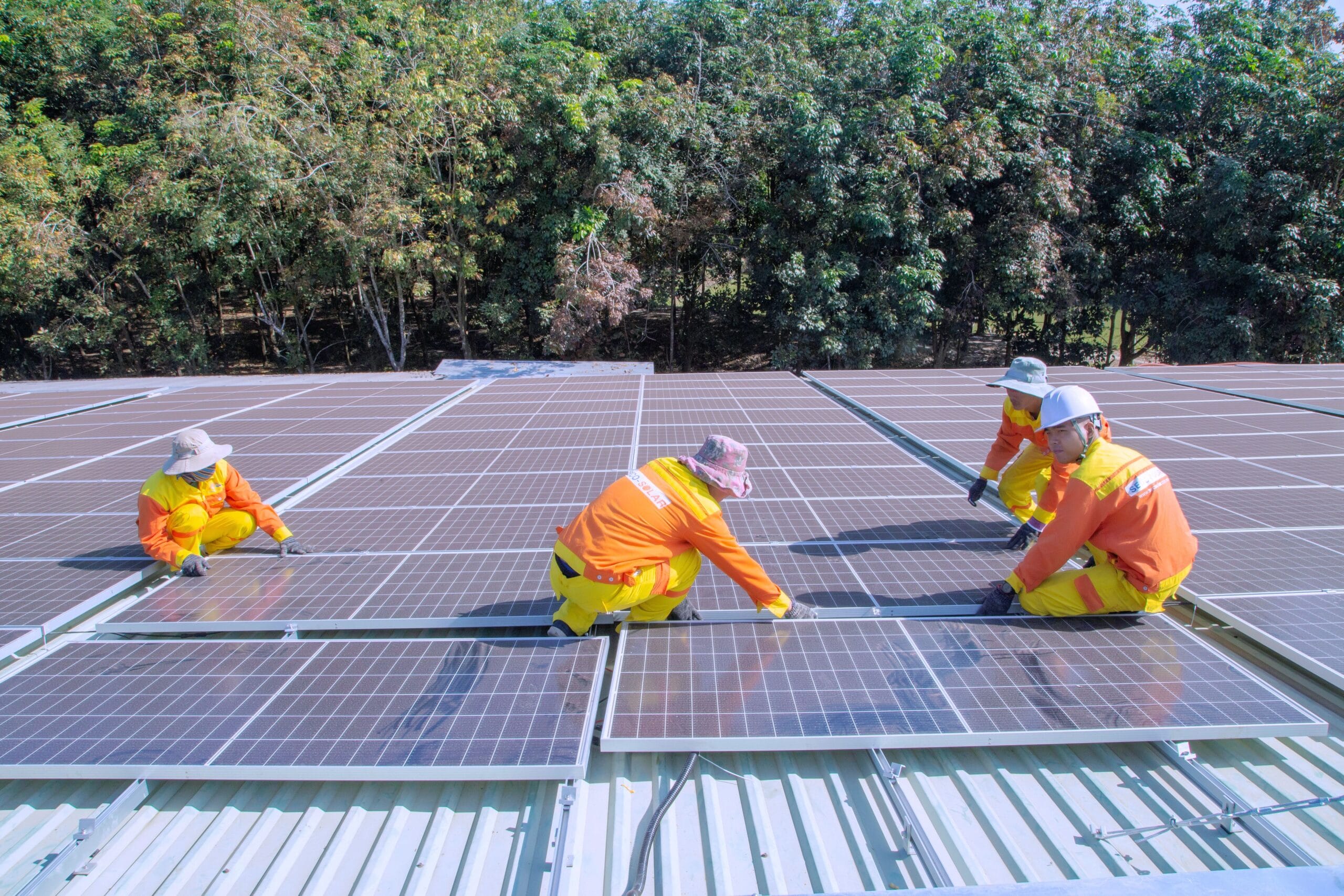
The money is arriving faster than the people. Four training and workforce leaders on why the answer isn’t more climate specialists.
Green skills are quietly migrating into jobs nobody files under climate. That was the thread running through this Energy Tech Summit panel, and it cut against the instinct to train more sustainability specialists. The clearer opportunity, all four panelists argued, is changing what everyone else already does.
Martin Baxter put the stakes plainly: you can have all the money in the world, but without the people to deploy it, nothing happens.
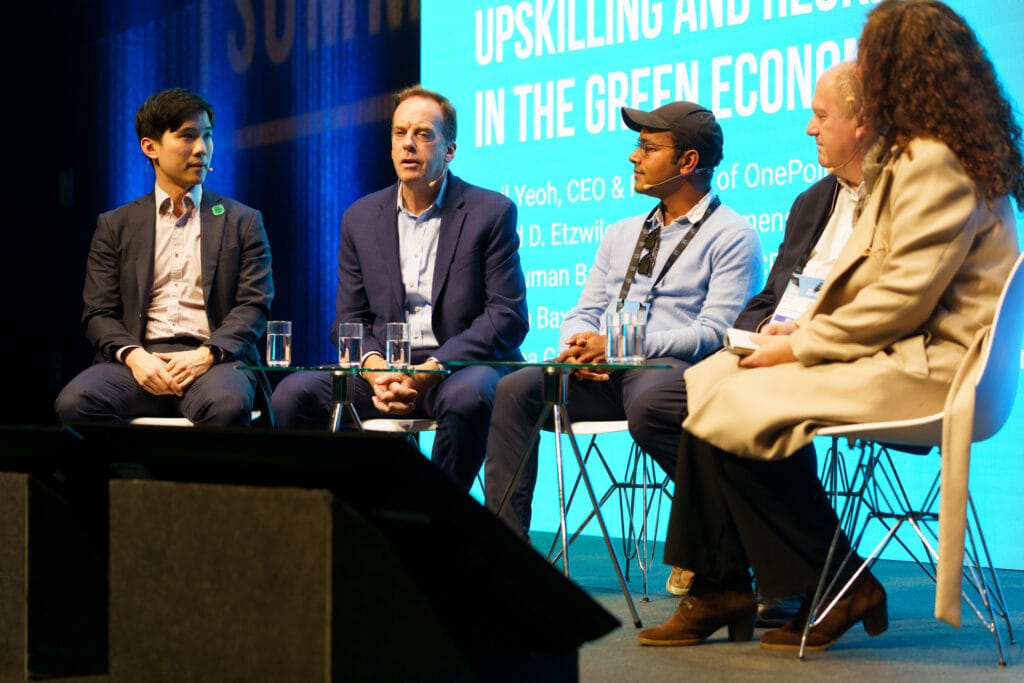
David D. Etzwiler, CEO of Siemens Foundation, sharing insights on a panel session during Energy Tech Summit 2025.
Four different routes into the same problem
Neil Yeoh runs OnePointFive, a climate advisory and academy, and brought data from a partnership with LinkedIn. A robotics engineer by background, he works across the gap between the capacity that exists and the capacity the transition assumes.
David D. Etzwiler leads the Siemens Foundation, the US foundation focused on workforce training, concentrated on electrical and EV charging work. He described a deliberate overlap between economic opportunity, geopolitical security and climate.
Anshuman Bapna founded Terra.do with a target of getting 100 million people working in climate, through learning programmes spanning carbon capture to regenerative farming, a large climate job board, and upskilling work inside major organizations.
Martin Baxter is deputy chief executive at a professional body for people in environment and sustainability roles, with members across roughly 130 countries. His organization is renaming to the Institute of Sustainability and Environmental Professionals.
What politics actually changed
Baxter’s read was that the underlying economics hold regardless of rhetoric. Business leaders may be quieter about what they do, but they consistently say it adds value – and organizations do not stop doing things that add value, they find a way to keep doing them under a different name.
He also tracked how the conversation shifted at successive COPs. Skills and workforce capacity moved from a side topic to an agenda item, with labour organizations, employer institutes and large consultancies driving it.
Bapna was more direct: climate is politics, and the scale of transition being attempted means you have to win the politics for changes to stick. But the geography of activity is shifting, with Southeast Asia, South Asia, Africa and Latin America taking on more.
Two effects surprised him. On the business side, uncertainty separated the serious buyers from the rest – fewer organizations, but ones with genuine strategic reasons, which makes real impact more plausible. And on the individual side, demand rose rather than fell: as governments ease off, more people conclude they personally have to step up.
Etzwiler pushed back on the word “clarifying”. From a US vantage point, he said, things have been murky. Federal policy shifted the game to state and local, which changes who he partners with. On EVs, where the foundation had gone all in, the honest reassessment was that training should broaden into electrical fields generally rather than EV-specific work – partly because the policy environment moved, but also because broader training creates more on-ramps and off-ramps regardless.
The skills mismatch nobody is measuring
Yeoh’s LinkedIn data produced the panel’s most useful finding, and it undercuts how most hiring works.
The majority of people hired into sustainability and climate roles are hired for skills they do not actually use on the job. They are recruited for climate science knowledge, then spend their time on supply chain management or data modelling. Job descriptions, in other words, are a lagging indicator of what the work requires.
His conclusion is uncomfortable for employers. If a decision-maker hiring engineers or clean energy staff does not understand which skills the job needs, the system is already broken – the constraint sits on the demand side, not only in supply.
Meanwhile green skills are spreading into roles that were never climate roles. What does this mean for a procurement manager collecting scope 3 data, or a marketing manager, or an engineer?
Why bootcamps beat degree programmes on hard skills
Yeoh made a specific argument about institutional speed. Universities have a real role in economics, sciences and policy, where knowledge moves slowly. But hard skills change faster than curricula can.
His example: when reporting rules change, his material can be updated within a week, against a cycle of three to four months for full refreshes. Community colleges, professional bodies and bootcamp-style training are agile enough to keep pace; four-year degrees are not.
Functional, not vertical
The panel’s strongest consensus was that reskilling should follow functions rather than sectors.
Baxter illustrated it with product design. Embedding sustainability into new products currently demands enormous time from the sustainability team – life cycle assessments, material choices, product integrity. It produces good outcomes, but it does not replicate across every product line. And nobody wants tens of thousands of dedicated sustainability professionals.
The answer is to change the tools rather than the headcount. The sustainability team’s job becomes feeding data and insight into the tools the design team already uses, so every design is done sustainably by default. “We don’t want people spending their lives diving into LCAs.” The phrase his organization uses for this is “all jobs greener”.
The same logic applies to new areas. Hydrogen sounds entirely new, Baxter noted, but much of it is not – it is a capacity problem more than a novelty problem.
The moderator brought supporting evidence from Houston, where fear about the energy transition gave way to opportunity once the overlap became visible. A consultancy study found the large majority of skills in oil and gas jobs transfer directly to energy transition work, which makes reskilling largely a matter of demystification. She also described a distinctive founder profile: entrepreneurs who came out of oil and gas careers, older than the typical Silicon Valley founder, arriving with problem knowledge from inside large corporates, project finance connections and sometimes their own capital.
AI as the accelerant, in both directions
Asked whether AI threatens the job market, Yeoh turned the question around.
He announced a partnership launching a free course on greenhouse gas accounting aimed at IT professionals, for three reasons: skills should be accessible, green skills need to reach beyond the same echo chamber, and – most importantly – this is functional reskilling in practice.
The logic is specific. IT professionals influence scope 3 data collection across the value chain, and they will increasingly own the scope 2 emissions rising with AI compute. He described speaking with a major technology company’s head of sustainability, worried that AI would drive scope 2 emissions sharply upward against existing net zero commitments.
So AI’s energy appetite may be quietly accelerating demand for exactly the skills the clean energy transition needs.
Etzwiler thanked Yeoh for naming the risks before the benefits, then offered his own use case. His foundation backs regional partnerships linking business, labour and academia to identify local needs and run apprenticeships. What he wants from AI is planning capability – mapping future needs, energy demand, training institutions and available workers region by region, so the work becomes proactive rather than incremental.
Where philanthropy fits
Etzwiler described a deliberate framework for corporate philanthropy: find the intersection of the big issues of the day, the assets of the parent company, and the foundation’s own long-standing focus.
For Siemens Foundation that means income and wealth inequality alongside economic and climate needs; a German-parented company that understands apprenticeships and work-based learning, and jobs requiring more than a high school degree but less than a college degree; and a foundation history in youth and technical skills.
The discipline he emphasised was market-facing. The last thing you want is to train people for jobs that pay poorly or will not exist in three to five years – which makes workforce philanthropy an exercise in reading where capital and demand are actually going.
The just transition problem
Baxter closed on the hardest part. The net effect of the transition is positive for employment, particularly in infrastructure rollout, which makes it easy to sell. But many communities depend directly or indirectly on fossil fuels at a scale that has no future.
His example was a UK steel plant closure he had to comment on live on radio, which will hollow out a large part of one town. The closure was foreseeable for years. Yet at community level there was no organizational bandwidth, capability, funding or drive to get ahead of it.
That failure carries a political cost as well as a human one. Communities harmed this way become reluctant participants in something everyone else finds exciting – which is why he argued for government, business and community groups working together to bring the jobs of the future to the places that will need them, and showing people a positive pathway that is then tangibly delivered.
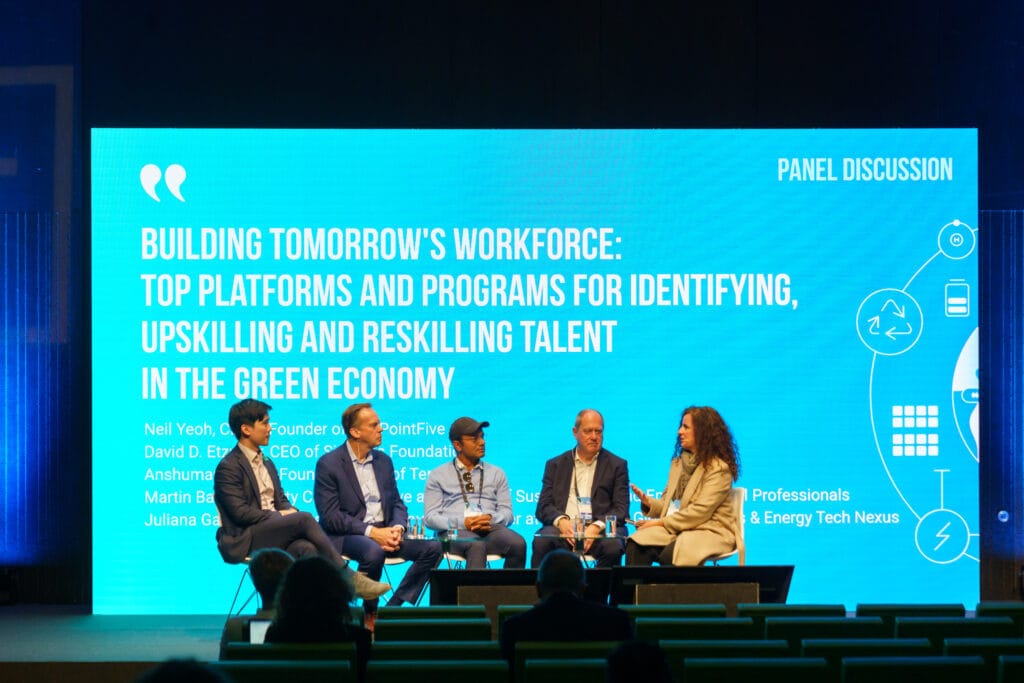
Building tomorrow’s workforce: top platforms and programs for identifying, upskilling and reskilling talent in the green economy – expert panel at ETS2025.
Takeaway
Bapna’s closing call to action was a hierarchy. Start local – families, communities, town halls, not just dinner tables. Then professional: every job has a green component, and roughly 3% of people in a large organization believing that is enough to shift how the whole organization thinks. Then political, because this is a bigger transition than the industrial or digital revolutions, it will not be easy, and it is generational work requiring stamina measured in decades. Which returns to the panel’s central point: green skills are not a specialism to be hired in, they are an attribute spreading through work that already exists.
Secure your pass
Energy Tech Summit brings together the startups, investors and corporates building the energy transition. Founder’s Pass is €699, fixed.