

Enjoyelec Tech showed how AI can coordinate home batteries, heat pumps and EV chargers to cut costs under dynamic tariffs – and support the grid.
Solar panels, home batteries, heat pumps and EV chargers are turning homes into small power plants. Managing them all, however, is getting harder – especially as dynamic electricity tariffs spread. At Energy Tech Summit, Ethan Zhu, CEO of Enjoyelec Tech, explained how AI-powered home energy management can help households save money while supporting the grid.
From single homes to virtual power plants
Zhu’s starting point was demand-side flexibility. Each home on its own is a small piece of the puzzle. Once thousands of homes are coordinated, however, they can form a large virtual power plant that helps the grid absorb more solar and wind.
Enjoyelec started in South Australia. There, homeowners can sign up for retail tariffs that pass through wholesale spot prices, which change every five minutes depending on solar, wind and weather. Zhu believes Europe is moving in the same direction as dynamic tariffs reach households.
With prices changing that fast, no household can manually switch its battery or washing machine at the right moment. That is where AI comes in. The company is also backed by automotive OEMs, reflecting the growing role of EVs in home energy.
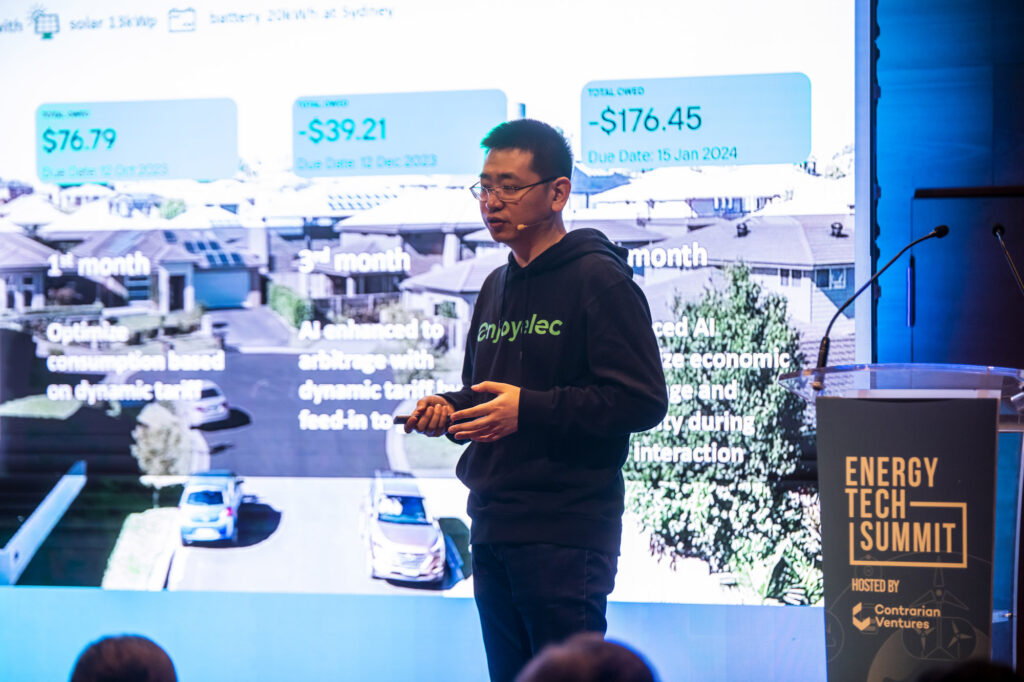
Ethan Zhu, CEO of Enjoyelec Tech presenting on stage
Why homeowners face a “nightmare”
Today, homes are adding solar, batteries, heat pumps and EV chargers. However, each comes from a different industry – solar and storage, heating, and automotive – and each brings its own app.
As a result, a homeowner may juggle five or six apps, plus another from their electricity retailer showing price spikes or negative prices. “We call this a nightmare,” Zhu said. That complexity discourages people from using their assets to support the grid, even when they are keen on green energy.
Interoperability is a further barrier, since devices from different industries rarely talk to each other.
Three steps to smarter home energy management
Enjoyelec tackles the problem in three steps. First, it connects devices through a range of protocols, including EEBus, Modbus, OCPP for EV chargers, SG Ready and OpenADR for demand response and utilities.
Second, its Enjoy app brings all devices together and links them with dynamic tariff providers. In Australia, for example, it works with retailer Amber. The company also offers the app as a white-label product for partners.
Third, an AI layer manages all devices with one global strategy. Without it, each manufacturer’s app optimizes its own device, which creates conflicts. Since every home has different loads, behavior and solar output, the AI learns each household’s patterns. It then forecasts day-ahead and real-time prices to decide when to charge the battery, how fast to charge the EV and when to run the heat pump.
Earning from negative prices and avoiding peaks
In markets with five-minute pricing, “no one can handle it” manually, Zhu said. AI can.
When prices turn negative on a sunny afternoon, for instance, the system can curtail rooftop solar while charging the battery and running the heat pump at full speed. Households then get paid for consuming power, and the grid gets help balancing supply and demand.
The AI also manages demand or capacity charges, which apply in markets such as Germany and Australia. If an EV charger, heat pump and battery all run at once, peak demand – and costs – can soar. Spreading their operation over time avoids that.
Ethan Zhu, CEO of Enjoyelec Tech presenting on stage
A customer case from Sydney
Zhu shared the case of a Sydney customer whose battery previously ran on the manufacturer’s default strategy. In the first month, Enjoyelec’s AI was still learning the home’s solar generation and consumption patterns.
According to Zhu, by the following December the household had gone from paying its retailer to receiving a net credit on its bill. Enjoyelec has since brought its platform to Europe, working with partners in markets such as Germany and France.
Takeaway
Dynamic tariffs and new home energy devices create real opportunities for households, but only if someone manages the complexity. Juggling several apps and five-minute prices simply isn’t realistic for people.
AI-powered home energy management can coordinate devices, cut costs and even turn bills into credits. Scaled across thousands of homes, it also gives the grid a powerful new source of flexibility.
Secure your pass
Want to meet the innovators making homes part of the energy system? Join us at Energy Tech Summit Europe 2027, the 8th edition, on 7–8 April in Bilbao, Spain.
Passes cost €1,399 until 30 November, then €1,599 from 1 December, €1,799 from 1 February 2027 and €1,999 from 1 March 2027.
Founders can join with the Founder’s Pass for €699. Use code ETS100 for €100 off.