

Iron as a fuel, a thermodynamic cycle nobody has built before, and a battery component you’ve never thought about. The finals track with no theme except ambition.
Decarbonization startups usually pitch inside a category. The Wild Card track has none, which makes it the most varied session of the Energy Tech Challengers finals – eight companies spanning the built environment, supply chains, heat, water, resilience, agriculture, circularity and new materials. What connects them is that each found a constraint everyone else had accepted as fixed.
beSirius: reporting that connects to the business
Sergey Tyan opened with a provocation: ESG reporting is dead, companies are pulling out, and that is a good thing – because sustainability turned into compliance.
The evidence is how the time gets spent. Sustainability teams at major companies spend the overwhelming majority of their valuable hours filling forms and passing them between each other, copying data document to document, disconnected from what matters to the business, shareholders, revenue and real decisions.
For heavy industries like metals – the sector powering the energy transition, tech and defence – that disconnection is expensive, because teams cannot make operational improvements while they are busy moving data around.
beSirius replaces static reporting with what Tyan calls living sustainability twins. An engine captures everything from a company’s sustainability documents – reports, policies, certificates – plus its practices, and makes all of it reusable. It can then fill any template, answer any question, and benchmark against any standard.
The core is an adapter: hold the data once, transform it to whatever a bank, customer, supplier or rating agency requires. But he argued the more valuable output is understanding what clients are actually asking about, which tells a company how to tailor its product to them – connecting sustainability work to revenue.
Asked whether the model needs many players onboarded to function, Tyan was clear it does not. Connecting twins across the value chain is the vision; a single company benefits immediately from having its own data on the platform.
Bisly: standardizing building automation
Siim Vips reached for Henry Ford. Cars became both affordable and more reliable through standardization, and that is what Bisly is doing for building automation.
The problem is a gap between known benefit and actual deployment. Building automation cuts energy costs substantially, yet the vast majority of buildings either lack it or run systems that do not work properly, wasting billions.
His diagnosis is structural rather than technical. Most of the deployment cost is overhead, handled by local integrators – which he compared to the coach-building trade before mass production. It simply does not scale.
Bisly’s answer is a patented cloud platform working with its own hardware and third-party equipment, with a universal digital twin used across sales, installation, commissioning and support. Designing from cloud down to hardware keeps every building on the same software version, which holds operating costs down.
The differentiation question drew the sharpest answer of his pitch: the system was built from the ground up for the large share of the market currently missing out, so you do not need to be an engineer to sell, install or maintain it.
Go-to-market has moved in stages – boots on the ground first to get the product right, then partner deployment, now channel sales through automation engineers plus security and low-current companies extending their own businesses.
LAVA: a thermodynamic cycle that doesn’t cool down
Doron Tamir spent twenty years in renewables, developing solar and wind, before concluding that solar, wind and batteries can be part of the solution but not the solution – which needs to be baseload, dispatchable and stable. He decided heat could do it.
The obstacle is a line on a chart. When gas expands it cools, which makes conventional expansion the most inefficient way to produce power – and every steam turbine, gas turbine, air conditioner and heat pump in the world sits on that line.
LAVA developed what Tamir claims is the first isothermal thermodynamic cycle, which would make turbines, heat pumps, air conditioning and compressors both more efficient and cheaper.
Asked to explain the mechanism against something like a Stirling engine – isothermal in principle but adiabatic in practice – he walked through it. Hot liquid enters a purpose-built nozzle, a second liquid is injected, and evaporation creates bubbles. Normally those bubbles would cool as they expand. Here they are surrounded by hot liquid, so their surfaces draw heat back in and they keep expanding without cooling. That is the move from the inefficient line to the isothermal one. The flow exits at supersonic speed, and six such nozzles rotate like a sprinkler: heat to kinetic energy to electricity.
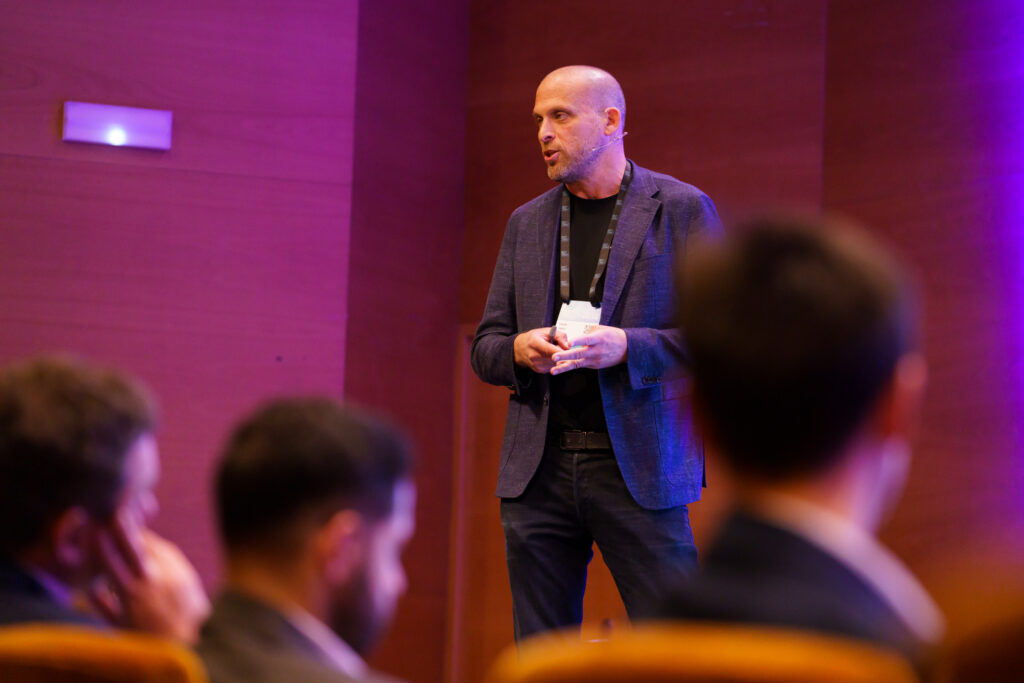
Doron Tamir, CEO of LAVA
Natrion: the plastic inside every battery
John Fox built his pitch on a component nobody considers: the separator, a piece of plastic keeping a battery’s positive and negative sides apart.
Today’s separators are benign – they do nothing else. And when a battery overheats, the plastic melts, which causes thermal runaway, and the liquid electrolyte carrying the ions can catch fire.
Behind that sits a supply chain problem. Separator manufacturing is overwhelmingly concentrated in Asia.
Natrion invented a new polyethylene that drops straight into existing gigafactories, and it does more than separate – it acts as part of the battery, with a path toward solid-state. Today it raises energy performance measurably without any other change.
The commercial argument turns on a nice inversion. Fox anticipated the obvious objection: it must be more expensive. It is. But because energy performance rises, the cost per kilowatt-hour measured at cell level is lower.
The gigafactory conversation is the crux. Tell a manufacturer you have an improvement and they will say they are not changing their process – and they don’t have to. They use different rolls of material.
On integration, he pointed to independent validation: a major OEM took the material, dropped it into their own cells, and reproduced the performance improvement Natrion claims.
Pipein: seeing inside invisible infrastructure
Alessandro Minori described pipelines as invisible infrastructure – old, approaching end of life, and lacking data about their actual condition, so operators cannot use maintenance data to prevent waste or disasters.
Pipein’s deep diagnostic system has two halves: a submersible robot inspecting from inside the pipe, and a digital platform letting operators shift from preventive to predictive maintenance. Inspection data is aggregated with maintenance data customers already hold, producing a report giving failure risk for each segment inspected.
The inspection is non-destructive. Ultrasonic sensors measure wall thickness without contacting the pipe, and thickness falling below nominal indicates a developing problem.
Commercially it starts as a B2B inspection service and evolves toward subscription, where customers pay recurring fees for platform access with inspections discounted.
His answer on sales cycle was the most encouraging data point. These are utilities, often public, so tenders and vendor qualification dominate – but once they see a capability that solves a problem unaddressed since the 1950s, things move. A contract that took a year to close now takes three to five months after successful pilots.
RIFT: burning iron
Mark Verhagen opened with a number and a constraint: thousands of industrial plants across Europe cannot decarbonize. They want to. Hydrogen and electrification are either too expensive or the infrastructure is absent.
RIFT offers iron fuel – grid independent, safe and carbon free, burned in a plug-and-play boiler system at the customer’s facility to produce clean industrial heat below fossil fuel cost.
The business model borrows from petrochemicals. A customer buys the boiler system with a long-term contract on fuel offtake conditions, and fuel comes from RIFT-owned production locations, where one fuel plant serves multiple boiler sites.
The best question of the pitch was the obvious physical one: there is no free lunch, so where does the energy come from? Verhagen’s answer is a loop. Combustion produces iron oxide ash, which returns to the fuel plant and is regenerated using low-carbon hydrogen back into iron fuel.
The company’s trajectory is unusually complete: lab to bench scale to industrial piloting to demo scale, with systems now operating daily in industrial contexts – and Verhagen noted this is the last testing system they will build.
Solar Materials: recovering what recycling throws away
Fridolin Franke identified solar panels as the fastest growing electronic waste stream globally, with insufficient infrastructure to recycle them – mostly because the technology to recover everything doesn’t exist.
Conventional shredding and sorting recovers glass, aluminium and copper but not the functional materials in the cells themselves: silicon and silver. Half the raw material value is lost, which makes recycling expensive enough that panels go to landfill instead.
Solar Materials built what Franke called a reverse production line, focused on silver recovery as the key value driver and using mainly mechanical process steps – lower capex and opex than chemical routes, without the environmental downside.
The structure is a hub system, with pre-processing at several European locations to shorten logistics distances for customers and secure volume.
The business model is two-sided and the economics are the interesting part. Recycling fees come from solar park operators and collecting schemes, priced below market. But the company would be profitable without the fee at all – which means it could ultimately offer recycling free and still make money on recovered materials, at lower margin but capturing all available volume.
On emissions from the process itself, his answer was specific: mostly mechanical with some low-temperature heat, consuming under 7 kWh per panel with no gas emissions.
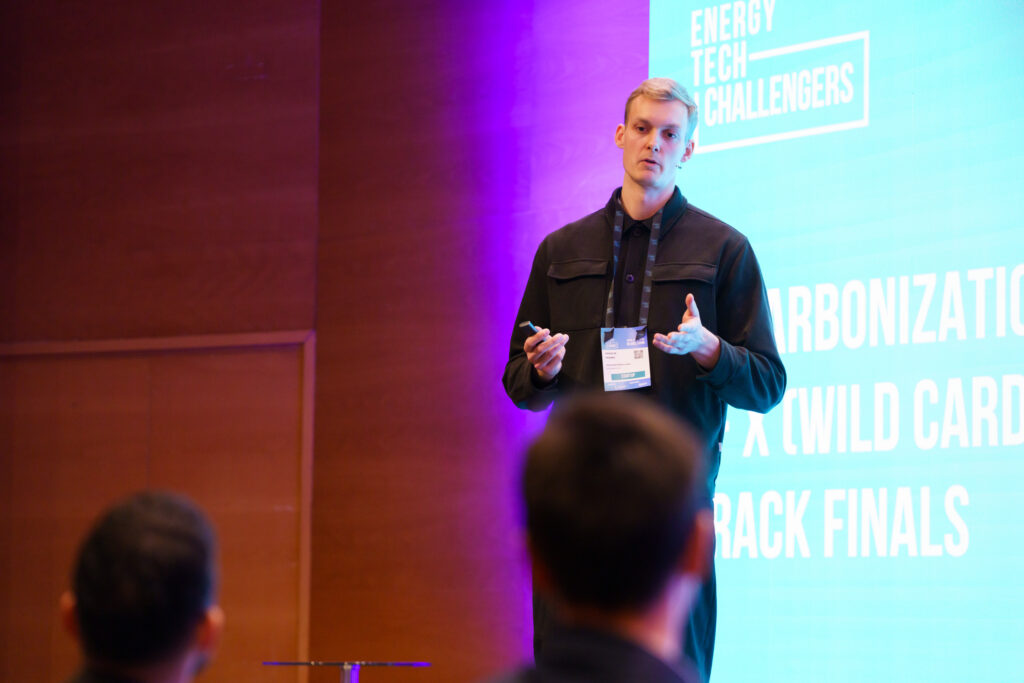
Fridolin Franke, Co-Founder & CGO at SOLAR MATERIALS GmbH
Zero Labs: clean energy for the companies nobody serves
Beltran Berrocal closed the session with the emissions category most decarbonization work ignores.
The overwhelming majority of a company’s emissions are indirect – supply chain or product use – and more than half of global emissions sit hidden there, generated by hundreds of millions of small businesses and largely untouched by decarbonization.
His empathy for those businesses came from having run a manufacturing company. They have no time, no money, and often no roof to put solar panels on. What they want is something simple.
Zero Labs turns renewable energy from a hardware problem into a digital one: a SaaS product that decarbonizes most of a small business’s emissions in minutes, provably.
On that building block sit three tools. A platform for large corporate sustainability departments – his example being a Fortune 500 managing nearly a terawatt-hour across 50 US factories through two PPAs, work that previously took four people four months and now takes two hours. Enhanced energy through fractionalization and green proofs. And a way to embed clean energy into products and services, turning sustainability from a cost into a revenue stream.
Asked where his right to win lies against others in scope 3, his answer was about friction rather than features. As a designer who has worked with these manufacturers, he built for zero friction in adoption – and noted these businesses act when their corporate customers ask them to, which is why go-to-market runs through the large corporates.
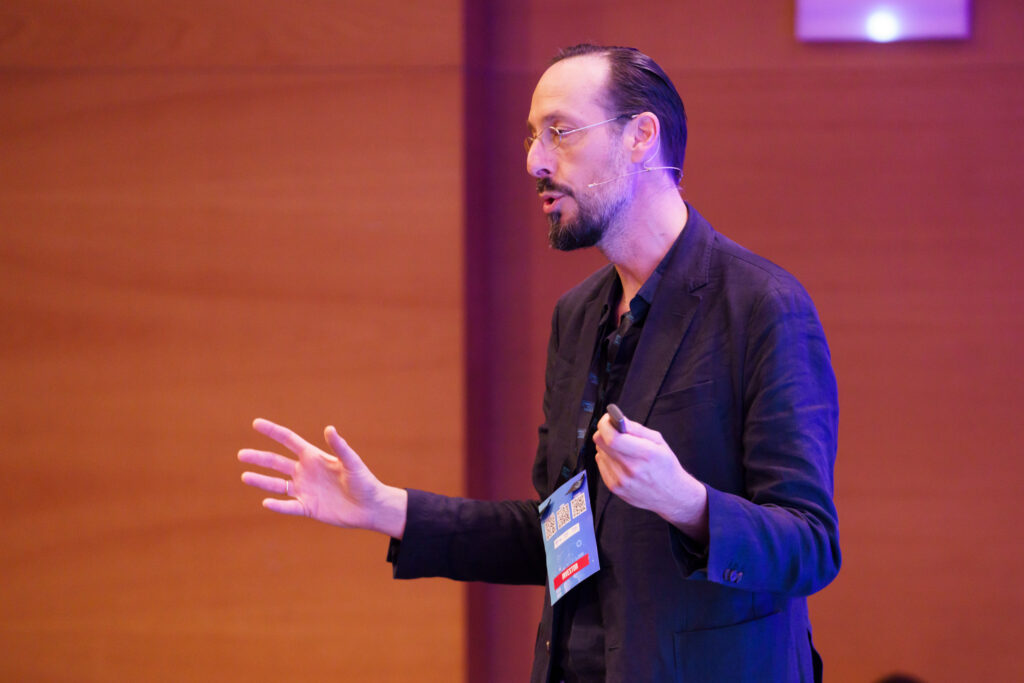
Beltran Berrocal, Co-founder & CEO of Zero Labs
Takeaway
The Wild Card track has no theme, and that turns out to be its value. Put eight unrelated companies on one stage and the common pattern becomes visible: each had found something the industry treats as immovable and refused it. Separators are inert. Gas cools when it expands. Recycling costs money. Building automation requires an engineer. Reporting is a compliance burden. In every case the pitch was not a better version of the existing thing but an argument that the constraint was never real – and the jury, consistently, asked what that reframing does to the unit economics.
Secure your pass
Energy Tech Summit brings together the startups, investors and corporates building the energy transition. Founder’s Pass is €699, fixed.