

Hydrosat’s CEO explained how thermal satellite imagery helps farmers grow more food while using less water and energy.
Water is what makes Earth unique, and it is what made agriculture – and civilization – possible. Yet the world now needs to grow far more food with less water. At Energy Tech Summit, Pieter Fossel, CEO and Co-Founder of Hydrosat, explained how satellite data can boost water productivity on farms around the world.
A planet defined by water
Fossel opened with an early photograph of Earth from space, which he called “humanity’s first selfie.” Images like it helped spark the environmental movement by showing how unique our planet is. What sets it apart, he said, is water, which covers more than 70% of the Earth’s surface.
Around 10,000 years ago, humans learned to manage water through irrigation. That agricultural surplus allowed people to settle in villages, towns and eventually cities.
A growing food and water gap
That positive story is now under pressure. According to studies from organizations such as the UN FAO and the World Bank, the world needs to double food production by 2050 just to keep pace with population growth. Yet agricultural productivity is growing more slowly than that.
India shows the scale of the challenge. It is now the world’s most populous country and a major agricultural producer and exporter. It is also among the most water-stressed countries per person, and it is moving towards water scarcity. Fossel warned that water shortages in such a large country would carry serious humanitarian, economic and geopolitical consequences. Similar pressures are building in Bangladesh and other fast-growing regions.
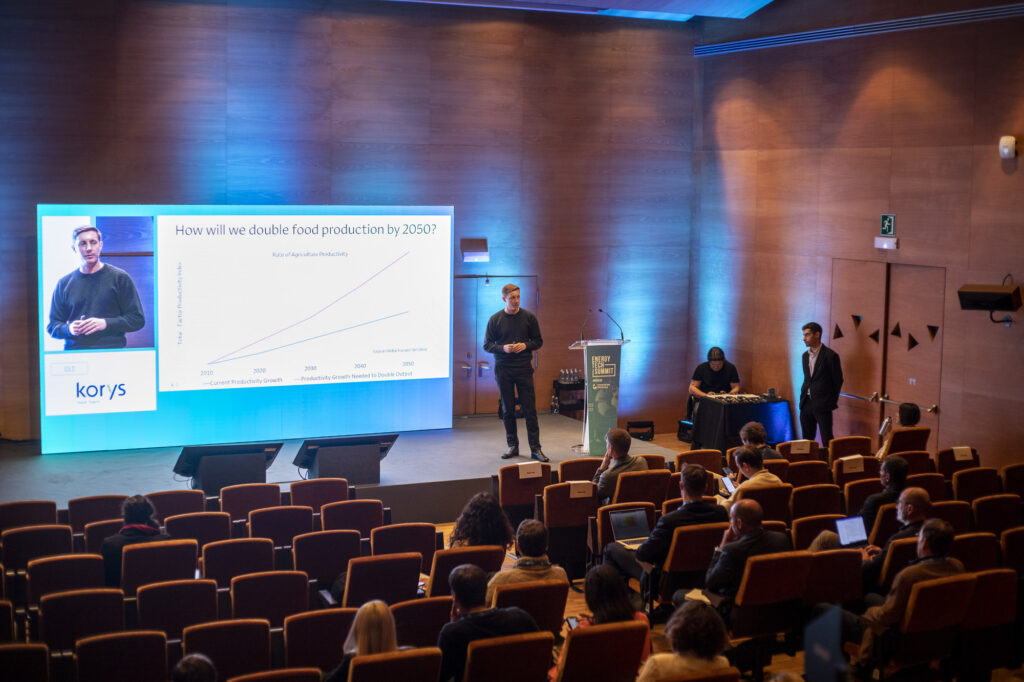
Join Pieter Fossel, CEO and Co-Founder of Hydrosat
More crop per drop: raising water productivity
Hydrosat’s mission is ambitious: a 50% increase in yield per hectare and a 30% reduction in irrigation water use for every field on the planet.
Cutting water use also saves energy. Irrigation water is often pumped from the ground using electricity, so using 30% less water also cuts pumping energy by around 30%, Fossel said. In many regions, those pumps run on diesel generators, which are expensive and polluting.
Satellites that read crop stress
Hydrosat uses thermal infrared satellite sensors to measure the temperature of crop canopies. That reveals how much water stress each crop is under, every day. Because the system relies entirely on remote sensing, “we don’t need people on the ground,” Fossel said, or any in-field equipment.
At the time of the session, Hydrosat’s IrriWatch product was used on around four million acres of farmland in 38 countries. It provides daily water use and soil moisture data, plus an irrigation planner.
Fossel shared two results. According to Hydrosat, partner Jain Irrigation saw a 30% reduction in water use on commercial rice farms in India. Meanwhile, a commercial tomato grower in South Africa achieved a 40% increase in yield per hectare.
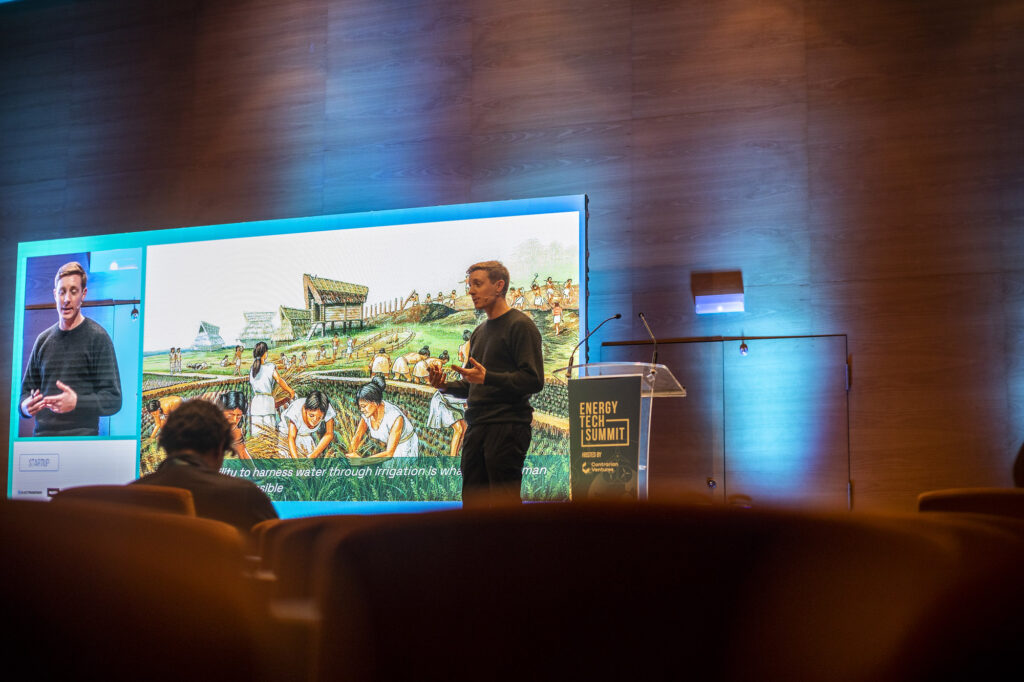
Join Pieter Fossel, CEO and Co-Founder of Hydrosat
From single farms to whole regions
The data works at every scale. A county government in California uses Hydrosat’s data to manage water rights and use, then shares it with every farmer in the county. In Central Asia, partner GeoBox provides the data to the government of Kazakhstan to manage a canal irrigation zone.
Hydrosat’s addressable market is huge. More than a billion hectares of farmland are irrigated or could be within the next decade. Cutting water use by 30% across that area, Fossel said, would have a major impact on sustainable water use, energy use and the carbon footprint of irrigation.
Takeaway
Feeding a growing population will require far more food with far less water. Satellite-based irrigation data offers a scalable way to raise water productivity without installing hardware in every field.
By helping farmers use less water and energy while growing more, technologies like Hydrosat’s link food security, water security and climate action.
Secure your pass
Want to meet the innovators tackling climate challenges from space to the field? Join us at Energy Tech Summit 2027, the 8th edition, on 7–8 April in Bilbao, Spain.
Passes cost €1,399 until 30 November, then €1,599 from 1 December, €1,799 from 1 February 2027 and €1,999 from 1 March 2027.
Founders can join with the Founder’s Pass for €699. Use code ETS100 for €100 off.