

Hyme Energy’s CEO explained how a cheap, abundant salt could store renewable power and deliver round-the-clock steam for industry.
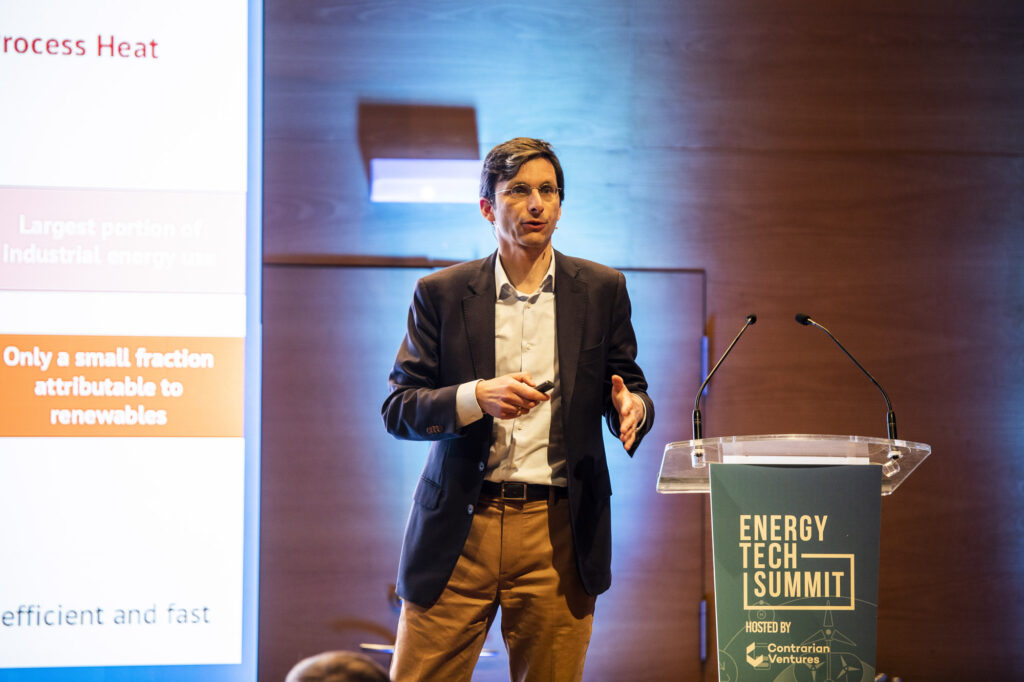
Around half of the world’s energy use goes into heating. Much of the heat used in industry runs at temperatures that heat pumps can’t reach. At Energy Tech Summit, Ask Emil Løvschall-Jensen, CEO and Co-Founder of Hyme Energy, explained how molten salt energy storage could replace fossil fuels for industrial steam.
Why industrial heat needs new solutions
Løvschall-Jensen started with the scale of the challenge. Most of the world’s energy still comes from fossil fuels, according to Løvschall-Jensen, and only part of today’s electricity is renewable. To decarbonize, the world needs much more clean power. It also needs ways to shift that power to when it is needed, and solutions for sectors such as heat.
Heating accounts for around half of all energy use, he said, and a third of it is in process industry. About half of that industrial heat runs above 200°C – beyond the range of heat pumps. That, in his view, is where thermal energy storage will play a vital role.

Dr. Jobst von Hoyningen-Huene, Co-CEO and Co-Founder of econnext AG
A cheap salt with big potential
Hyme develops utility- and industry-scale thermal storage to replace natural gas in industry, as well as coal and biomass boilers in power plants. At its core is a group of salts called hydroxides, including sodium hydroxide, also known as caustic soda.
These salts are produced in huge volumes worldwide from salt water, which makes the storage medium “the one thing that we can scale infinitely.” They are also inexpensive, compact, non-toxic and non-flammable. However, they are highly corrosive, so Hyme’s core technology is the chemistry control system that makes them usable for storage.
How the storage plant works
In a Hyme plant, grid power heats molten salt in a hot tank, which can hold several gigawatt hours. The stored heat then produces steam, either for industrial processes or for combined heat and power.
The system is very compact, so it can sit on industrial sites next to existing gas boilers. It can also charge and discharge independently. For example, it can charge in six to eight hours when renewable power is cheap. It can then discharge for up to 24 hours a day. That matters because many industrial customers run 24/7, often for 11 months a year.
From pilot to first projects
At the time of the session, Hyme was preparing to inaugurate its first industry-scale pilot in Denmark. For Løvschall-Jensen, the supply chain and partners behind the pilot are just as important as the technology. As he put it, “if it was easy then it would have been done several decades ago.”
Hyme’s first operational integration project was planned at a biomass plant on Bornholm, a Danish island in the Baltic Sea. However, the main demand comes from industry.
Dr. Jobst von Hoyningen-Huene, Co-CEO and Co-Founder of econnext AG
Full electrification or a hybrid model
Hyme offers industrial customers full electrification of their steam supply. Alternatively, companies can keep their gas boilers as backup, perhaps burning biogas when renewable power is scarce. For the rest of the year, they run on stored green electricity.
Either way, the aim is to replace fossil steam entirely, whether a site produces milk powder, sunflower oil, cardboard or chemical feedstock. Hyme models future power and gas prices with customers. In the right European markets, Løvschall-Jensen said, the solution can already compete with natural gas.
Retrofitting coal plants with molten salt energy storage
Hyme also sees a major follow-up market in retrofitting coal power plants. Many plants across Europe, including in Poland, will close within the next decade. These sites already have grid connections, heat customers and steam turbines.
Because Hyme’s salts reach the right temperature and pressure, the storage system can feed steam directly into existing turbines. Løvschall-Jensen expects this market to grow from around 2030, as existing plants reach the end of their lives.
Hyme delivers turnkey projects for customers that want to own and operate plants. It also works with infrastructure partners on heat-as-a-service models, which can help de-risk financing and add asset management and energy trading benefits.
Takeaway
High-temperature industrial heat remains one of the hardest parts of the energy transition. Molten salt energy storage offers a way to turn cheap renewable power into round-the-clock steam.
From food factories to retired coal plants, the technology could help replace fossil fuels with green electricity while using existing infrastructure.
Secure your pass
Want to meet the founders decarbonizing industrial heat? Join us at Energy Tech Summit 2027, the 8th edition, on 7–8 April in Bilbao, Spain.
Passes cost €1,399 until 30 November, then €1,599 from 1 December, €1,799 from 1 February 2027 and €1,999 from 1 March 2027.
Founders can join with the Founder’s Pass for €699. Use code ETS100 for €100 off.