

Hive Power’s CEO explained how software can orchestrate thousands of EVs to support grid operators while cutting charging costs.
Power and mobility used to be separate worlds. Now, electric vehicles are bringing them together. At Energy Tech Summit, Gianluca Corbellini, CEO and Co-Founder of Hive Power, showed how aggregated smart charging can turn EV fleets into a resource that helps balance national grids.
Why power and mobility are merging
Corbellini believes the link between power and mobility will become so important that one sector could eventually absorb a large part of the other.
The power sector needs flexibility for three reasons. First, infrastructure: shifting demand and production protects power quality on the grid. Second, markets: flexibility makes it possible to benefit from price differences and makes energy markets more efficient. Third, sustainability, since renewable-heavy grids are often cheaper and easier to balance with flexible demand.
At the same time, the mobility sector is moving fast towards EVs. Drivers and fleet owners want cheap electricity to lower the total cost of ownership.
Gianluca Corbellini, CEO and Co-founder of Hive Power
A flexibility orchestrator for EVs
Hive Power, a Swiss startup, offers software called FLEXO, short for “flexibility orchestrator.” It enables automated smart charging, charging EVs “at the best time at the best price,” while keeping the experience seamless for drivers.
The software sits as an intelligence layer on top of existing IoT platforms. Besides EVs and charging stations, it can also manage solar systems and stationary batteries. Use cases include behind-the-meter optimization, price arbitrage on energy markets and services for national grid operators.
How smart charging supports grid balancing
Grid services involve several stakeholders. Car owners or fleet managers control the vehicles. A balancing service provider (BSP) bids flexibility into the market. On the other side, the transmission system operator (TSO) buys flexibility to keep the national grid stable.
In Switzerland, Hive Power works with the country’s largest car dealer. The company is moving to a long-term rental model that bundles insurance, taxes, maintenance and energy. Because energy is part of the package, it wants to charge cars when power is cheap – and aggregate its large fleet to provide flexibility to the grid.
The process works in several steps. First, Hive Power forecasts how much flexibility will be available in the coming hours, days or weeks. The BSP then bids that flexibility into the TSO’s market. Next, the software builds a merit order, deciding which cars to call first based on factors such as reliability or state of charge.
When the grid needs support, the software sends signals to individual chargers and cars. If grid frequency rises above the standard level, it starts charging to increase demand. If frequency falls, it stops charging.
Value for every stakeholder
Everyone can benefit. Drivers may receive cashback or a lower monthly fee. Fleet managers and car dealers, meanwhile, become more competitive because they can pass on real savings.
Today, the low-hanging fruit in Europe is price arbitrage on energy markets. For small consumers, that often requires working with an energy retailer. At the time of the session, Hive Power was preparing to launch grid balancing services in Switzerland and was testing them in Belgium.
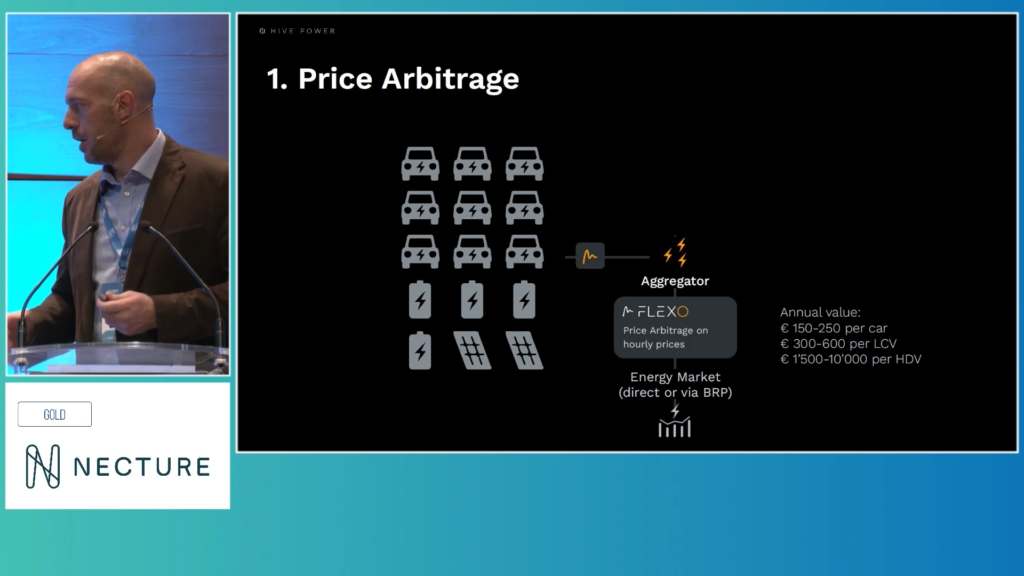
Gianluca Corbellini, CEO and Co-founder of Hive Power
The next step: stacking value across markets
Corbellini expects the bigger opportunity to come from pan-European flexibility platforms such as Equigy and Piclo. These could allow aggregators to stack value across energy markets, transmission operators and, in the future, distribution system operators managing local grids.
That is technically much harder. The baseline is charging against prices, but the system must also be ready to deliver flexibility to the other players whenever they need it. In Corbellini’s view, that is exactly why solutions like Hive Power’s will be needed.
Takeaway
EV fleets are becoming a powerful source of grid flexibility. With smart charging, fleet operators can cut energy costs while helping grid operators keep frequency stable.
As flexibility markets open up across Europe, aggregating EVs could unlock value for drivers, fleets and the grid at the same time.
Secure your pass
Want to meet the companies turning EVs into grid assets? Join us at Energy Tech Summit 2027, the 8th edition, on 7–8 April in Bilbao, Spain.
Passes cost €1,399 until 30 November, then €1,599 from 1 December, €1,799 from 1 February 2027 and €1,999 from 1 March 2027.
Founders can join with the Founder’s Pass for €699. Use code ETS100 for €100 off.