
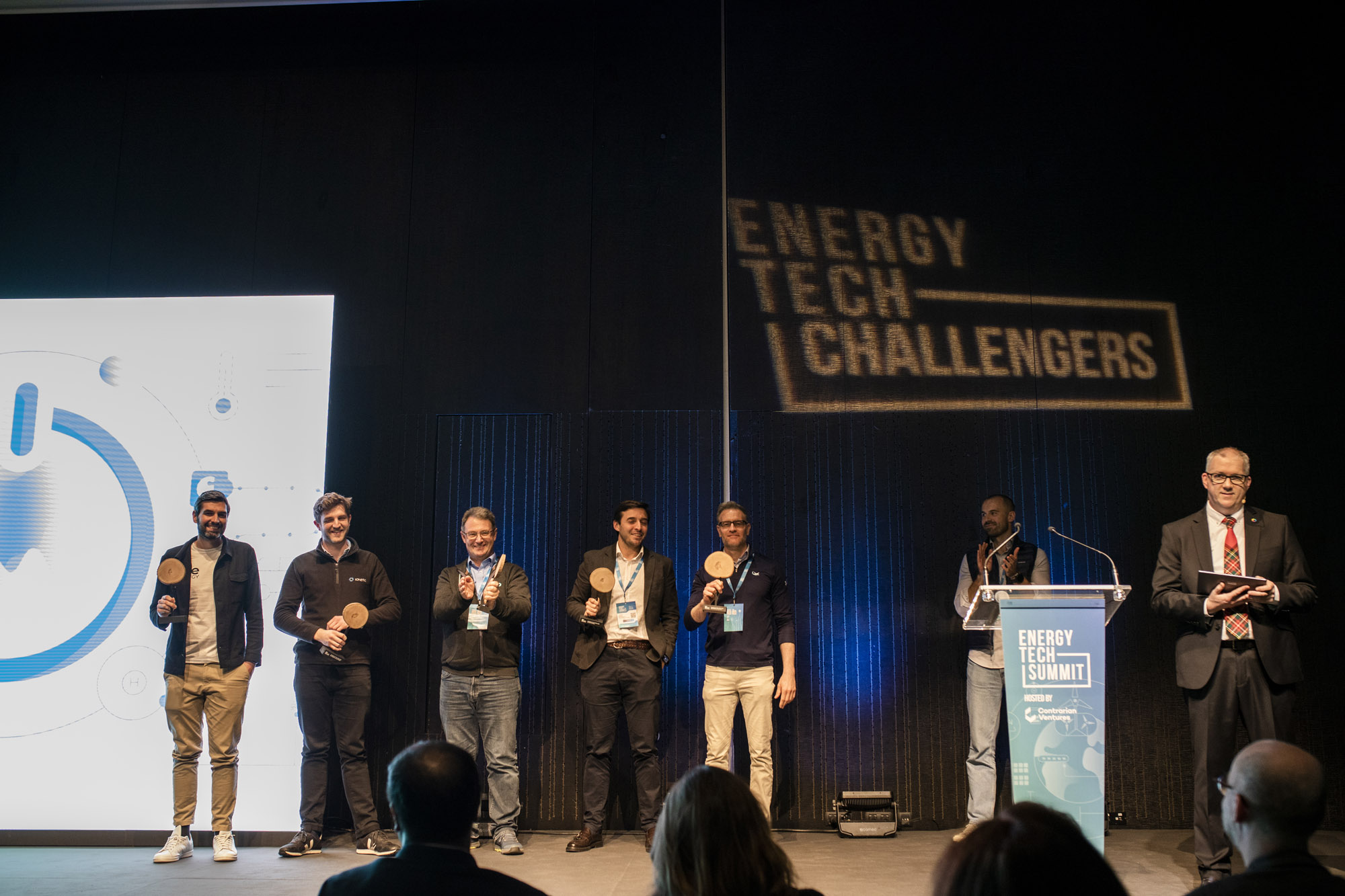
Track winners in charging, batteries, green molecules, climate fintech and transport went head to head for the ultimate title.
Hundreds of applications, five track winners and one ultimate champion. The superfinal of Energy Tech Challengers brought together the strongest energy tech startups of the 2024 edition for one last round of pitches at Energy Tech Summit.
The format stayed the same: three minutes to pitch and two minutes of questions. This time, however, the jury chose the best of the best, judging each startup on its problem, product, go-to-market strategy, traction, team, financing potential and sustainability.
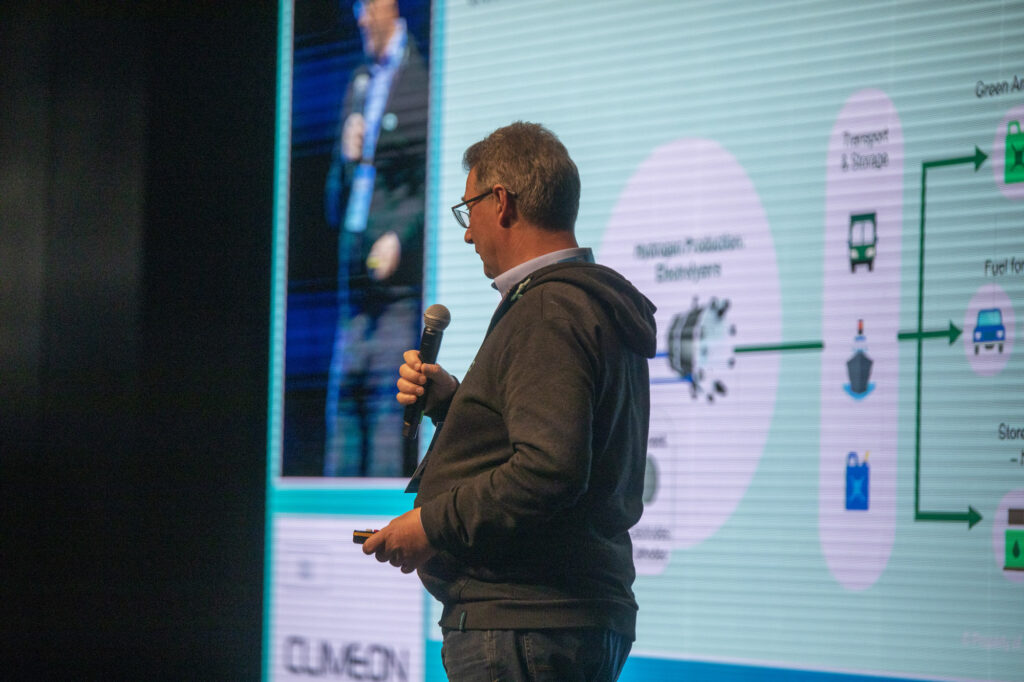
Leon Rizzi from Jolt pitching at Energy Tech Challengers 2024 in Bilbao, Spain.
ME Energy: off-grid fast charging from liquid electricity
Alexander Sohl, Founder of ME Energy, won the Green Energy Infrastructure track. His starting point: everything will soon have a battery, but grids are too slow and expensive to extend. Citing McKinsey, he said the EU could be missing around 20% of the charging points it needs by 2030.
ME Energy offers a complementary solution: mobile, off-grid fast charging stations that need no grid connection. They combine on-site solar or wind with a patented generator that runs on liquids made from organic waste, such as methanol, ethanol and DME. Because the stations are independent of the grid, they also keep working during blackouts.
The company sells charging as a service, so customers pay per kilowatt hour rather than buying infrastructure. At the time of the session, Sohl said customers such as MAN and BASF were saving 24% and 18% on costs respectively.
Production was the main bottleneck. ME Energy had therefore outsourced manufacturing to turnkey partners to scale faster. Asked about feedstock, Sohl explained that the company supplies fuels as a service and aims for local, closed carbon supply chains.
IONETIC: battery packs for niche vehicles
James Eaton, CEO and Co-Founder of IONETIC, won the Batteries & Value Chain track. IONETIC serves niche vehicle makers, such as bus and truck manufacturers, that can’t afford traditional battery pack development.
Its platform combines software and hardware to design, test and manufacture packs. By reusing a validated architecture, IONETIC cuts testing and builds different packs on one flexible line, making development around ten times cheaper.
The jury asked why IONETIC both designs and manufactures. Eaton explained that design alone would mean handing over the IP, losing the repeatable savings. Manufacturing, he added, is “frankly the profit engine,” with long-term contracts that make revenue very sticky. Its first production line will be in the UK, close to its main customers, and the model can be copied to new regions.
Jolt: one electrode a minute
Leon Rizzi, CEO of Jolt, won the Green Molecules track. Jolt makes activated electrodes for electrolysis, from chlorine production and water treatment to hydrogen. In hydrogen, it focuses on alkaline and AEM electrolysis.
His message to investors was blunt. Many backed electrolyzers, but “you should have invested in the electrodes.” In other words: “sell the shovels and picks.”
Today’s electrodes are often made by hand-painting precious metal catalysts and baking them in an oven, sometimes dozens of times. Every electrode comes out slightly different and degrades at its own rate. That, Rizzi argued, makes it hard to warrant electrolyzer stacks and to secure project finance.
Jolt instead sprays the coating under an infrared lamp. In about a minute, an exothermic reaction forms the catalyst and fuses it into the substrate, increasing its surface area without precious metals. That means “one electrode a minute versus one electrode every 12 to 18 hours.” According to Rizzi, Jolt can warrant its electrodes for ten years with minimal degradation, even with renewable power.
At the time, Jolt said it had moved from TRL 3 to TRL 9 in two years without public funding and was running its Barcelona factory largely on solar power.
Renewabl: hourly renewable energy certificates
Gabriel Umaña Gómez, Head of Commercial at Renewabl, won the Climate Fintech track – and joked that he would “probably” miss his flight to London, “but it’s worth it.”
Renewabl offers a marketplace for 24/7 hourly renewable energy certificates. Today, many companies buy cheap certificates that don’t match when or where they consume power. Renewabl measures each buyer’s hourly carbon-free energy score and lets them buy matching certificates by location and technology.
The jury asked how certification works. Umaña explained that Renewabl doesn’t change how registries issue guarantees of origin. Instead, its software allocates each certificate to a buyer’s actual consumption curve, with blockchain-based traceability. That way, buyers can show exactly which wind or solar plant covered each hour.
REGENT: electric seagliders for coastal travel
Adam Triolo, VP of Commercial Business Development at REGENT, won the Decarbonization of X wild card track. REGENT builds all-electric seagliders – wing-in-ground-effect vessels that fly just above the water.
Ground effect lets seagliders carry larger loads further on less power. Crucially, because they never leave ground effect, they can be certified “as a boat instead of as an aircraft.” They float near the dock, rise onto hydrofoils in the harbor and then lift onto their wing in open water.
REGENT is developing two models: the 12-passenger Viceroy and the 100-passenger Monarch. Beyond passengers and cargo, seagliders could serve defense logistics, offshore operations, search and rescue and tourism. At the time of the session, REGENT was building its full-scale prototype and reported an order book of more than 600 seagliders.
Asked about scale, Triolo noted that ground-effect vehicles were first proven decades ago. Combined with distributed electric propulsion and modern batteries, the concept could deliver low ticket prices and strong margins.
Crowning the best energy tech startups
Before the results, a General Partner from Contrarian Ventures praised the field as the strongest yet. Out of more than 400 applications, 50 startups had been selected to pitch live in front of 79 jury members.
After all five track winners were crowned, the jury named the ultimate winner: Jolt, with its fast, precious-metal-free electrodes for electrolysis.
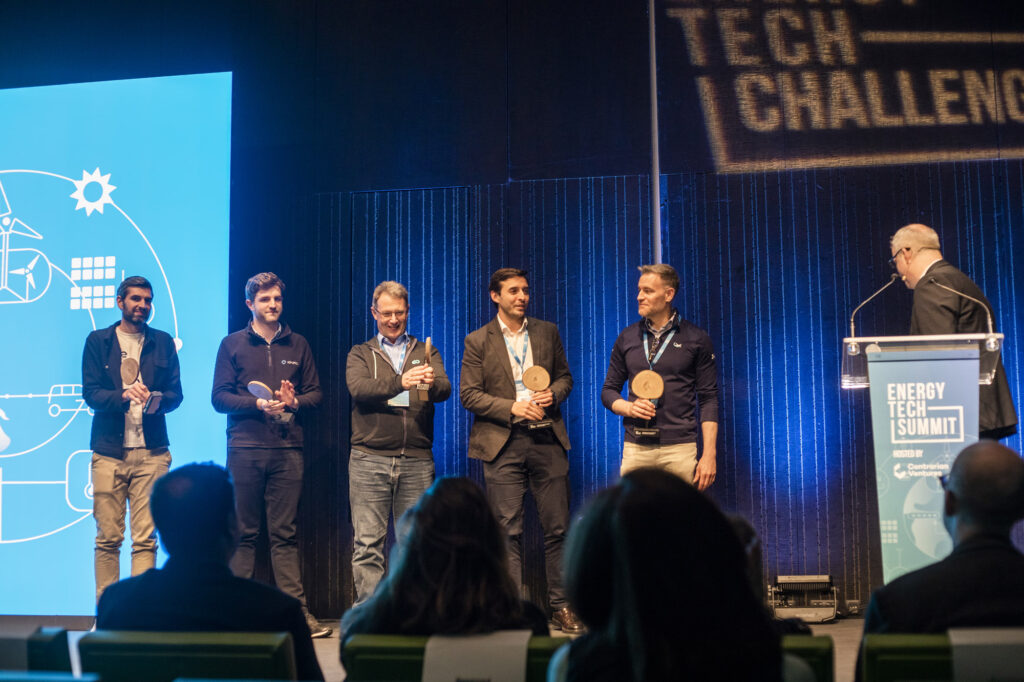
Energy Tech Challengers 2024 winners award ceremony.
Takeaway
The superfinal showed how broad energy innovation has become. From off-grid charging and battery packs to electrodes, energy certificates and electric seagliders, the winners tackle very different bottlenecks.
What they share is a focus on scale and real customers. Each one is solving a problem today’s infrastructure can’t – and building a business model to match.
Secure your pass
Want to see the next generation of energy tech startups pitch live? Join us at Energy Tech Summit Europe 2027, the 8th edition, on 7–8 April in Bilbao, Spain.
Passes cost €1,399 until 30 November, then €1,599 from 1 December, €1,799 from 1 February 2027 and €1,999 from 1 March 2027.
Founders can join with the Founder’s Pass for €699. Use code ETS100 for €100 off.