

Founders in the Climate Fintech track pitched new ways to finance clean energy, track supply chain emissions, price climate risk and prove renewable energy claims.
The energy transition needs trillions in capital, but money alone isn’t enough. Investors need trusted data, companies need to understand their emissions, and buyers need proof that green claims are real. At Energy Tech Summit, startups in the climate fintech track pitched tools to fix those gaps.
Each founder had three minutes to pitch and two minutes to answer questions from an expert jury.
Alter5: a digital marketplace for green energy finance
Salvador Carrillo, Co-Founder of Alter5, opened with a joke: “as I have three minutes don’t clap yet.” Then he got straight to the problem. Plenty of institutional investors want to fund the energy transition, but the market is fragmented across technologies and sponsors, and there are few standardized solutions. According to Carrillo, banks can absorb only up to 60% of the financing needed.
Alter5, founded in 2020, is a platform for investing in green energy assets. It digitizes the process: sponsors upload projects, while AI helps originate deals and suggest the best financial structure. Investors, in turn, get curated deal flow, standardized documentation and tools to monitor financial and ESG ratios.
At the time of the session, Alter5 said it had more than 100 investors on the platform and had deployed over €100 million in utility-scale projects. It operates in Spain and Italy and is expanding into storage, self-consumption financing and e-mobility. The company earns a commission on each closing and on each year of financing.
Asked how it checks project quality, Carrillo explained that Alter5 screens sponsors, track records and permits before listing. However, investors still carry out their own technical, insurance, financial and legal due diligence.
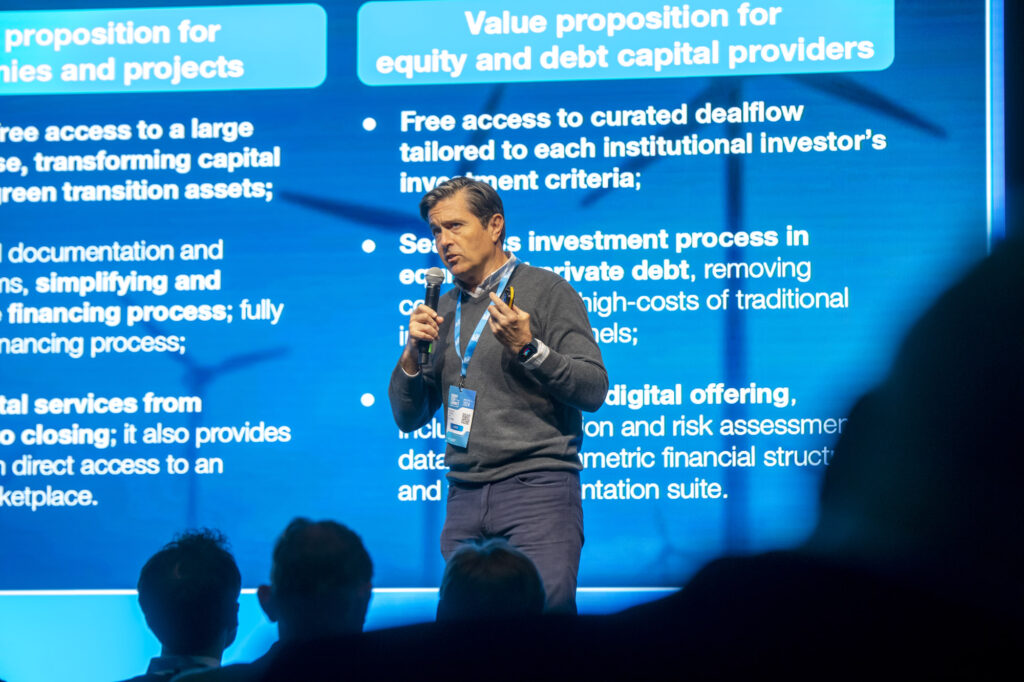
Salvador Carrillo from Alter5 pitching on stage
Bono: connecting industrial decarbonization with finance
Nicolas Bodek, Co-Founder and CEO of Bono, focused on industry and its supply chains. Large companies can’t hit their net-zero goals unless their suppliers measure and cut emissions too.
Bono connects three groups. Industrial companies face pressure to decarbonize but lack knowledge and budget. Sustainable technology providers struggle to close deals. Meanwhile, financial institutions want to decarbonize portfolios but fear greenwashing.
Bono’s platform helps companies survey suppliers, measure emissions and build decarbonization roadmaps. Its marketplace then connects them with solutions, from renewable energy to electrification, and finally with financing. Bono uses the GHG Protocol and works with energy bills, invoices or spend-based factors.
At the time, Bono reported users in seven Latin American countries and had measured more than half a million tons of CO2. Bodek closed with a quote from Larry Fink: “will you lead or will you be led?”
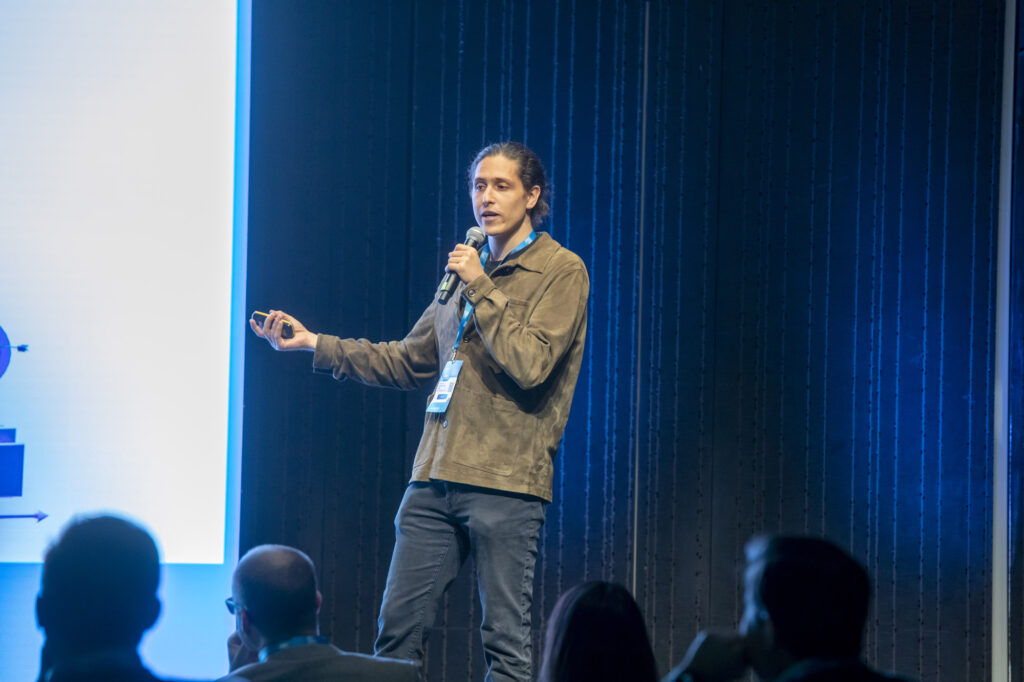
Nicolas Bodek from Bono pitching on stage
EIVEE: supply chain transparency for accurate carbon accounting
Christopher Thorsell, Chief Strategy Officer at EIVEE, argued that “climate change is a supply chain challenge.” Most emissions sit in supply chains, yet very few suppliers can provide emissions data.
The data often exists, Thorsell said, but companies don’t know where to find or how to use it. In his view, supply chain transparency is 90% of the work, while calculating emissions is only the last 10%. Many competitors focus on that last step.
EIVEE connects financial, production and waste data into one platform that cleans, enriches and categorizes it. Experts then validate the output. Once set up, updates are largely automated. Because EIVEE links granular transaction data to precise emission factors, it can calculate emissions down to product and raw material level.
The company sells directly to manufacturers and through partnerships. At the time, it had just announced a partnership with a leading Nordic bank that refers business customers to EIVEE. Its model is a yearly subscription, including implementation.
Quant Foundry: climate fintech for deep risk analytics
Dr Chris Cormack, Managing Director of Quant Foundry, works in regtech for climate risk. Banks and asset managers need to understand both transition risk and physical risk in the companies they finance.
Quant Foundry built a model that integrates those risks, starting with research Cormack published while at Imperial College London. It combines downscaled physical risks, policy changes and technology shifts with a detailed model of each company’s balance sheet. Crucially, it goes further to estimate market impacts, such as probability of default, loss given default and equity growth.
At the time, Quant Foundry said it could analyze around 50,000 companies after a proof of concept using Bloomberg data, and was already revenue-positive and profitable. It plans to sell data-rich analytics, software licenses and consulting services.
Asked how the market is changing, Cormack said climate risk is moving beyond high-level reporting. Clients now want to quantify the economic value of mitigation – for example, whether a project remains viable if extreme weather damages its assets more often.
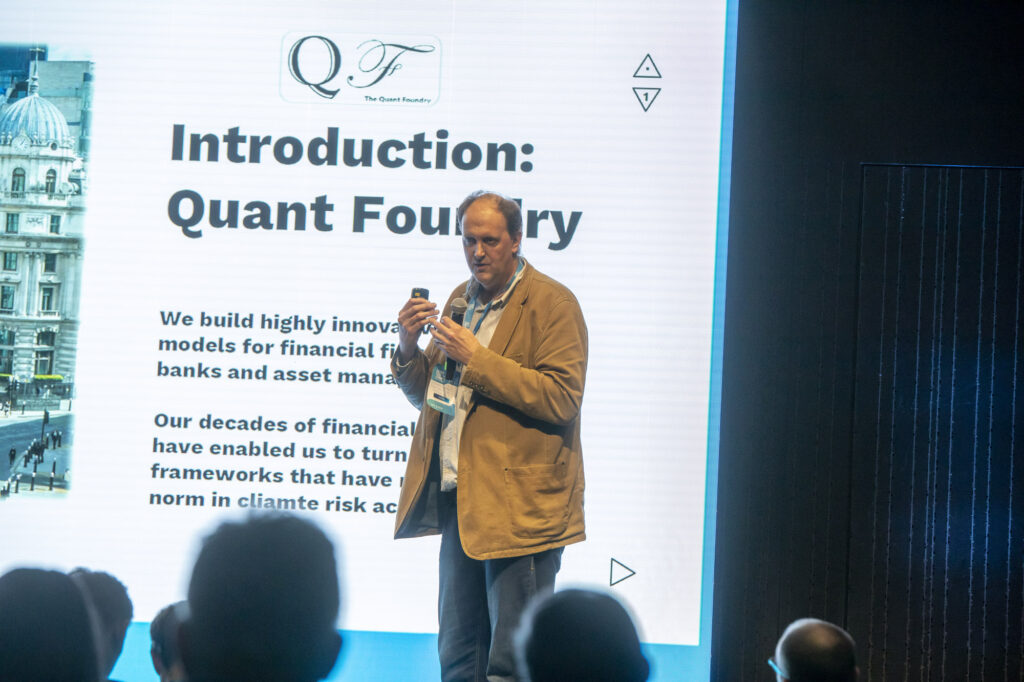
Chris Cormack from Quant Foundry Limited pitching on stage
Renewabl: hourly certificates for real renewable claims
Gabriel Umaña Gómez, Head of Commercial at Renewabl, pointed to a credibility problem. Companies typically claim renewable energy through PPAs, green tariffs or unbundled certificates. Those routes can be complex, opaque and, in some cases, misleading.
Renewabl offers a marketplace for 24/7 hourly certificates. Buyers can choose energy by location and technology, measure their hourly carbon-free energy score and receive reports for CDP and SBTi. Ledger-based traceability shows where the energy comes from.
The model also benefits sellers. Today, certificates are usually priced the same regardless of the hour. With hourly pricing, a wind farm producing at 2 a.m. – or a battery shifting power – can earn more. Umaña cited an Aurora report suggesting that utilities can capture around 30% more value by pricing hourly rather than monthly.
Renewabl aims to replace brokers and traders. At the time, Umaña said Renewabl charged a 7.5% transaction fee, compared with 20–30% for traditional intermediaries.
Takeaway
The climate fintech track showed that financing the transition depends on better data. From project origination and supply chain emissions to climate risk and renewable energy claims, each startup is building trust where markets still lack it.
As reporting rules tighten and investors demand proof, these tools could help move capital faster – and make sure it goes where it truly cuts emissions.
Secure your pass
Want to meet the founders and investors reshaping climate finance? Join us at Energy Tech Summit Europe 2027, the 8th edition, on 7–8 April in Bilbao, Spain.
Passes cost €1,399 until 30 November, then €1,599 from 1 December, €1,799 from 1 February 2027 and €1,999 from 1 March 2027.
Founders can join with the Founder’s Pass for €699. Use code ETS100 for €100 off.