
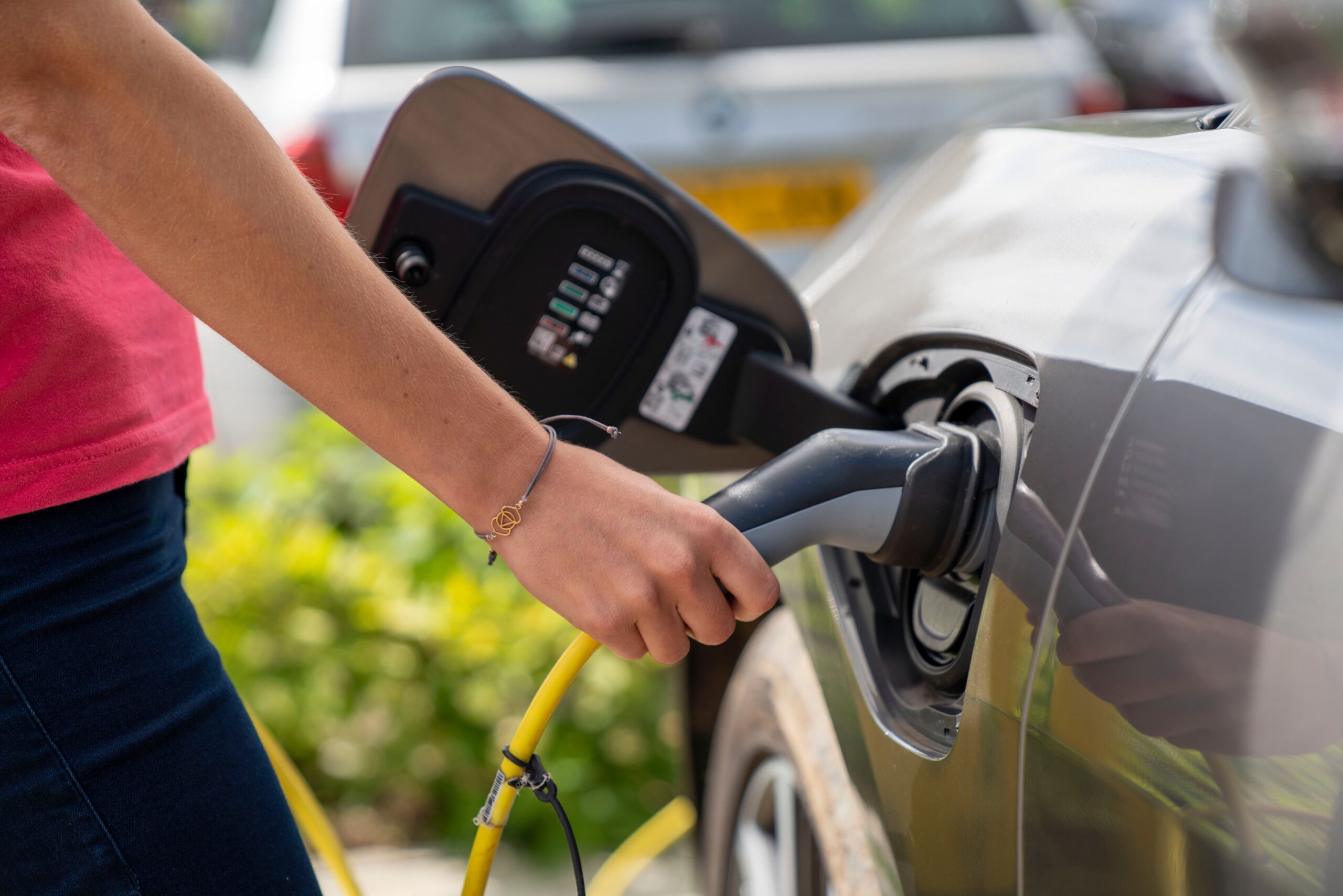
Wallbox’s CFO explained why EV growth is still on track, why the charging industry will consolidate, and how bidirectional charging could turn cars into home batteries.
Electric vehicles are changing more than how we drive. They are also changing how homes use, store and even sell energy. At Energy Tech Summit, a fireside chat explored where EV charging is heading – from market growth and industry consolidation to bidirectional chargers that turn cars into home batteries.
Jan de Dreu, Executive Director of Debt Investments at BBVA Spark, BBVA’s unit for high-growth tech companies, led the conversation. He was joined by Jordi Lainz, CFO of Wallbox, the Barcelona-based EV charging company founded in 2015.
Wallbox has since gone through a financial restructuring, which it completed in 2026.

Jordi Lainz, CFO of Wallbox, sharing insights during a fire-side chat at Energy Tech Summit 2024.
Is EV adoption really slowing down?
De Dreu opened with a debate that has filled headlines. EV sales in the US and Europe fell short of earlier forecasts, raising questions about whether the slowdown is temporary or permanent.
Lainz pushed back. “I wouldn’t say that it’s in slowdown,” he said. At the time of the session, he noted that EV sales in the US and Europe had still grown by more than 30% the previous year. Growth was lower than expected only because the market had come from a period of hypergrowth.
In his view, the market will alternate between boom periods driven by incentives and steadier phases of solid growth. What matters is the direction: the transition is under way, moving from early adopters towards mass adoption. In the Nordics, EVs already dominate new car sales, and China keeps growing fast. Meanwhile, high interest rates and inflation have hit car sales across the board, not just EVs.
What drives wider EV adoption
Asked what will unlock mass adoption, Lainz pointed to three factors: price, range and charging infrastructure.
EVs are still more expensive than combustion cars. However, Chinese carmakers are entering Europe with good technology at lower prices. Putting up trade barriers is complicated, he noted, because European carmakers earn much of their revenue in China. Together with incentives, that competition should bring EV prices down. At the same time, Lainz expects major investment in ultra-fast charging.
What makes an EV charging company last
Many companies now make EV chargers, including carmakers such as Tesla. So what makes a long-term winner? For Lainz, three things stand out.
First, chargers need “to be agnostic with any OEM.” As adoption spreads, households and businesses will own cars from many different brands.
Second, geographic footprint matters. Chargers sold in Spain differ from those sold in France, the UK or the Nordics, because regulations, certification and grid conditions vary. Entering a new country takes far more than opening a sales office, so scale becomes a real barrier to entry.
Third, technology is key. Smart chargers can charge when energy is cheapest, work with utilities and take advantage of peaks in renewable generation that currently go to waste.
Consolidation in EV charging
Lainz expects the industry to consolidate. “We will see a significant consolidation in the space in the coming months and years,” he said. Without global scale, companies can’t win large contracts.
Wallbox’s acquisition of ABL illustrates the point. ABL was the leading charging company in Germany, Europe’s largest EV market, which also has its own technical regulations. When German incentives for EVs and chargers ended, the market dropped sharply and ABL couldn’t survive alone. As a result, Wallbox was able to acquire it and strengthen its position in Europe.
EV charging and the home energy system
De Dreu then turned to grid pressure. Some countries, especially in northern Europe, have faced grid congestion and even power outages. Can EV chargers help?
Lainz sees a race to control the home energy management system, with solar panels, meters, chargers and cars all competing for that role. Adding an EV can roughly double a household’s energy use. However, a smart charger means that doubling your consumption doesn’t have to double your bill.
Features such as solar-optimized charging, integration with local grid software and bidirectional charging all help. In Lainz’s view, EVs entering every home in Europe will be a disruptive shift for energy management, and Wallbox aims to be at the center of it.
The promise of bidirectional charging
Bidirectional chargers don’t just charge the car. They also let its battery send energy back to the home or the grid. Many companies claim to offer them, but Lainz had a simple challenge for skeptics: “try to buy one.”
Wallbox started selling its bidirectional charger, Quasar, in the US, where blackouts – especially in California – drive interest. At the time of the session, Wallbox was running a beta program with more than 100 homes in California and preparing to launch its charger alongside the Kia EV9.
The potential is significant. An EV battery can store around 100kWh, which Lainz said could power a home for several days during a blackout. Owners can also charge when energy is cheap or from their own solar panels, and use that energy at home when prices rise. Where the market allows, they can even sell power back to the grid. Wallbox’s first-generation bidirectional charger did exactly that in the UK with Octopus Energy.

Jan de Dreu, Executive Director of Debt Investments at BBVA Spark moderating an expert chat on EV charging at ETS2024.
Takeaway
EV charging is evolving from a simple plug into a core part of the energy system. Growth may be bumpier than forecast, but the long-term transition continues.
For charging companies, scale, brand-agnostic hardware and smart software will decide who lasts. Meanwhile, bidirectional charging could turn millions of cars into home batteries – helping households save money and grids stay stable.
Secure your pass
Want to meet the companies shaping the future of EV charging and energy? Join us at Energy Tech Summit Europe 2027, the 8th edition, on 7–8 April in Bilbao, Spain.
Passes cost €1,399 until 30 November, then €1,599 from 1 December, €1,799 from 1 February 2027 and €1,999 from 1 March 2027.
Founders can join with the Founder’s Pass for €699. Use code ETS100 for €100 off.