
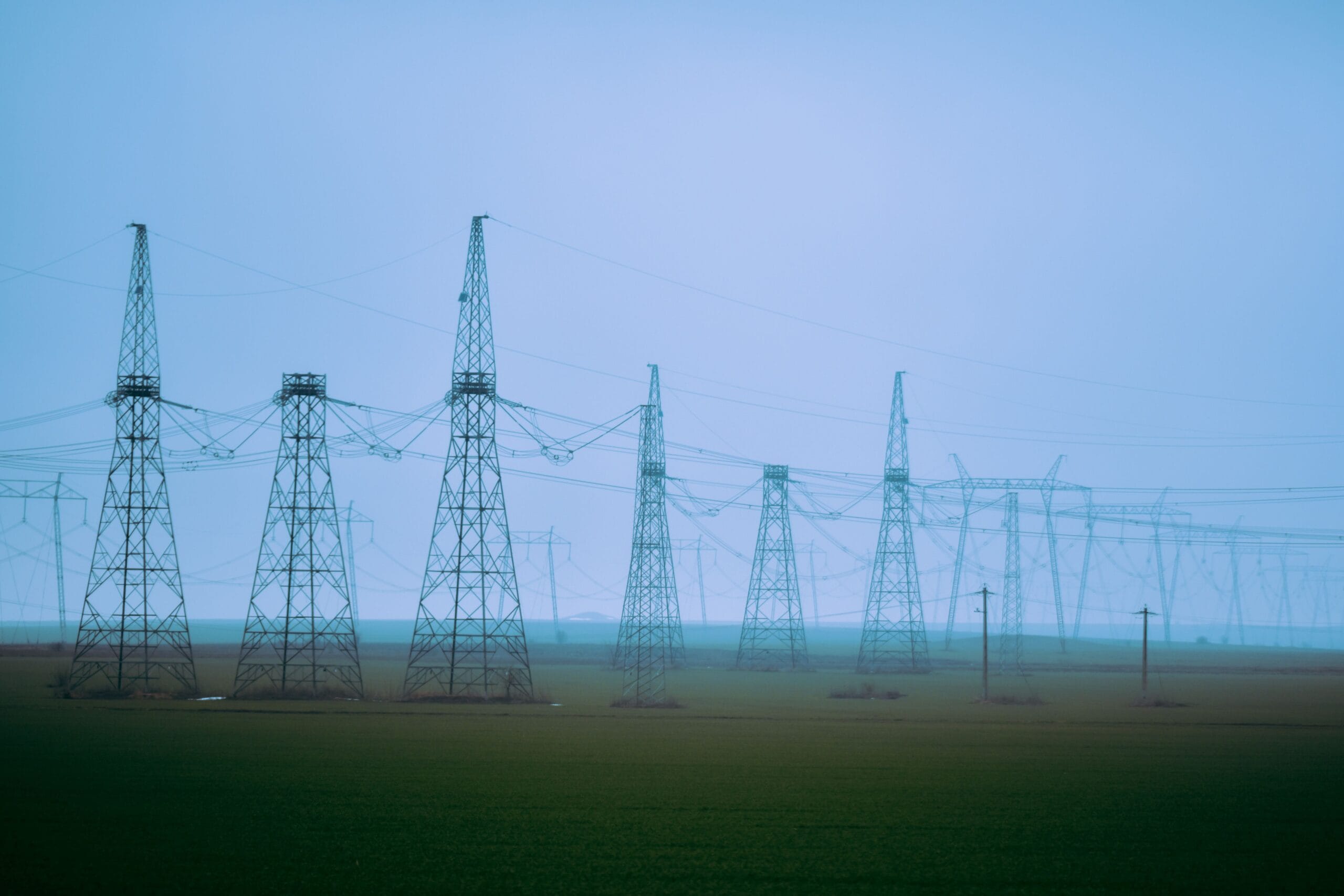
Eight hundred power stations became a million assets. Coal-era control rooms still run them, and consumers still fund a network that sits idle roughly 92% of the year.
Electricity market design decides which technologies actually scale, so Michael Langguth, Co-Founder at Carbon13, opened by setting the context. Europe wants to triple electricity generation, electrify industry, and handle data center demand on top of both. His first question, therefore, was deliberately contrarian: what part of that system will not scale?

Moment from electricity focused panel of Michael Langguth, Co-Founder at Carbon13 sharing insights on demand.
Who was on stage
Matthew Plante is President of Voltus, a virtual power plant platform with around 9 gigawatts of load under management.
Alex Schoch leads electrification and flexibility across the Octopus Energy Group, spanning transport, heating and cooling, and the work of integrating all that demand into power systems and energy markets.
Stephane Lauzon heads the oil, gas and energy group at SAP, working on how the company’s portfolio meets customer needs day to day.
Does decentralization even matter?
Plante disagreed with the premise immediately, which set the tone for the session. Decentralizing electricity generation is not a goal of his, he said. Centralized generation works extraordinarily well, and while it may need supplementing, it does not need replacing.
Schoch took the both-and position and illustrated it with British numbers. Twenty years ago, the UK ran on roughly 800 power stations — few enough, he joked, to manage on a pivot table. Operators only had to plan for weekdays, weekends, and the occasional anxiety about Christmas.
Lauzon agreed that centralized generation currently provides the stability the system needs, simply because nothing else is ready to replace it. Going forward, however, the balance will vary by geography, depending on each region’s readiness to absorb new sources and the flexibility it wants.
Plante later added the proportion that frames the whole debate. Roughly 85% of worldwide renewables are utility-scale and centralized, while about 15% are decentralized. Both are needed, and there is no reason both cannot scale.
Antiquated control rooms and misaligned incentives
Pressed on where the current system fails, Schoch identified two axes: technology and regulation.
On technology, legacy control room systems create the problem. Operators built them for a power system of coal stations, gas peakers and nuclear plants — assets with entirely different response characteristics. Consequently, companies bringing new assets to market find themselves in what he called a dystopian situation: they have to disguise a battery or an aggregated pool of demand flexibility as a gas peaker, simply because the operator’s systems cannot recognize it otherwise.
On regulation, incentives produce the inertia. Unless grid operators, and distribution operators especially, earn returns based on efficient utilization of their asset base rather than on capex investment, the signal will always point one way: build more copper. That, Schoch argued, effectively makes markets redundant.
Plante answered the same question historically, and produced the image of the session. The grid has not fundamentally changed in 200 years. Hand Thomas Edison an iPhone today and he would have no idea what to do with it — yet put him inside a power plant and he would run it exactly as it was originally run.
AI load is now acting as a forcing function. As a result, Plante expects the grid to change more in the next 30 years than it has in the last 200, and to be redefined in a thoroughly positive way. He believes his children will live in a world that runs exclusively on renewables, storage and flexible load.
Why market design cannot be standardized
Asked about the regulator’s role across diverging national pathways, Plante began with a point about incentives for technology companies themselves. This is one of the most regulated industries there is, and companies can make considerable money at the cutting edge of regulation. Therefore technology companies in this sector have to be regulatory companies too.
He was blunt about harmonization. Different countries drive on different sides of the road and speak entirely different languages, so a single standard market design is nonsense. Nevertheless, shared principles and best practices exist, and the work is identifying them and pushing hard for rules that support the grid the industry is trying to build.
Lauzon added a dimension the panel returned to repeatedly: people. Technology evolves quickly, yet what consumers are ready to accept moves at its own pace.
Dynamic pricing is his example. Many people value predictability and choose a fixed rate over a 12 or 24-month term. Moreover, dynamic pricing raises a further question of granularity — whether a consumer would accept a price that differs from their neighbour’s.
Langguth offered the counterweight from the household side. Previously a consumer only consumed. With solar on the roof, a battery and an EV, that household participates in the energy market and can gain from it. In countries like Germany, he sees a substantial push toward exactly that combination.
Value is moving to the demand side
Schoch placed all of this inside a structural shift, starting from physics. The laws of physics do not change at national boundaries, whatever some might prefer, and any energy system has to balance supply and demand.
For as long as integrated power systems have existed, the financial value sat in extracting and refining fuels to generate electricity, while demand was simply a buyer. Now, however, a large share of that value is moving to the demand side.
For the first time, therefore, supply and demand sit in something closer to financial balance. That is precisely what makes market design the decisive question: how do you ensure equal access to these markets during a reallocation of value on that scale?
Choice matters within it. A consumer might lock in an 18-month fixed rate at a slight premium for certainty, or let an aggregator market a home battery to them. Likewise, a business with high energy costs will reach for any tool that reduces them.
The 8% problem
When Langguth asked what technology breakthroughs would help, Schoch said the sector doesn’t need any.
Solid state transformers will be genuinely useful, he acknowledged. Fundamentally, though, this is a market design and policy question rather than a technology one. Without the right price signals, grid operators will keep running the low voltage distribution network the analog way.
He described that network as a black hole. The operator delivering power to your house has no visibility of whether you have power — they find out when you telephone to report an outage.
Fixing it starts with visibility, and again requires no breakthrough. Deploy grid edge technologies for a view of the extreme edge, or add monitoring at substations and feeders. That produces a rich data layer. From there, the remaining work is gathering, standardizing and normalizing the data so companies can build other capabilities on top.
What customers actually respond to
Lauzon reported that his customers respond primarily to market opportunities and incentives, whichever direction those point. In the US, considerable new money is going into LNG and LNG exports, simply because the incentives are there.
At the same time, he pointed to Texas as an underappreciated case. It is one of the largest wind and solar producers in the United States. Since the severe weather event of 2021, the local grid has become considerably more resilient through subsequent severe weather — largely thanks to renewables and battery storage.
Comparing regions, he sees greater willingness in Europe to adopt smart meters, EVs, batteries and heat pumps. That openness shapes how his customers think about delivering energy to their own consumers.
A billion dollars: where would the panel put it?
Langguth asked where each panelist would put a billion dollars. Plante started by explaining what he would not fund.
Decarbonization happens because it is affordable, he argued, and the moment decarbonization moves away from reliability, decarbonization goes away. Renewables are now the most affordable new generation in every market, which is why they are the primary source of new capacity. That march will continue without his billion.
His pick is storage, and specifically behind-the-meter storage. Almost all US storage today is utility scale, because commercial, industrial and residential storage never took off while costs stayed high.
Two things changed simultaneously. Prices rose with AI load growth, and the battery cost curve fell significantly. Consequently, the maths finally works. Batteries are now replacing diesel gensets, both four-hour and longer duration. In markets that have incorporated storage, the resilience and affordability data are, in his words, extraordinarily clear.
Storage wins the vote
Langguth connected that to Germany’s experience of price shock, where households that had recently switched to gas moved to solar and batteries within a few years.
Lauzon cautioned that such transitions are medium to long term. In the short term, he noted, operators restart coal plants — as happened in Germany.
Schoch offered a more dramatic example of the same dynamic. In Pakistan, an explosion of solar and battery adoption across commercial, industrial and residential segments has left the grid operator unable to collect enough revenue to continue operations, because the network sees so little use.
That is exponential growth in the literal sense, he stressed — a doubling at a pace no regulator, and no infrastructure programme, can match. When the whole world does it simultaneously, supply and demand lag follows automatically.
His own billion also goes to storage. Cost declines will continue, and the next generation of battery chemistries looks promising. On top of that, a highly industrialized Chinese supply chain — covering precursors, cathodes and anodes rather than only cell assembly — will compress time to mass market faster than most people can conceive.
Lauzon agreed, with regional variation, that storage is where the money should go today. Industrial sites and homes are where it starts to change what happens on the grid.
The Iberian blackout, and what it revealed
Langguth asked where this can break, referencing the Iberian Peninsula. Schoch was direct: the blackout should not have happened. In a UK control room, he suggested, that situation would have been an ordinary Tuesday morning.
The underlying error was structural. Build large volumes of renewables while relying on fundamentally slow gas and hydro assets to stabilize the system, and you are, in his phrase, bringing a push bike to a Formula 1 race.

Energy Tech Summit expert audience engaging with the panel session.
Flexibility as an everyday resource
Plante declined to compete with Schoch on storage and went all in on flexibility instead — and his point was about how its role has changed.
Grid operators used to reserve flexibility for preventing blackouts. Now people use it daily, whether because the grid is too carbon intensive, prices are too high, or reliability is at risk.
He gave the operational proof: Voltus has flexed its resources in some form every single day since April 2024. That shift from occasional safeguard to everyday resource is not going to reverse, and it is accelerating steeply.
When Langguth asked where flexibility will come from in 10 or 20 years — grid scale, companies or consumers — his answer was consumers, without hesitation.
Can solar plants provide flexibility?
An audience member from Estonia described using utility-scale solar plants in ancillary, capacity and energy markets. This included active participation in frequency regulation, and he suggested this remains untapped across much of Europe.
Schoch reframed it. Solar effectively becomes a variable baseload, so pairing it with storage or other generation is a co-optimization problem.
On the specific opportunity, he was sceptical about scale rather than principle. Ancillary power markets are shallow — by his estimate, the whole European region needs less than five gigawatts of that kind of flexibility. Curtailing a solar plant for frequency regulation pays well and works perfectly well as a mechanism. Even so, the genuine value sits in energy markets and system balancing.
Takeaway
The panel disagreed about decentralization and agreed about almost everything else, which made the areas of consensus more telling. The sector needs no technology breakthrough. The distribution network is largely invisible to the people who operate it, and it sits idle roughly 92% of the year while consumers pay for it. Incentives pay operators to build rather than to use what they have already built. Spain had under 50 megawatts of batteries when its grid failed. Electricity market design, on this account, is not a technical constraint at all — it is a set of incentives that still reward the system Thomas Edison would recognize.
Energy Tech Summit 2027 returns to Bilbao, April 7–8, with more conversations like this one.