

“Go to the local Starbucks and buy a big cup of patience.” A software founder on what changed when he moved to hardware.
Juliana Garaizar, Partner at Energybackers, opened the second day with a fireside chat about making the leap from startup to scale-up. Her guest was Talmon Marco, Co-Founder and Chairman of the Board at H2Pro, whose route into green hydrogen ran through consumer software rather than energy.

Juliana Garaizar, Partner at Energybackers moderating a fireside chat with Talmon Marco from H2Pro.
From consumer apps to electrolyzers
Marco described himself simply as a software guy. Most of his experience came from business-to-consumer internet software, and after several ventures that did well, he and his partners decided they wanted to do something that made the world better.
Notably, the search came before the sector. They actively looked for a project that was interesting, challenging and had a genuine chance of positive climate impact. Hydrogen emerged from that search rather than from any prior expertise.
Why hydrogen specifically? Because it is one of the few tools capable of a double-digit percentage impact on global emissions. Electrification handles a great deal, yet hydrogen reaches parts of the economy that electrification does not.
The market already exists – in the wrong colour
Marco’s central thesis inverts how most people discuss the sector. Many companies say they are waiting for the hydrogen market to arrive. H2Pro argues that the market is already here.
The problem is that it runs on the wrong kind of hydrogen – grey hydrogen, or in China, black hydrogen. Consequently, the challenge is not creating demand but displacing an incumbent product.
The only obstacle, he said, is that green hydrogen is amazingly expensive. That is a large only. If green hydrogen cost a couple of dollars, nobody would be using grey.
The arithmetic of price parity
Marco then walked through the calculation that determines everything downstream, and it starts with feedstock rather than capital cost.
Grid electricity at eight, ten or fifteen cents per kilowatt hour, multiplied by fifty, already lands well above grey hydrogen. So the first question becomes where to find cheap electricity.
His answer is behind the meter, connected directly to ultra-cheap renewables, primarily solar.
However, behind-the-meter power creates a second problem. That electricity is intermittent, and electrolyzers do not handle intermittency well – they prefer a stable supply with small variation. Accordingly, H2Pro built an electrolyzer from the ground up to work with intermittent energy. Because of how it operates, it cycles up and down constantly anyway, even on grid-supplied electricity.
Where the technology stands
Asked about stage, Marco began with a founder’s joke: startups always need capital.
The company has deployed a half-megawatt system – not tiny, not huge – and will build a 5 megawatt system next, in Spain.
That deployment sits inside a 100 megawatt solar project developed with a large solar developer. Within it, H2Pro starts with 5 megawatts of electrolyzer capacity, growing to 25 in a second stage.
Crucially, the solar asset itself is stranded, because it cannot connect to the grid. Marco sees more of this everywhere, in Spain and in the US alike, since the grid has become the bottleneck. Hydrogen therefore releases a resource that would otherwise sit idle.
He also sketched how the physical architecture changes. Today, a natural gas pipe runs to a refinery, where the gas becomes hydrogen. With green hydrogen, solar and electrolysis get coupled on site, feeding a hydrogen pipeline instead. That grid is being deployed slowly in Europe, yet it is happening, and it will eventually serve refineries, ammonia production and industries such as steel.
Why Spain
Garaizar asked whether the location choice reflected investors or resources. Marco’s answer was mostly geographic: if you want to deploy solar, you are probably not doing it in northern Finland.
Spain has abundant solar irradiation, and the environment around solar, renewables and hydrogen is favourable there. Furthermore, the company found good partners locally. It is not the only place in Europe, he said, but it is a very good one.
Software money versus hardware money
The comparison Garaizar kept returning to was between Marco’s two careers, and the differences he described were mostly about time.
At his previous company, they also went five years without raising, because the whole project was shorter and it was funded out of pocket. H2Pro has likewise not raised in five years, and is starting again now.
The timescales, however, are completely different. Deep tech demands far more patience. In software, the question is why a problem cannot be fixed today rather than tomorrow. In hydrogen, the question is whether something can be done in one year instead of two.
Fundraising mechanics differ just as sharply. The investor pool for climate, and for hydrogen specifically, is smaller. Moreover, the capital stack becomes layered: balance sheet funding, debt, project finance and grants, each with its own process.
Marco put the contrast memorably. In a software startup, he would walk into a room and probably leave with a cheque, after which somebody might ask what he planned to do with it. Here, you have to work considerably harder – though harder, he added, also makes it more interesting.
The investors deep tech needs
On his own cap table, Marco named Breakthrough Energy as largest shareholder, alongside other substantial institutional backers.
The characteristic that matters, though, is patience. In many cases these companies need investors who are not pure financial players. In exchange for that patience, the eventual payday should be correspondingly greater.
Messaging in a changed political climate
Garaizar asked whether the shift in US policy – and the move in language from net zero toward energy security and abundance – had changed how H2Pro pitches.
Marco called the adjustments to US incentives, combined with a slowdown in Europe, unfortunate for climate companies generally rather than hydrogen alone.
Even so, the core message has not changed. The company is still decarbonizing, and it always described renewable energy as the fundamental source for hydrogen. What has changed is augmentation: energy security now sits alongside the climate argument.
That argument writes itself in the current environment, he suggested. Shipping disruption and conflict have made energy security an immediate concern rather than an abstract one – though, as he noted, energy security has always been an issue.
His longer view stayed firm. Things are slower, yet things that need to happen will happen. The global economy will decarbonize, and he has no doubt about it. Electric vehicles have slowed, for instance, and yet the transition continues. Manufacturers sticking with internal combustion because it sells today may secure the next quarterly bonus, in his view, while mortgaging the company’s future.
On the US specifically, H2Pro is taking a step back. The hydrogen industry currently depends heavily on subsidies, much as solar did for two decades. Once the technology scales and prices fall, or once conditions change, the company will be better positioned to do meaningful work there.
Four pieces of advice for founders
Asked what he would tell the entrepreneurs who had been pitching all week, Marco offered four things.
First, patience. “Go to the local Starbucks and buy a big cup of patience,” he said, “because you’re going to need it.”
Second, be truthful in fundraising, or as truthful as you can be. You are allowed to say what you do not know. About the things you do know, however, be realistic and avoid overpromising.
Third, raise as much as you can. You can never raise too much money, and he warned specifically against postponing a round over dilution concerns. H2Pro raised far more than it needed in 2021, is still spending that money today, and still holds a considerable amount in the bank.
Fourth, and the one he clearly regrets most, get engineering on board early. This is not a science project or a pure technology project. H2Pro brought on an outstanding engineer who is now its CEO, and Marco wishes that had happened two or three years sooner. It would have saved substantial headaches, money and time.
The delay had consequences. The company is now seven years old, and things would have moved faster otherwise. “They say move fast and break things,” he said. “We definitely broke a lot of things early on.” Technically, though, he is satisfied the company is on the right track – it simply took a while.
What an exit looks like in deep tech
Marco was direct that exits are not the current focus, since H2Pro remains at the entrance to this space rather than the exit.
Nevertheless, he laid out the options plainly. There are three ways out: you sell, you go public, or you go bankrupt. Obviously, nobody wants the third door.
His warning concerned the first. If you build a company for sale and that sale does not materialize, you have a serious problem. Therefore you should build a company to grow and to be independent, with going public as a step in that direction rather than a destination. That, he said, is what H2Pro is trying to build.
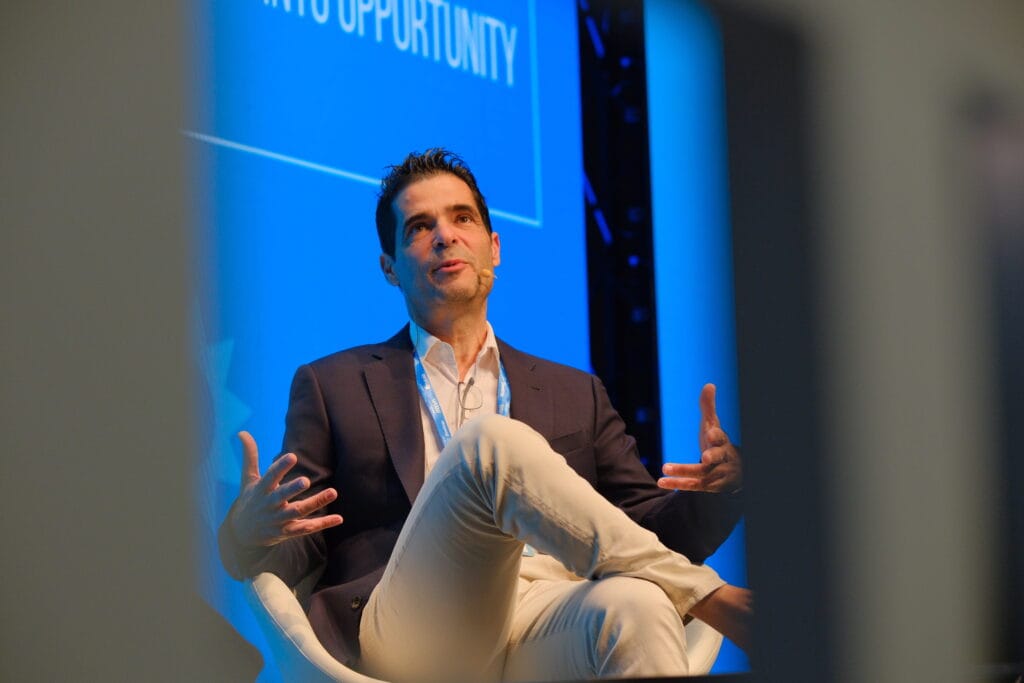
Talmon Marco, Co-Founder and Chairman of the Board at H2Pro, sharing his takes on scaling in the energy tech market at ETS2026.
Takeaway
Two things separate this conversation from a standard founder interview. The first is Marco’s reframing of the green hydrogen market: demand already exists at scale, so the competition is against grey hydrogen’s price rather than against indifference. Everything in the company’s design follows from that single number, which is why the electrolyzer had to tolerate intermittent power in the first place. The second is his candour about what the transition from software cost him. He waited too long to hire engineers, broke a great deal in the process, and now runs a seven-year-old company that he thinks could have moved faster. For anyone in the room making the same jump, that admission was probably worth more than the technology.
Energy Tech Summit 2027 returns to Bilbao, April 7–8, with more conversations like this one.