

A palladium sheet lets only hydrogen through. It has been thinned to a tenth of laboratory scale. And the hydrogen market has stopped believing its own forecasts.
Jørgen Svare, Chief Sales Officer at Hydrogen Mem-Tech, opened the keynote programme with a talk about membrane technology. He gave a candid read on the hydrogen sector’s recent history. His company purifies and extracts hydrogen from different gas mixtures, delivering pure hydrogen to the point of use. It operates out of Trondheim, which he called the tech capital of Norway.
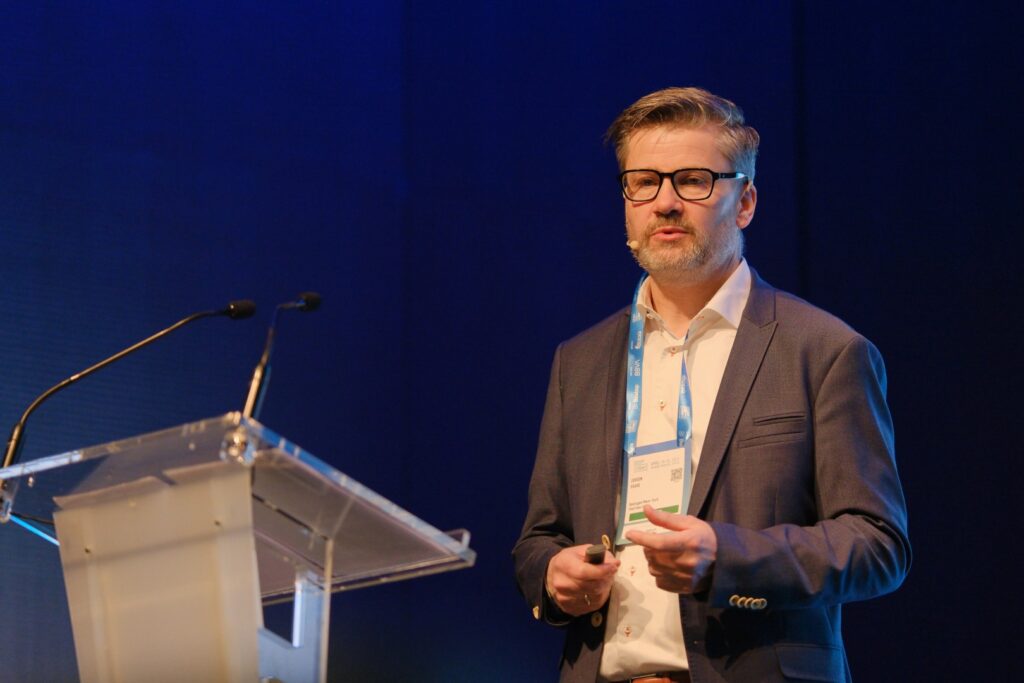
Jørgen Svare, Chief Sales Officer at Hydrogen Mem-Tech during his keynote at Energy Tech Summit 2026
A market past peak hype
Svare’s framing device was the Gartner hype cycle. He was unsentimental about where hydrogen sits on it. The enthusiasm and the flood of potential projects have subsided. The market has reoriented toward bankable projects that need fewer subsidies.
In his reading, the sector passed the peak of inflated expectations some time ago. It now sits near the end of the trough of disillusionment, moving slowly toward the slope of enlightenment. In this phase, teams plan and execute real projects using real technologies.
The successful projects going forward, he argued, will sit in low carbon hydrogen. Increased adoption of alternative fuels such as methanol, ammonia and biogas will drive that shift. That is most visible in maritime, distributed power generation and industry, where demand for alternative fuels is growing quickly.
Why shipowners are building for fuels they don’t yet use
The maritime case was the clearest illustration Svare offered, and it turns on the lifespan of a vessel.
Despite setbacks at the International Maritime Organization, emission-free fuels remain central to the sector’s planning. Shipowners are trying to future-proof new builds. A ship built today will stay in service for decades. To protect that investment against requirements that have not arrived yet, owners are building vessels capable of running on dual fuels such as methanol or ammonia.
Some are going further. They are setting aside space on board to produce electricity from methanol at a later stage. That is where the purification requirement appears. Reformed methanol or cracked ammonia used to generate electricity has to be pure enough not to destroy the fuel cells. That means a purification step sits between the fuel and the power.
The gap the grid cannot close
Svare’s second argument concerned Europe’s electrification and the constraint underneath it. Europe is electrifying at high speed, partly to move away from dependency on Russian gas. But the power grid is not keeping pace with the demand for electrons.
Closing that gap will take decades and a great deal of investment. Local production from sun and wind will help. But the sun does not always shine and the wind does not always blow, which leaves a need for an alternative source to compensate.
His candidate is distributed power generation built on the value and logistics chains that already exist for methanol and ammonia. Generating locally from those fuels, once again, requires a purification step.
The case for biogas over electrolysis
Green hydrogen, in Svare’s account, has a structural problem in the European context. Standard green hydrogen relies on electrolysis of water using electricity. Europe is a substantial net energy importer that is simultaneously shifting its energy base toward electricity.
His alternative is to harvest what is already distributed across the continent: the thousands of biogas plants spread across Europe. Producers can make hydrogen there locally at low cost, with close to zero need for external energy. It is still green hydrogen, he argued, but it is low-cost green hydrogen that does not eat further into Europe’s energy deficit.
He was also realistic about the fuel mix. Methanol, ammonia and biogas all matter. But natural gas has played, and will continue to play, an important role in the hydrogen space. Whatever the route, something has to guarantee the hydrogen meets the quality the application requires.
That is the position Hydrogen Mem-Tech claims. Its palladium membranes are feedstock agnostic, so the solution works across every hydrogen value chain. The company’s stated ambition is to lead the purification system market for high purity hydrogen.
How the membrane works
The technology rests on palladium, a precious metal with a useful property: it reacts only to hydrogen. Technicians deposit the palladium onto a plate that Svare described as looking like a sheet of A4 paper, but mirrored. The palladium lets hydrogen diffuse straight through the membrane while blocking everything else.
He was careful to say the company did not invent this. Laboratories have used palladium this way for decades. The technology came out of a Norwegian research foundation, whose researchers have studied palladium since the early 1990s in some cases. That foundation is a part owner of Hydrogen Mem-Tech, and the two work closely together.
What the company did is make it industrial. Laboratory membranes ran 40 to 50 microns thick. Hydrogen Mem-Tech reduced that to a tenth, producing membranes under 5 microns. That means the membranes need far less energy to push gas through them.
Three things combine into what Svare called an extremely compact and efficient solution for purifying hydrogen at industrial scale: the thickness, the size, and the way the membranes stack on top of each other. The company fixes a bundled stack to a small skid and calls it a separator. It has no moving parts, which makes it silent and free of daily maintenance.
Each separator handles anything from very small volumes up to 10,000 standard cubic meters of gas per hour. Depending on the gas composition, that can translate to as much as 10 tons of hydrogen a day. Patents protect the technology, and the company has demonstrated it in pilot and customer projects.
The factory is already built
Svare’s pitch to investors rested on a distinction he made explicitly. The company has already invested more than €4 million in a production line and process in Norway. That production is modular and scalable, so capacity rises in line with demand.
In his framing, this means investing in Hydrogen Mem-Tech is a bet on the broader hydrogen market rather than on building a factory. “The factory is there.” The product is in the market, and the existing line already covers the capacity expected over the next couple of years.
Selling through partners across many segments also spreads the risk. That leaves the company less exposed to the growth of any single vertical.
What the partnerships have delivered so far
The company pivoted in 2025 toward selling through partners. Svare listed the results across maritime, industry and distributed power generation.
The company recently shipped a separator to a maritime integrator holding a contract in the defense sector. A newly signed industry partner was due to test the separator, then introduce it to its own customer network. That partner already holds a contract for more, and expects to receive the first vessel membranes in 2027.
“So this is actually happening,” Svare said, calling it validation of both the technology and the partner-led route to market. The company was raising €5 million to support existing and new partners and accelerate commercial sales across those segments.

Audience during Jorgen’s keynote at Energy Tech Summit 2026
Takeaway
The keynote made a narrower claim than most hydrogen pitches, and that was the point. Svare did not argue about which fuel wins or how fast the market grows. His argument is that every route to hydrogen ends with the same requirement: gas pure enough not to destroy what it feeds. That holds for methanol, ammonia, biogas, natural gas and electrolysis alike. Feedstock-agnostic membrane technology is a bet on the category rather than on any one pathway within it. That is a considerably safer position in a sector still climbing out of its own disillusionment phase.
Energy Tech Summit 2027 returns to Bilbao on April 7–8, with more conversations like this one.