

Spain alone has 250,000 kilometers of low voltage cable. Half of it sits underground. Almost none of it is observable.
The shift is happening at the edge
Sobotka’s starting observation connected directly to the panels that preceded him. The fundamental shift, he said, is happening at the edge of the network. That is exactly what the morning’s discussion of consumers, battery storage, and flexibility portfolios had circled around.
Halfway to the moon, and underground
The scale of the problem is hard to convey. So Sobotka reached for a comparison the room could hold onto.
Spain’s low voltage network alone runs 250,000 kilometers. That is roughly half the distance to the moon. Add the medium voltage network, and you cover the full distance. Add the two together, and you get the round trip.
The complication is that this network isn’t a straight line. It’s an extraordinarily complicated web of nodes, and about half of the low voltage network sits underground. Batteries, heat pumps, and solar inverters increasingly load each of those nodes, and that load produces peaking events throughout the grid.
The visibility gap sits in exactly this layer. Corinex is seeing a large volume of RFPs across Europe for medium and low voltage, Sobotka said, because that’s where utilities feel the pain points most.
The funding gap nobody can close by spending
The commercial question underneath all of it is where the money should go. Regulators push DSOs to reinforce their grids, and Corinex positions itself as digital reinforcement: the visibility that tells a utility where it actually needs to reinforce.
Sobotka showed the publicly disclosed commitments from the major European players, and he noted that real figures depend on market and regulatory conditions. As an example of the scale involved, he pointed to one operator with $58 billion in commitments.
Then came the number that framed the rest of the talk: even if every one of those commitments materializes in full, a substantial gap remains.
Spending alone can’t close that gap. That’s why Sobotka framed efficiency of deployment as the principal question. Make low and medium voltage observable, his argument runs, and the same capital covers considerably more of the need.
What Corinex actually installs
The company provides sensing data in the grid, the communication layer, and the bandwidth required to move it. Architectures differ by market: Germany has street cabinets, while the UK has none — a gap Sobotka attributed to historic underinvestment.
In Germany, Corinex provides a high-density low voltage network that captures up to 200 sensing parameters. The volume matters, because more data means more to train models on. That, in turn, supports deterministic, regulation-compliant algorithms — enough to automate feeders and run a grid in real time.
What DSOs need to see falls into roughly six categories: current, load, voltage sensing, power flow direction, phase balance, and power quality. Sobotka said power quality is becoming steadily more important as data centers and low-carbon technologies arrive at the edge of the grid.
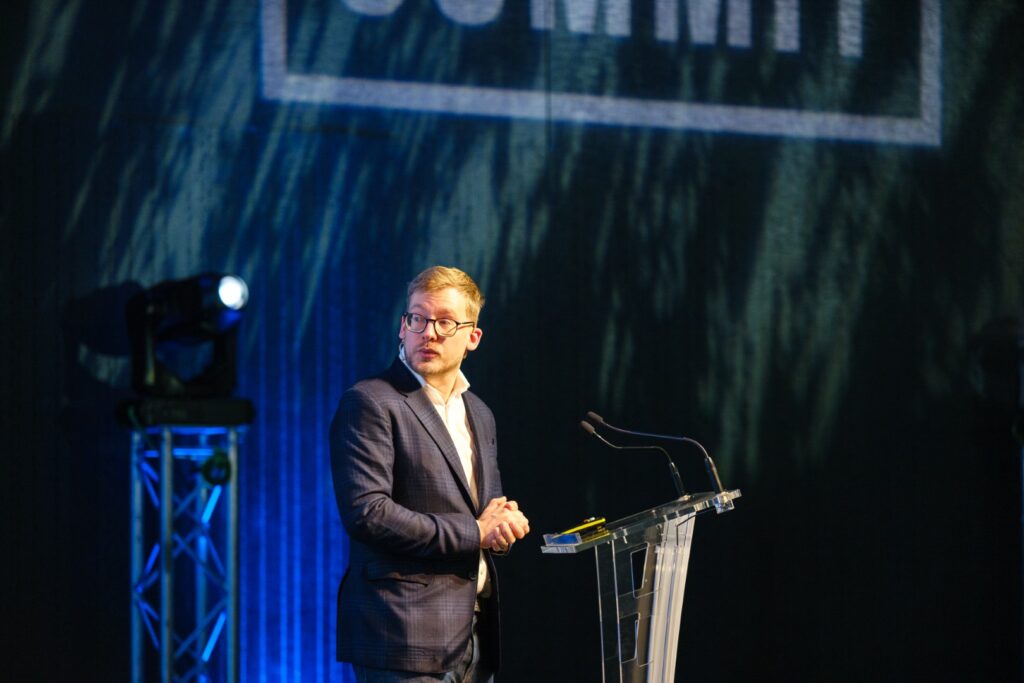
Jan Sobotka, Director of Strategy at Corinex delivering his keynote at Energy Tech Summit 2026
The pitch to investors: three ways to save money
Sobotka reduced the central thesis to three propositions.
First, avoid unnecessary capex. Don’t upgrade the grid everywhere — upgrade it where it needs upgrading. Visibility shows where the grid is genuinely constrained, so additional copper and capacity go where utilities actually require them.
Second, defer infrastructure upgrades. DSOs and DNOs are capex constrained despite appearances, so deferral carries direct value.
Third, reduce structural opex across the whole grid by deploying visibility and flexibility solutions.
Communicating through the cable that’s already there
Sobotka kept returning to one technical constraint: half the low voltage network is buried. As he put it, good luck getting LTE or any radio signal down there.
Corinex transmits its signal over the existing electrical copper already in the ground, reaching the home directly. In markets where regulation permits beyond-the-meter devices, the company can even connect through to the solar panel, the EV, and the battery. That lets it modulate them in real time and give the DSO extra protection at the substation.
Sobotka was candid about how this stacks up against alternatives. Corinex installs a product on the physical infrastructure itself, and that’s what yields the sensing parameters. Narrowband power line communication remains the most widely deployed solution in Europe, and Sobotka expects an incremental upgrade toward broadband as data requirements rise.
The device sits directly in the grid, with processing capability at the edge — close enough to integrate with endpoint protocols. From 200 sensing parameters, including signal-to-noise ratio, voltage, phase, temperature, and harmonics, the system can determine fault detection for DSOs.
The flexibility case: nobody has to change their behavior
The second architecture Sobotka described places Corinex products next to the low voltage technologies themselves: the EV, the heat pump, the battery.
Operators can then modulate those assets without affecting the end customer’s time-of-use schemes. The distribution operator gets a protected substation. The consumer doesn’t have to change anything about their behavior. Sobotka called it a genuine win-win for both sides.
Takeaway
The keynote made an argument about arithmetic rather than about technology. Europe’s network operators have committed enormous sums to grid reinforcement, yet even those sums fall hundreds of billions short of what electrification requires. If the money can’t stretch to reinforcing everything, then knowing precisely which parts of the network are constrained stops being a nice-to-have. Instead, it becomes the thing that decides whether the capital works. In that framing, digital grid intelligence is less a monitoring product than a capital allocation tool. And the layer it illuminates — low voltage, largely underground — is the one utilities have historically been least able to see.
Energy Tech Summit 2027 returns to Bilbao on April 7–8, with more conversations like this one.