

Baseload 2.0: What Actually Gets Built in the Next Five Years
A geothermal developer, a tidal operator, a growth investor, and an electrification giant on what actually gets built in the next five years.
The race for 24/7 clean power has a naming problem, and moderator Gabriel Scheer, Senior Director for Investments and Innovation at Elemental Impact, named it immediately. Organizers billed the panel as “baseload 2.0,” covering geothermal and advanced nuclear, yet nobody on stage represented a nuclear company. Instead, the panel had a geothermal developer, a tidal power operator, a growth-stage investor, and a global electrification supplier. The question they took was simple: how does this expansion actually get built?
Who Was on Stage
Carl Hoiland is co-founder and CEO of Zanskar, a next-generation geothermal company based in Salt Lake City and backed by around $200 million in venture financing. Within what he called a Cambrian explosion of geothermal technologies, Zanskar’s distinction is artificial intelligence. The company was first to show that AI can find, discover, and de-risk geothermal resources at a speed, cost, and scale that wasn’t possible before. Specifically, it’s the architectures Zanskar built in-house that make this possible.
That matters because the industry spent decades assuming decades of drilling had already tapped it out, absent artificially engineered systems. Zanskar’s work over the past few years suggests there’s probably an order of magnitude more resource than earlier estimates suggested. By its own latest figures, that’s enough to meet all the coming load growth demand.
Andrew Scott, CEO of Orbital Marine Power, admitted to gate-crashing a panel whose title didn’t mention him. His UK-based, vertically integrated company operates the world’s most powerful tidal turbine off the north coast of Scotland. His claim on the 24/7 conversation is precision. Tides follow a distinct pattern that the moon’s orbit sets, so the company isn’t linked to the weather. It can predict exactly how much power it will produce at any point, and it can warrant how much it will generate over a period.
The Investor and the Electrification Supplier
Josh Dienstag is Chief Investment Officer of Carbon Direct Capital, a growth-stage equity investor based in New York. The firm invests in technology companies that meet the economic and energy efficiency goals of hyperscalers. One distinguishing feature of how it invests is a separate but affiliated technical consulting firm employing 70 scientists, who partner on technology due diligence.
Analia Troncoso Ceola is Global Head of Strategy, Business Development and Sustainability for the Motion business area at ABB. She joked that ABB invited her precisely because she cannot speak about geothermal or nuclear as a technical person. The company simply serves those markets. ABB leads in electrification, automation, and digital solutions across more than 120 countries. It operates from grid to chip, sitting at the intersection of data centers, energy developers, OEMs, and hyperscalers. What ABB sees, she said, is an energy expansion in which any source you can get hold of counts.

Panelists speaking at Energy Tech Summit 2026
Time to Power, Not Cost
Dienstag opened with a framing that set the tone for the session. Start with the premise: 100 gigawatts more to power AI, and 80% of AI deployments sitting in the United States. His answer, given that, is more of everything. There’s a menu of clean firm offerings, and investors evaluate them on several criteria.
The decisive criterion, in his experience, isn’t cost. It’s time to power. How quickly can you get on baseload at scale? Through that lens, he said, the relative attractiveness of these solutions becomes quite stark.
The weakest option on that measure is next-generation nuclear, and fusion in particular. Fusion companies talk about first commercial plants perhaps in the mid-2030s, which is why Dienstag thought organizers had slightly mislabeled the panel. Fusion, in his view, won’t be a majority of the solution for powering AI this decade.
At the other end of the spectrum sits gas. He expects gas to take the lion’s share of practical US deployments, whether behind the meter or otherwise. Significant sponsorship from the administration and the energy majors backs that. Carbon capture attached to that gas produces what he called a blue electron sent to the grid, and he pointed to Google’s Broadwing project in Illinois as the case in point.
The third option he’s excited about is geothermal. He listed why: administrative support, new granting programs, hyperscalers signing PPAs, power arriving today, and strategic investment from leaders like ORMAT.
Europe’s Different Mix
Scott took the European view, starting with what does the heavy lifting globally: solar and wind. Even so, abundance varies and one size doesn’t fit all, so the renewable journey favors particular technologies in particular places. Talk about 24/7 clean power, he added, and you have to include long-duration energy storage.
The image he used was a tapestry: rich, varied, and full of opportunity for entrepreneurs. Europe’s dynamic differs sharply, though, because the continent focuses on sovereignty and security of supply. Gas doesn’t provide that. It can technically fill gaps, but it carries a security exposure for Europeans that the US doesn’t share.
What Geothermal Can Ramp, and How Fast
Hoiland said the pace at which geothermal hit its key milestones has surprised many people inside the industry. The rapid pace caught the sector slightly off guard, and it probably should have prepared more for the buildout.
He thinks about it across two axes: when geothermal takes a big role, and what role it plays within the grid mix. On timing, the need is immediate. Neither geothermal nor nuclear will meet that demand, so existing solutions have to carry it in the meantime.
A Ready-Made Workforce
In a two-to-five-year window, though, geothermal ramping is realistic. That’s because it has something most novel technologies lack: an almost ready-to-go workforce operating at global scale and considerable efficiency. Take the entire global oil and gas rig fleet capable of drilling geothermal wells, Hoiland argued, and switch it over tomorrow. The industry could then add hundreds of gigawatts of firm geothermal power every year — more delivered electrons than all the solar added globally last year.
Not having to rebuild that workforce from scratch, as nuclear will, is one of the few reasons geothermal can ramp faster than its peers. Beyond five or ten years, he was less certain, given advances in long-duration storage, fission, and fusion. Still, in the five-year window, he thinks people underappreciate and underrepresent geothermal in the conversation.
What ABB Is Building on Both Sides of the Meter
Troncoso Ceola named two things as critical to solving demand from AI-ready data centers. The first is partnership across the value chain, starting before design. That’s because every hyperscaler tailors its solution to whatever energy source is available where it wants to build, so ABB partners with the hyperscalers and the energy developers simultaneously.
The second is efficiency inside the building. ABB offers a DC power solution that consumes considerably less energy, along with AI solutions that significantly reduce consumption in liquid cooling. Together, electrical and mechanical design reduce the total energy equation.
The company also works at grid level with synchronous condensers. For the non-technical, she described them as massive spinning machines, like motors, that introduce stability into the grid. Combining different renewable and gas sources can make a grid unstable, which is how outages happen. Synchronous condensers remove the noise from the various sources and provide the stability the grid needs.
On firm power specifically, she said the last 18 months have brought geothermal and nuclear customers ABB hasn’t had in years. It has partnered with Fervo Energy on a geothermal plant in Utah. Meanwhile, Canada and the US are both bringing back traditional nuclear and uranium enrichment, and regulators have simplified approval frameworks to accelerate new projects.
The Case for Simply Using Less Power
Scheer asked where the low-hanging fruit sits on efficiency and regulation, and Dienstag reframed the question. Bringing on supply through private capital and offtakes is one route. Grid efficiency is another. But the energy system is inflexible and bureaucratic, so the idea of a relatively stagnant system suddenly hyperscaling is, in his view, quite unlikely to go as everyone hopes.
The third avenue his firm talks about most is using less power. That’s a great deal easier than upgrading the energy system. He pointed to the arithmetic behind the forecasts: a single Blackwell chip has a thermal capacity of around 1,400 watts, and Wall Street projections multiply that figure by hundreds of thousands of GPUs.
Carbon Direct is therefore investing in chip innovation that completes the same computations for radically less energy. One investment, a Texas company called Neuropos, uses a new paradigm for GPU design. It promises a fraction of the energy draw. Dropping a more efficient chip into the same server, in the same data center, on the same grid, beats performing gymnastics on grid reform. You’d be betting reform arrives on schedule, Dienstag argued, and that’s a bad bet.
Hoiland backed the efficiency argument with a precedent. Reasoning and agentic layers have offset rising demand, so consumption per query has stayed roughly flat. Even so, it shows how much a hard cap forces the system to find efficiencies. If we treated energy the same way, recognizing how immovable that ceiling is for the next few years, it might have the same effect.
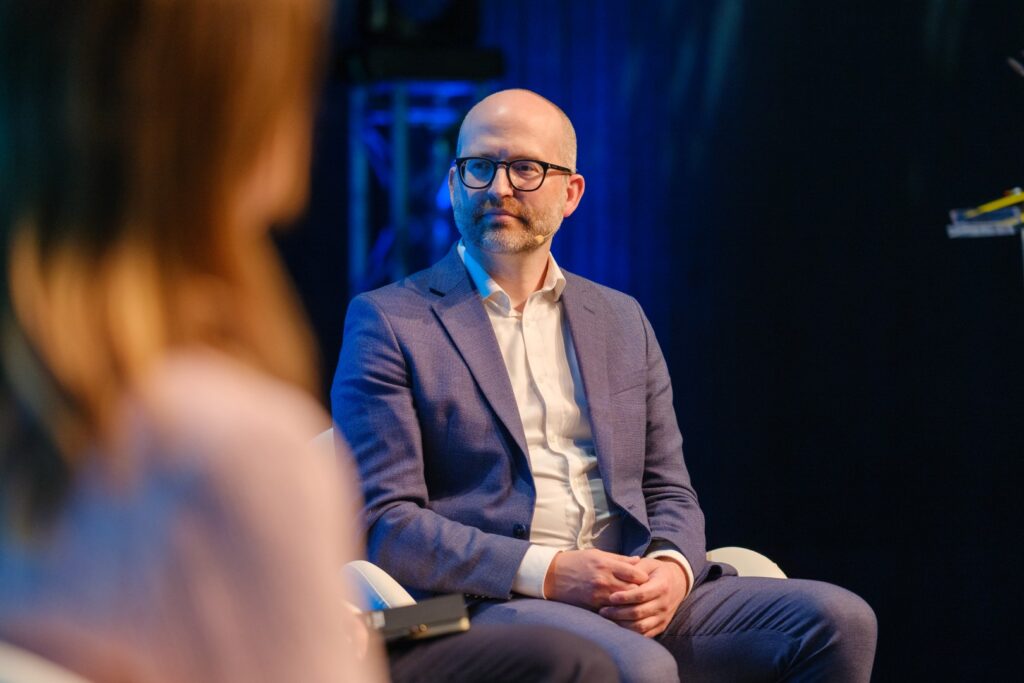
Carl Hoiland, CEO of Zanskar at Energy Tech Summit 2026
Reviving a Plant Instead of Joining the Queue
Hoiland’s own example came from the same logic. Most development pipelines sit in interconnection queues for years, while plenty of resource would happily deliver power tomorrow. So Zanskar looked at underutilized assets already on the grid.
In New Mexico, the company acquired a geothermal power plant that had underperformed for years, and that its owners were about to decommission. Zanskar’s models had pointed to an enormous resource underneath it that nobody had ever drilled into. The existing interconnection and grid tie infrastructure came with the acquisition.
Less than 12 months after acquiring it, the company had brought the plant back to full nameplate capacity. It has since proven enough subsurface resource to build multiple expansions on site, with second and third phases breaking ground soon. Those are electrons delivered to the grid today — electrons that standard processes would not have allowed.
Transmission, Motors, and Retrofits
Scott added a practical constraint that’s both regulatory and efficiency-related. Europe generally, and the UK acutely, suffers from a lack of transmission and interconnectivity. Grid limits already constrain large amounts of renewable power.
The double penalty is what happens next. You waste clean power you’ve already bought, it never reaches the load centers, and gas has to replace it there instead. Planning transmission across countryside is complex, and transmission operators find it difficult to invest at risk. The UK is already living with the consequence: an inefficient grid buildout for the energy system it will need.
Troncoso Ceola brought numbers to the efficiency case. Around 45% of the energy used worldwide runs through motors. ABB’s high-efficiency motors, she said, can save up to 90% of energy consumption in measurable terms.
She also cited an International Energy Agency study finding that Europe’s installed data center base is more than 25% extremely inefficient. Colocators, hyperscalers, and operators are responding with retrofits, and ABB is receiving many requests about which technologies to implement. The question they’re asking is how to make the most of existing infrastructure without building new. Motors, variable speed drives, and a dozen other existing technologies can improve the efficiency of capacity already in place.
Cost of Capital Under Geopolitical Shock
Scheer asked how recent energy shocks are affecting the cost of capital, and Dienstag declined to sugarcoat it. These are risk assets. When events like this happen, risk premia go up and discounted cash flows go down. Forming capital gets harder at the margin, and delays hit deployments as a result.
The countervailing force is that hyperscalers have all revised their capex guidance upward, so those companies still find it easy to price funding rounds. He also cautioned against overemphasizing cyclical commodity shocks against secular themes that some of the world’s largest companies have set in motion. Rising fossil fuel prices, he added, don’t automatically benefit renewables or long-duration storage — that conclusion simply isn’t valid.
Real Assets and a Changing Comparison
Hoiland saw genuine positives inside the complexity. One is a return to real assets in the public markets. As a technology-enabled developer, Zanskar has always sat in a gray area between venture and private equity backing. Interest in real assets is rising, though he wondered aloud whether that’s a geopolitical trend or capital that AI’s effect on software moats has displaced.
The bigger change is demand. Geothermal companies used to compete against the marginal cost of existing assets, meaning they had to build a plant that could displace an operating gas facility. That was hard to beat. Now the comparison is new build against new build, and Hoiland said geothermal pencils out all day long against a new-build gas facility. Hesitation around greenfield development contracts has fallen accordingly.
Hyperscalers are also coming forward with capital early in the development cycle. A customer willing to prepay, or put equity into a project, sends a strong signal and effectively lowers the cost of capital. Meanwhile, the surrounding investor ecosystem is maturing and filling in the missing middle. Project finance for post-NTP construction has appeared in geothermal, and Zanskar reached first close on what Hoiland described as the sector’s first pre-NTP non-recourse development capital facility.
Reading the Geopolitical Picture
Scott thought it was too early to read the geopolitical impact. The UK is a lead market for Orbital because government policy recognizes the need for a 24/7 tapestry, and the company is building commercial projects against targeted support. He noted the obvious downside too: renewables are capital-intensive and capex-heavy upfront, so rising interest and lending rates feed directly into the cost of renewable energy.
Troncoso Ceola made the supply-side point. Data center demand is unprecedented regardless of energy shocks — a once-in-a-generation situation, as she put it — and it keeps moving. Energy companies now have plans B, C, and D for diversifying away from conflict areas, naming Venezuela, Argentina, Australia, and the US west coast. For ABB itself, it’s too early to say. The company runs a local-for-local strategy built on decentralized regional supply chains, which also limited the damage during the tariff disruption.
The Most Provocative but Plausible Thing Coming
Scheer closed by asking each panelist for the most provocative but plausible development that could reshape how this gets done, warning the audience that he hadn’t prepped them on the question.
Dienstag went first, and went bleakest. Companies might not be able to build as many data centers, he said, and might have to build smaller ones instead. There’s already a residential backlash, and consumer electricity price inflation will sharpen it. AI adoption, he suggested, might simply fall short.
Scott picked the gas price. If prices stay high through a European winter, that should correlate directly with action to speed up replacing gas reliance. It won’t happen overnight, but the higher and longer prices stay, the more both policy and investment move toward alternatives.
The Optimist’s Case
Hoiland offered the most optimistic reading, and the most interesting one. Spend long enough in this industry, he said, and your hopes of radical change fade, because it’s slow and high-inertia. Yet he doesn’t think the energy industry has faced this much planned capex in decades. The nearest comparable is shale gas in the United States, where lawmakers rewrote regulations remarkably fast, and on a bipartisan basis, once the support was there.
So he wonders whether the industry is being too conservative with itself. There may be far more political and social will to overhaul regulation and process than anyone currently allows themselves to believe — particularly around interconnection and transmission, and around instrumenting the system to find the gaps and coordinate across larger regions.
Troncoso Ceola agreed on the regulatory point and added ABB’s own direction. The company works continually with startups on new electrical and cooling technologies to reduce both energy consumption and data center footprint. She envisages significantly smaller data centers in the future. On data centers in space, she was careful: ABB isn’t helping with that yet, but it has supplied instrumentation and controls to aerospace, and to agencies building infrastructure in orbit, for years. If ABB can help build a space station, she reasoned, it can build a data center.
Analia Troncoso Ceola, Global Head of Strategy, Business Development and Sustainability, Motion Business Area of ABB at Energy Tech Summit 2026
Takeaway
Scheer’s closing observation was the sharpest reading of the session. Only one of the four answers was about technology. The other three were about people: the social license data centers need to operate, the engagement with communities, and the political work needed to change regulation. The technologies for 24/7 clean power mostly exist already, or come close, and the panel disagreed only on sequencing. What none of them could route around was the human side — who accepts a data center nearby, who approves an interconnection, and who pays the electricity bill while construction is still underway.
Energy Tech Summit 2027 returns to Bilbao on April 7–8, with more conversations like this one.