
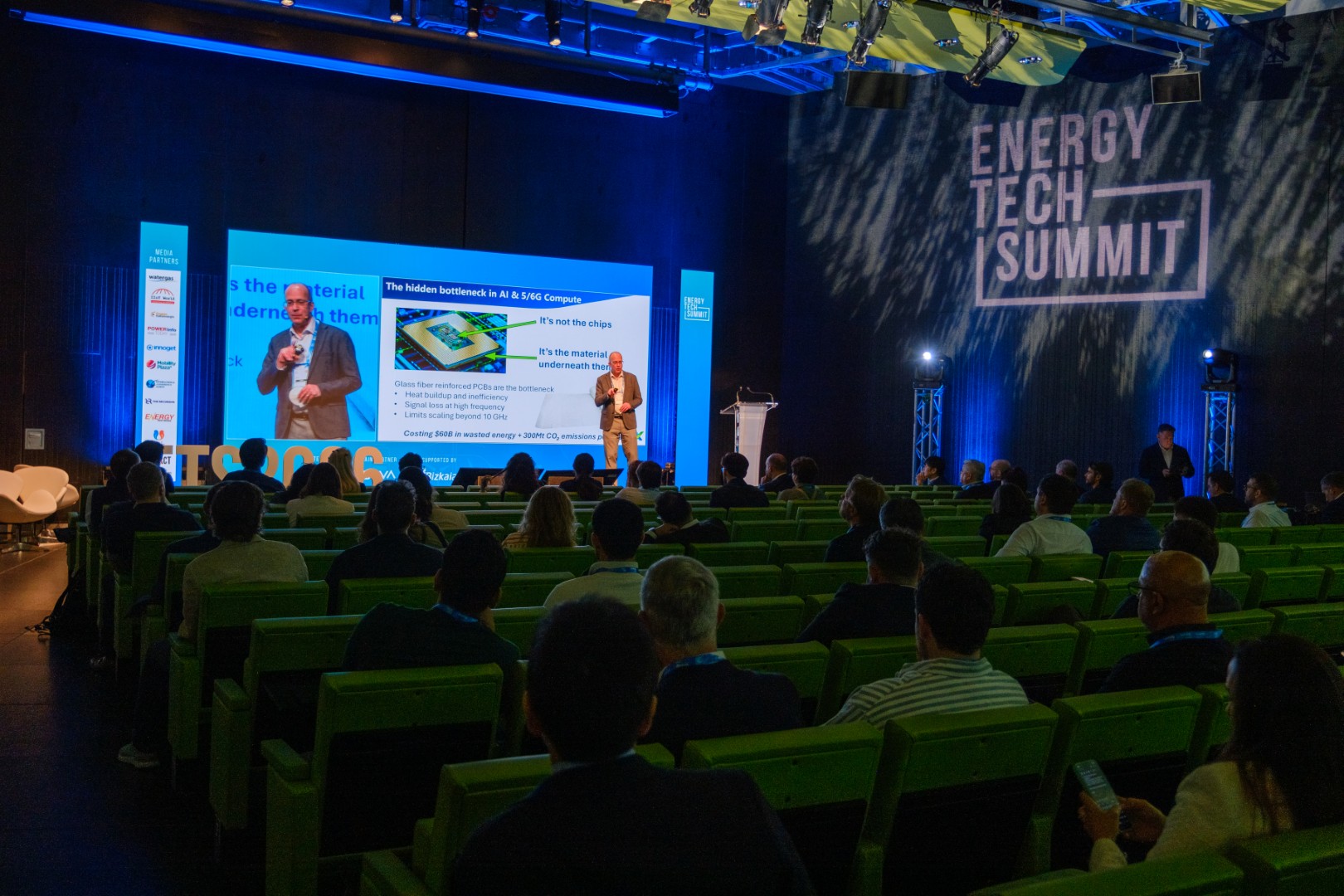
Mine shafts taller than the Empire State Building, molten salt reactors, and power from scrap aluminum — what founders pitched at the green energy infrastructure track of Energy Tech Challengers.
Founders had three minutes on stage and two minutes of jury questions at Energy Tech Challengers, the startup pitch battle at Energy Tech Summit. At the green energy infrastructure track, pitches ranged from viral consumer apps to hundred-megawatt nuclear reactors. All of them, however, chased the same goal: reliable, scalable clean energy systems.
Here’s what happened on stage.
clever-PV: Home Energy Management That Went Viral
clever-PV never planned to be a company, co-founder and CCO Willi Appler told the audience. Instead, the four founders built a free app to manage solar surplus charging for friends and family. It went viral, hitting 6,000 users in 18 months. As a result, the side project became a startup.
Today, the German firm counts more than 85,000 registered users and over 120,000 connected assets, including EVs, batteries, solar systems, and heat pumps. No extra hardware is needed, since users simply link their devices through their manufacturer’s portal.
The business is bootstrapped, and it runs at around €1.3 million ARR with 20 employees. It now grows mainly through white-label apps. More than 30 have been built for utilities and installers, and their combined reach exceeds four million end customers.
When the jury asked what subscribers actually get, Appler pointed to the data. Automated optimization delivers €300 in average annual savings, and some users save up to €1,000.
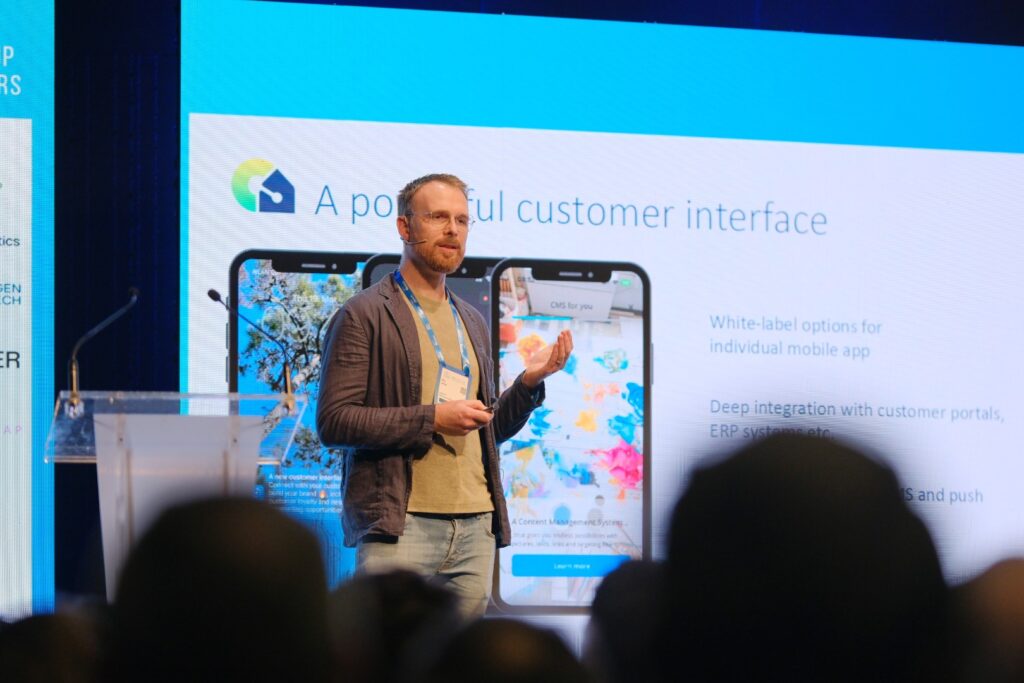
Willi Appler, Chief Commercial Officer and Co-Founder of clever-PV
Green Gravity: Energy Storage in Abandoned Mine Shafts
“What is the cost of solar at midnight tonight?” That was the question Green Gravity founder and CEO Mark Swinnerton put to the room. It was his shorthand for the volatility problem renewables can’t solve without storage.
His company’s answer sits underground. Green Gravity lifts giant masses up disused mine shafts using excess renewable power. It then lowers them to generate electricity when the grid needs it. According to Swinnerton, round-trip efficiency runs above 80%, with 10 megawatts per shaft and durations of up to 24 hours.
The first system is under construction in a leased shaft in New South Wales, Australia. As Swinnerton put it, the shaft is “bigger than the Empire State Building, but underground.”
The opportunity, he argued, cuts both ways. Nearly 100,000 mine shafts exist worldwide, and their owners want out. One leased site alone, for example, carries a $200 million closure liability that reuse can shrink. Green Gravity’s pipeline now stands at around 15 GWh, and the company has a funding round open.
OakTree Power: Earning Revenue From Assets You Already Own
OakTree Power CEO Chantel Scheepers opened with a show of hands: who owns an EV, a heat pump, or office cooling? And who earns money from them? “That gap between what you own and what you earn,” she said, “is exactly why we exist.”
The company turns those demand assets into digital grid infrastructure, at zero cost and with zero wires, then pays clients at least €50,000 a year for the privilege. The urgency, per Scheepers, is structural: by 2030, half of Europe’s distribution network reaches end of life. Digital flexibility, in other words, beats new cables on both speed and cost.
OakTree is already profitable in the UK, France, and Belgium, she told the jury, with net recurring revenue of €1.4 million in 2025.
EU harmonization rules, she added, changed the game, since one platform can now serve 27 markets. Her team has scaled flexibility before: they built Europe’s first virtual power plant, expanded it to 18 countries, and eventually sold it. OakTree is now raising €4 million to repeat the trick across Europe.

Chantel Scheepers, CEO of OakTree Power
Pionix: The Operating System for EV Charging
Even the best charging station vendors run at a 10% failure rate, Pionix CEO Dr. Marco Möller told the jury. That’s “far off acceptable,” he said, and it’s about to get worse as billions of EVs meet incompatible chargers, apps, and backends.
Pionix builds a common software layer that runs on the charging stations themselves. In Möller’s words, it’s “a software monopoly like Android for wall boxes, or Linux for web servers.” He described it as one of the largest open-source projects in clean tech. More than 80 organizations and over 700 professionals contribute to it, and the platform reached over 100,000 charging stations last year alone — roughly 10x growth per year.
The company monetizes premium services around that free core, including hardware modules, integration support, and digital twins for testing chargers. Möller and his co-founders, serial entrepreneurs from Germany’s drone industry, have raised almost €15 million. His closing math for the jury was simple: if a third of the ecosystem runs on Pionix, “that’s fine for us.”
Redoxblox: Industrial Heat Cheaper Than Natural Gas
Scott McNally, VP of Business Development at Redoxblox (rebranded to Tempo), brought a prop: a small brick he invited the jury to come touch after the session. It was a thermochemical energy storage cell. It’s denser than lithium-ion, he said, but about 20 times cheaper to produce, with no rare earths.
The company is aiming past data centers at a far bigger prize: industrial heat. Steel, cement, food, and refining together consume 24% of all energy used globally, McNally said, which is about 30 times the size of the data center market.
The cells charge on the day’s cheapest electricity, then deliver constant 1,200°C heat at 95% round-trip efficiency. In Europe, that already undercuts natural gas by around 50%, McNally claimed. “We don’t care what the average is,” he said. “We care what the lowest four-hour period in the day is.”
The company has raised $41 million and employs 55 people across San Diego and Madrid. It’s now seeking $25 million more, with cash flow break-even targeted for 2028.
Thorizon: Modular Nuclear Without Long-Lived Waste
Thorizon CEO Kiki Lauwers opened with the text message that started it all: “Hey Kiki, there’s a CEO vacancy for a startup nuclear reactor. Isn’t this something for you?” Her first reaction was “no, nuclear, dangerous, waste,” so she didn’t reply. Then she looked closer, and found the largest source of carbon-free energy in Europe.
The company she now leads is building a modular molten salt reactor delivering 100 megawatts of electricity, built around a cartridge-based core. That design, Lauwers said, tackles corrosion, simplifies operations, and produces no long-lived waste.
First deployments are planned on existing nuclear sites in the Netherlands, France, and Belgium, with utility EPZ as launching customer. Manufacturing, meanwhile, happens offsite: the core is produced by VDL, a major supplier to ASML. Lauwers said Thorizon is on track for delivery by 2032, and the company is raising €40 million. She closed with an invitation: “Even if you’re a little bit scared of nuclear, come talk to us. Perhaps we can change your mind.”
AlumaPower: Firm Power From Scrap Aluminum
Rob Alexander, CEO and co-founder of AlumaPower, closed the track holding his fuel: a disc of scrap aluminum. His target, he told the room, is a 100-gigawatt gap in firm power that variable renewables can’t fill.
The company’s generator corrodes the discs to release electrons, producing zero emissions at source with more power density than a diesel generator. That, Alexander argued, is the point: emissions rules limit diesel backup to roughly 1% runtime, making it “dead weight capital.” AlumaPower, by contrast, can run whenever needed.
He walked the jury through a California data center case. With dispatchable AlumaPower backup, the required solar build fell 42%, battery storage fell 64%, and total build cost fell 37%. Fuel supply won’t be the constraint either, he added, since today’s global scrap surplus could firm 85 gigawatts of data centers.
The first paid pilot ran in Toronto in 2024, and military customers are already on board. The company is now raising a $10 million convertible debt facility while hunting for one last demo partner.
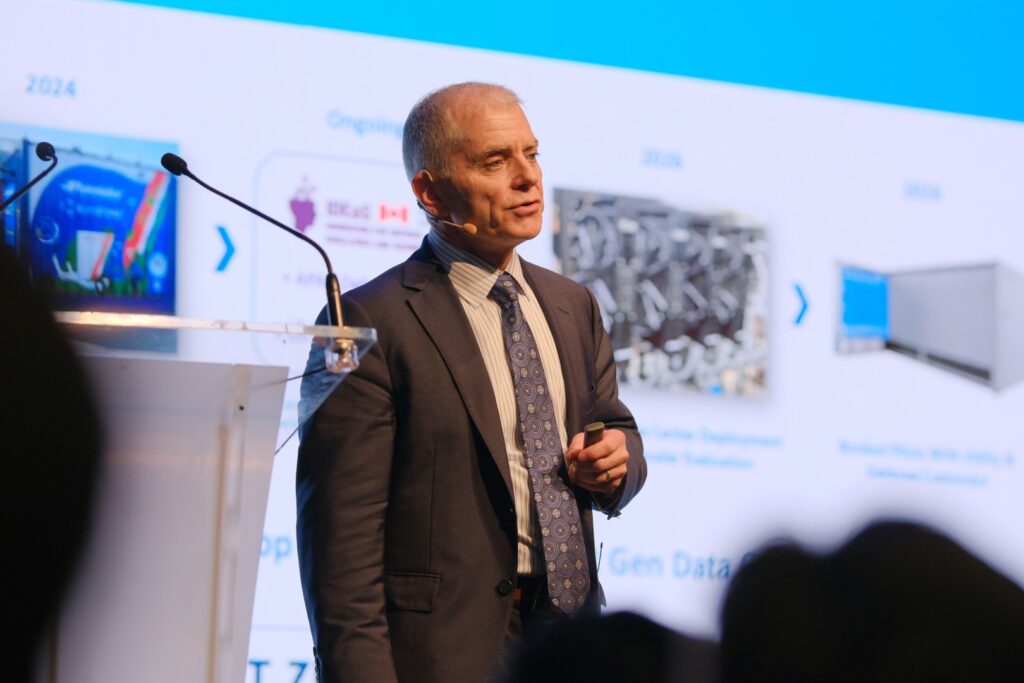
Rob Alexander, CEO and Co-Founder of AlumaPower
The Takeaway
One question, wildly different answers: how do you build clean energy infrastructure that’s reliable and scalable at once? Between software layers, mine shafts, molten salt, and scrap metal, the track showed just how wide the solution space has become.
Energy Tech Challengers returns at Energy Tech Summit 2027 in Bilbao, April 7–8. Want to watch the next generation of energy startups pitch live — or take the stage yourself?