
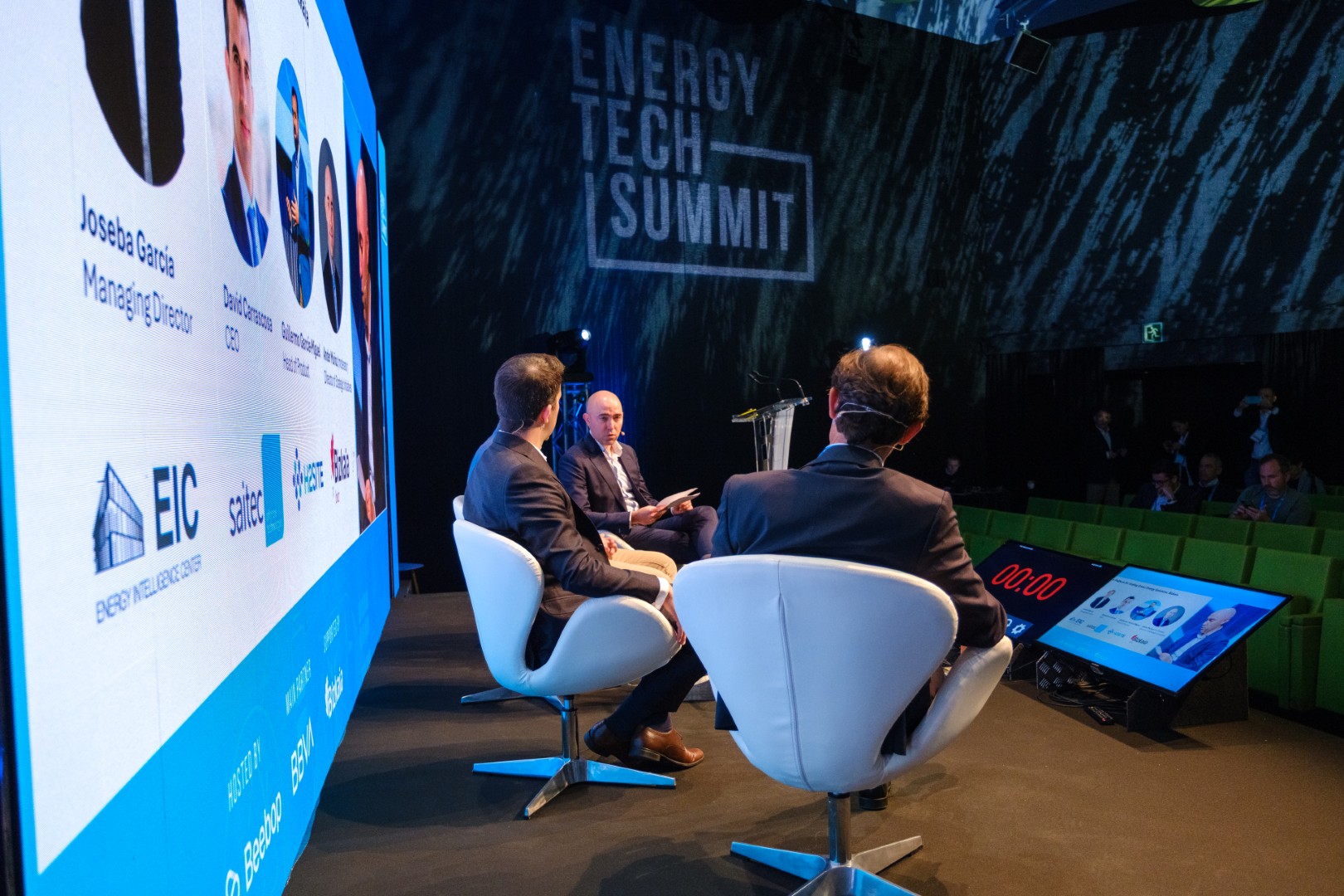
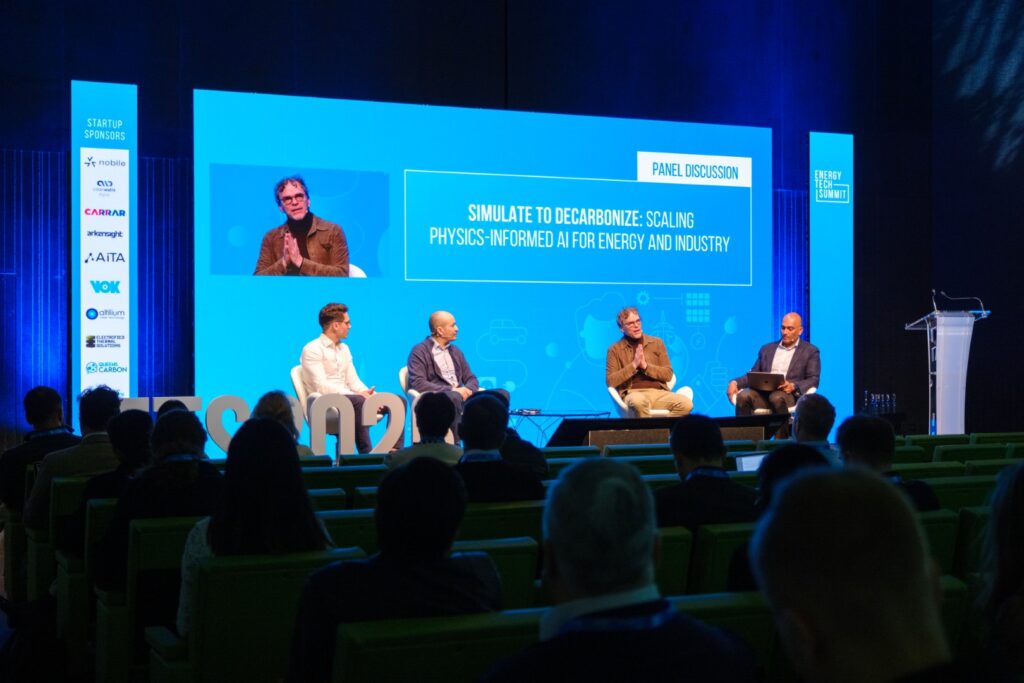
A utility investor, a building autonomy founder, and a simulation founder on scarce data, nuclear certification, and why buildings are the most complex robots we build.
Anup Jacob, Managing Partner at Activate Capital, opened by admitting that physics-informed AI still needs a clear definition. Every conversation now runs through AI, and the industry has spent the past year talking about AI moving into the physical world. What happens when AI starts operating inside products and infrastructure, he suggested, is a very different question from what happens when it writes text.
Three Routes Into the Same Problem
Fainite: Physics AI for Engineering Design
Alex Donzelli, CEO and founder of Fainite, met this problem early. He began his career at Caltech, modeling the supersonic failure of aerospace materials. He then moved into energy and machine vision, where he found engineering teams hitting the same wall again and again.
Simulations are slow and computationally intensive, and that drags on product development and manufacturing. So engineers simplify. They make assumptions about how a material or product will behave, and every simplification costs accuracy. Fainite is building a physics AI engine that, in Donzelli’s description, carries the knowledge of thousands of engineers and solves complex design problems without those compromises. Examples include predicting turbine lifetime under changing operating conditions, generative design of solar panels for satellites, and optimizing the energy-intensive manufacture of ceramics.
EDF Pulse Ventures: The Buyer’s View
Michel Hunsicker brought the buyer’s perspective. He’s Investment Director at EDF Pulse Ventures, the corporate venture arm of a utility running nuclear, renewables, hydro, and gas assets. He has an engineering background and more than 20 years in the industry.
Simulation matters to EDF on two fronts. First, there’s asset optimization and the digital twin work that goes with it. Second, there’s a less well-known part of the business: EDF manufactures nuclear reactors through Framatome and large steam turbines through Arabelle Solutions. His example was additive manufacturing, where simulating the printing process to check for residual stress — before trying a new printing strategy — can currently take longer than printing the part itself.
PassiveLogic: Buildings as Complex Robots
Troy Harvey, CEO of PassiveLogic, described a platform for what he calls generative autonomy. The idea is to build a custom world model in tens of minutes or a few hours, then drop it onto a general-purpose autonomous platform that controls infrastructural robotics. That means buildings, data centers, and logistics centers — or, as he put it, “the most complex robots we build. They just happen to be bolted to the ground.”
The comparison he used made the scale concrete. A building like the one the panel sat in has around 5,000 IO points — sensors in and controls out. A Waymo has perhaps 75 to 100, and it only does three things: steer, brake, accelerate. All of that complexity in hard assets is, in his words, under-controlled and undermanaged.
Why Current AI Models Don’t Transfer
Jacob asked the direct question: what are generative models failing to do that physics-informed AI can?
For Donzelli, it starts with scarcity. Engineering data is expensive and thin, while conventional machine learning needs volume to train on. The alternative is to embed physical laws into the model itself — conservation laws and differential equations, implemented directly into the solver. That both simplifies training and improves the output.
The harder requirement is guarantees. In safety-critical work, engineers need assurance that results are accurate. A probabilistic approach that’s 98% right isn’t good enough for many applications. Jacob put it more plainly: you cannot recall a wind turbine that’s only 98% accurate.
Why Language Models Can’t Provide Guarantees
Harvey took the argument straight to language models. Three years into their being everywhere, he said, people have lost sight of what they actually are. “These are probabilistic word choosers.” The systems aren’t intelligent so much as extremely good speakers — strong on vocabulary and semantics. For domains that require guarantees, the transformer architecture underneath them is provably unable to guarantee its outputs.
His second objection was about structure. AI trains successfully on problems that would take large engineering teams a long time to model by hand. But in doing so, it breaks a principle that has held across 70 years of computer science: composability. The models are monolithic, and they can’t be pulled apart.
He used autonomous vehicles to show what changes once physics goes in underneath. Four years ago, he said, those vehicles were only around 30% as good as a human driver. The gains since have come from reinforcement learning on physics models — they’re pre-trained on physics.
The goal he described is composable models that understand their own ground truth. Fragments could then be assembled into entirely new models in minutes, with no training period required. That’s what makes the approach applicable to any domain, rather than a niche one. Physics, he argued, is the ground truth worth building on. “Physics existed before we were here and will exist after we’re here.” It’s not a human construct.
Where the Training Data Comes From
Jacob pointed out that language models learn from images and websites. So what do physics-informed models learn from?
Harvey called this the crux of the whole problem. Language models look like a revolution, he said, but he expects schoolchildren to be building their own within a few years, simply because the dataset was already there. Humanity spent tens of thousands of years labeling the world in every language. Then billions of people uploaded all of it into one repository. Scraping it is now trivial.
No such corpus exists for anything else. Nobody has spent millennia naming and labeling the behavior of materials under load. So you have two choices: wait for the data to accumulate slowly, or take the fundamentals and infuse them into the model, so it already knows the basic laws of the universe before it sees anything at all.
What Industry Needs Before It Adopts Physics-Informed AI
Hunsicker’s answer to the adoption question was the black box problem. If models can’t be opened up and explained, regulated industries simply can’t move.
He illustrated it with the hardest case he has. Getting a simulation certified by the nuclear safety authority takes months, sometimes years. EDF has internal models that took a long time to get through that process. When engineers see a new model, their first reaction is that the authority will never accept it — because approval means walking through the entire mathematics behind simulations that are already validated. A hybrid approach, he suggested, might be the middle path that gets the sector there.
Something in that direction is already running. He pointed to Metroscope, which simulates power plants using machine learning with a Bayesian approach rather than deep neural networks, and which has been deployed across EDF’s nuclear fleet. At the process level, that already works. For specific CFD or finite element simulation, he said, there’s still some way to go.
On-Premise, or No Entry
Asked how much data security limits scalability, Hunsicker gave the nuclear answer first. The opening question EDF asks any solution provider is whether they offer on-premise deployment. If not, for many of them, that’s where the conversation ends. The data is too critical, and the risk of tampering too serious. After that comes hosting — where the data physically sits — and sovereignty, which he said matters more now than it used to. Without on-prem capability, there’s no way into a nuclear plant at all.
Harvey arrived at the same place, but from real-time constraints. You cannot drive a Tesla from the cloud, and you cannot run building or logistics automation from it either. The physical world migrates to the edge, and autonomy has to mean actual autonomy: disconnect the internet, and the system keeps operating.
So both operation and learning run on-premise, and that’s where infrastructure differs from transportation. Stamp out 100,000 identical vehicles, and the rules are effectively the same in Bilbao, San Francisco, or Germany. But this building, the one across the street, and the manufacturing center down the road are all different. Learning therefore has to happen on site.
PassiveLogic’s answer is a general-purpose foundation model that understands physics well enough to plug in and start operating, then learns locally rather than generally. That doubles as data security, since nothing needs to leave the site.
Five to Ten Years Out
Cheaper Hardware, Faster Simulation
Donzelli split his forecast into what he expects and what he hopes for. On the expected side, the entry barrier to hardware should fall, bringing more entrepreneurs into physical problems — the space economy after the first reusable rocket is the visible example. Designers and product managers should also start running assessments that were previously the preserve of simulation engineers, which would shorten the back-and-forth between teams inside large enterprises.
Digital twins, in his view, will finally become twins. Today they’re static replicas of things that change dynamically, because simulations take time to converge and every new parameter means another run. Faster simulation would let the twin deform as the real object deforms.
The two things he hopes for are more ambitious. First, programmable physics, where an engineer defines an objective function and a set of constraints, and the model explores the solution space on its own. Second, continuously evolving systems — a power plant simulating its own behavior against live recorded data and adjusting as conditions change. At that point, he said, the limitation becomes the user’s ability to define the right problem.
The barrier he named for today is talent. Engineering and machine learning are still separate disciplines, and a mechanical engineering student today won’t learn enough machine learning to apply it to real problems. He expects education to close that gap, and skepticism to fade with it. Enterprises already understand surrogate models reasonably well, though he still meets resistance in academia. He finds that a little ironic, since academia supplied the infrastructure in the first place — transformer models applied to physics came out of universities before being reworked for real engineering problems.
A Slower, Hybrid Path
Hunsicker was more incremental. He doesn’t expect engineering work to change radically overnight, and he shared a conversation from a fortnight earlier with an EDF colleague working on open-source CFD models. The team is already thinking in hybrid terms: run the existing model for the first five iterations, insert the AI model for one additional iteration to save time, then hand back to the conventional model for the next one.
Technology Inclusion for the Trades
Harvey used his answer on whether this is a zero-sum game to make the most unexpected point of the session. PassiveLogic rolls out at the top with large enterprise partners and REITs, and at the bottom with blue-collar installers and contractors. It’s the second group he wanted to talk about.
“This is the first time they’ve felt technology inclusion in their whole career,” he said. They’ve felt left behind for 20 or 30 years, and now somebody is treating them like grown-ups and telling them AI is for them too. The tools are built so that, as he put it, “boiler Bob and HVAC Harry” can build their own custom AI models.
He had the evidence to back it up: an HVAC union in Canada, where the person running the union classes told him afterward that it had drawn the most attention of any topic in 20 years of teaching. What mattered, in Harvey’s reading, wasn’t that the material was dumbed down — it was translated into their world. A great deal of inclusion has yet to happen in the tech market, and he thinks AI is the catalyst for it.
Takeaway
The panel’s through-line was scarcity of a specific kind. Language models exist because humanity had already built their training set, without ever meaning to. Nothing equivalent exists for turbines, reactors, or buildings, and waiting for it isn’t a plan.
Physics-informed AI is the workaround. It brings two things the physical world requires and probabilistic models can’t supply: outputs you can guarantee, and models you can pull apart and recombine. The remaining obstacles are less technical than institutional. A nuclear safety authority needs to see the mathematics. A site won’t let data leave the building. And an engineering workforce is still trained in one discipline at a time.
Energy Tech Summit 2027 returns to Bilbao on April 7–8, with more conversations like this one.