

Waste-to-compute plants, photonic GPU networks, and batteries that run three times longer — what founders pitched at the Energy for AI track of Energy Tech Challengers 2026.
AI’s appetite for power got its own track at Energy Tech Challengers 2026. Founders pitching clean energy, infrastructure, and digital solutions for computing’s growth each got three minutes on stage, followed by two minutes of questions from an investor jury.
Here’s what happened on stage.
Boson Energy: Turning Urban Waste Into Edge Compute
“I’m here to turn your waste into edge compute,” Boson Energy CCO Heike Carl Zatterstrom told the room. His diagnosis was blunt: real-time AI has to happen in cities, but cities have no spare power, and grid upgrades take decades. New York alone, he said, needs 750 megawatts of distributed urban edge load by 2035.
The feedstock, meanwhile, is everywhere. The EU sends 100 terawatt hours of potential edge compute to landfill every year, Zatterstrom said. In fact, two landfills in Madrid alone emit twice the greenhouse gases of all the city’s traffic combined.
Boson’s standard unit converts 100 tons of non-recyclable waste — the output of roughly 100,000 people — into four megawatts of DC power, plus cooling. It sits behind the meter, on just half a football field of land. District heating and truck charging come as side products, and Zatterstrom claimed 10 times the profitability of incineration.
His closing pitch made the stakes concrete: New York could go from paying $500 million to dispose of its waste, to instead generating billions in value from it.
Carrar: Batteries That Stop Aging the Way They Used To
Batteries degrade about 2% a year, and the industry calls it physics. Carrar co-founder and CEO Eitam Friedman disagreed. “For 30 years, the industry got better at managing the problem,” he said. “We managed the consequence, but we never managed the cause.” That cause, he explained, is heat stress inside the cell.
Carrar’s liquid changes phase the instant it touches the cell surface, pulling heat out before it creates stress. As a result, the cell holds a constant thermal state, with no path to thermal runaway.
The claimed results are striking: systems that run three times longer on the same capex, a 30% smaller footprint, and a safety profile that opens the door to UL certification. “Certification does not open one market,” Friedman said. “It will open entire markets.”
He listed the traction so far: a five-year contract with a global automotive OEM, a partnership with a Korean battery maker, and two active commercial storage projects. Carrar has raised $15.5 million, and it’s scaling toward commercial deployment by 2027.
Hydrohertz: Zonal Cooling for Data Centers Hitting a Thermal Wall
Data centers are hitting a thermal wall on AI compute, Hydrohertz founder and CTO Martyn Talbot told the jury. Meanwhile, waste heat leaves the system lukewarm and useless, and new builds wait up to seven years for grid connections.
His fix goes inside the rack. Cooling systems today treat the whole room, row, or rack as one big unit. The Hydrohertz valve, by contrast, segments the rack and controls cooling at shelf level, using four independently controlled flow paths from a single moving part. The payoff is less cooling power, more room for compute, and hotter waste heat that can actually be sold.
Pressed by the jury on traction, Talbot didn’t oversell it: “We’re pretty much new into the data center area.” Instead, the validation comes from automotive testing — 150,000 miles and over a million revolutions — with simulations pointing to similar gains in data centers.
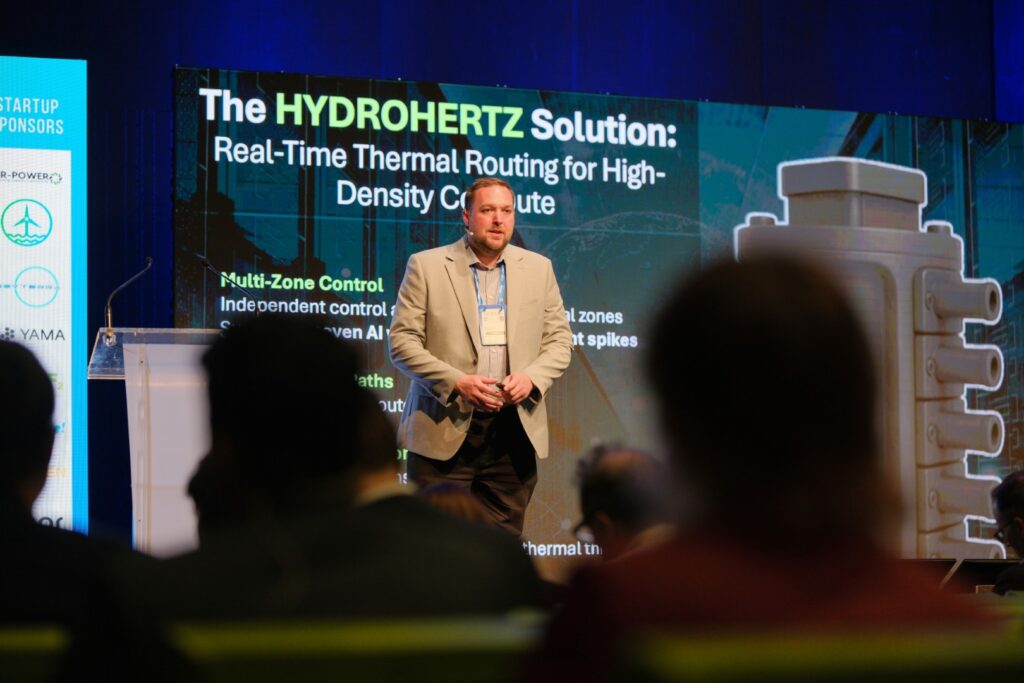
Martyn Talbot, CTO & Founder of Hydrohertz
LAVA Power: A New Thermodynamic Cycle for 24/7 Clean Power
LAVA Power co-founder and CEO Doron Tamir opened with a red line on a chart: entropic expansion, the thermodynamic cycle behind every piston and turbine. In his words, it’s “the most inefficient way to have power.” LAVA’s blue line is different — the first isothermal cycle, in which gas expands without cooling down, delivering roughly 30% better efficiency.
The company builds a heat engine and a heat pump on that cycle, and together they form a Carnot battery. The system charges with electricity, stores the energy as heat at just 120°C (“then all the materials are very low cost,” Tamir noted), and discharges through the heat engine. He cited 65% round-trip efficiency, rising to 90% with waste heat recovery, and no degradation over 30 years.
LoadCrest: Unlocking the Grid for the 800-Volt Data Center
LoadCrest co-founder Vishoka Bala gave the company’s first-ever public pitch, and aimed it squarely at a $50 billion bottleneck. Developers are ready to build AI data centers, she said, but grids can’t handle the interconnection — especially as hyperscalers push the industry toward 800-volt architecture.
The product is a 20-foot container of converters, inverters, and a transformer, plus the part LoadCrest actually sells: proprietary control software. The sharpest moment came during jury questions, when Bala reframed the interconnection problem entirely. Studies fail, she argued, not because power is unavailable, but because AI workloads swing on and off in ways the grid can’t absorb. “A 50-megawatt site swinging on and off — the grid cannot be your shock absorber.” LoadCrest’s controls filter out those harmonics instead, replacing racks of buffering equipment.
She quoted savings of nearly $90 million in five-year total cost of ownership for a 100-megawatt site, priced at $500,000 per megawatt plus $20,000 per megawatt per year. The targets are neoclouds and tier 2–3 providers building 50-megawatt campuses, many of them currently locked out of the grid.
The first LOI pipeline covers 500 megawatts, with another 500 in early stages, Bala said. The team has already deployed utility-scale power systems for the US military, and it works with Sandia National Labs.
Noon Energy: 100-Hour Storage With No Critical Materials
Noon Energy exists to kill renewable intermittency, EVP of Commercialization Aric Saunders told the jury. The pitch: carbon-based storage for 100-plus hours, turning wind and solar into baseload power.
The technology is a reversible solid oxide fuel cell. It uses no critical materials or rare earths, and at scale it’s two to three times more energy-dense than lithium-ion. The company is targeting $20 per kilowatt hour of capex by 2029–2030.
The pipeline he cited is substantial: over $6 billion across roughly 310 gigawatt hours, dominated by hyperscalers and island grids. A 100 kW, 10 MWh system already runs in California, in partnership with the California Energy Commission, and over 100 megawatts of critical component supply is already secured.
Founded in 2018, Noon has raised $33 million and is now raising a $65 million Series B. Its first commercial project is planned for 2027, with hundred-megawatt scale targeted by 2029.
Oriole Networks: Connecting GPUs With Light
Oriole Networks co-founder Joshua Benjamin asked the room to look under the hood of AI: thousands of GPUs, tied together by a network he called the fundamental bottleneck. In his description, that network is power-hungry, slow, and hard to build.
Oriole’s answer is Prism, a pure photonic network that connects any two GPUs within nanoseconds, eliminating the switching layers in between along with their cooling and delay costs. The result, per Benjamin, is GPUs working at full capacity, all at once.
Asked how Oriole differs from other photonics players — including Google, which appeared in the same quadrant on his slide — Benjamin drew the line at the system level. Competitors, he said, ship ever-better transceiver modules, while Oriole engineers the whole stack from the physical layer up, with GPU engineers among its 80 staff validating every layer.
The company has raised $50 million across seed and Series A funding, holds about 20 patents, and is now raising a $150 million Series B. Its first product is planned for 2027, on a roadmap running to 2032. “It’s definitely going to happen,” Benjamin said of photonic AI networking. “The question is who’s going to build it best — and first.”
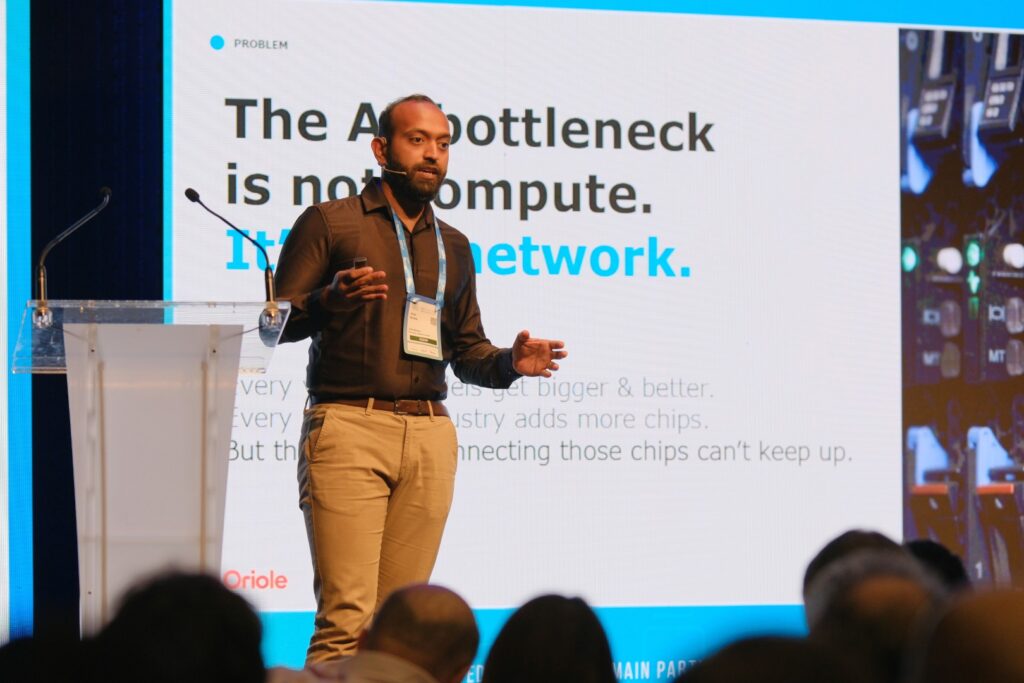
Joshua Benjamin, Co-Founder & Network Architect of Oriole Networks
The Takeaway
The track covered every layer of AI’s power problem at once. There’s where the electrons come from (Boson, LAVA, Noon), how they’re stored (Carrar, Noon), how they reach the servers (LoadCrest), and how much the compute actually needs (Hydrohertz, Oriole). In short, the bottleneck is real, and so is the startup pipeline forming around it.
Energy Tech Challengers returns at Energy Tech Summit 2027 in Bilbao, April 7–8. Want to watch the next generation of energy startups pitch live — or take the stage yourself?