

Five people run a utility. 170,000 home batteries sit behind a single trading desk. And one founder believes physical power trading has no future at all.
Veery Maxwell, Partner at Galvanize Climate Solutions, opened by flipping the usual framing. In San Francisco, she said, the only conversation is about how the grid is holding back AI data center growth. This panel looked the other way. It asked how AI in power trading and market infrastructure can boost utilization, increase efficiency, and cut friction out of the system.
Three Companies, Three Approaches
tem: An AI-Native Trading Utility
Joe McDonald, co-founder and CEO of tem, has spent more than a decade in energy trading. His first company aggregated battery storage and renewable generation. It traded them in the UK’s short-term electricity markets, both day-ahead and within-day. Shell bought the business in 2019 and turned it into its short-term electricity trading desk.
tem is building what McDonald calls the world’s first AI-native transaction infrastructure. In practice, that means faster price discovery and smoother payments between the people generating electricity and the people using it. About 24 months ago, the company built its first “neo utility” on an agentic framework, with exclusive access to that pricing infrastructure. It has since scaled to more than $500 million in annualized gross transaction value. It now serves around 5,000 businesses – from large data centers and manufacturing sites down to corner shops and local schools.
Beebop: Turning Home Batteries Into Tradable Assets
Jan-Willem Rombouts came to flexibility in 2010, after a career as a quant trader at Goldman Sachs. He founded REStore, grew it to a few gigawatts of power under management, and sold it to Centrica around 2017.
His current company, Beebop, gives suppliers, traders, and utilities upstream access to their own customers’ flexibility. Huge volumes of batteries, solar panels, and other distributed energy resources sit behind meters. Neither suppliers nor traders can usually reach them. Beebop makes those assets tradable in the markets where the value sits, including imbalance management and continuous intraday trading. It also helps device manufacturers access virtual power plant programs run by utilities, so they can offer bill savings to customers. The company operates from the US through the UK and Europe, having started in New Zealand and Australia, and now works with more than a dozen large suppliers and utilities.
Enmacc: Opening Up Long-Term Hedging
Jens Hartmann runs Enmacc, a marketplace that provides trading infrastructure to market participants. Most innovation has focused on short-term power markets, where renewables have driven volatility and change. Enmacc went the other way, focusing on longer-term hedging, speculation, and procurement. It handles power, gas, and carbon contracts for years ahead – some starting within weeks – all on one platform.
The client base spans 670 companies across Europe: industrials, corporates, utilities, hedge funds, investment banks, oil traders, and specialist trading houses. Hartmann was clear that Enmacc does not compete with traders. Its goal is democratization – giving smaller participants access they never had before.
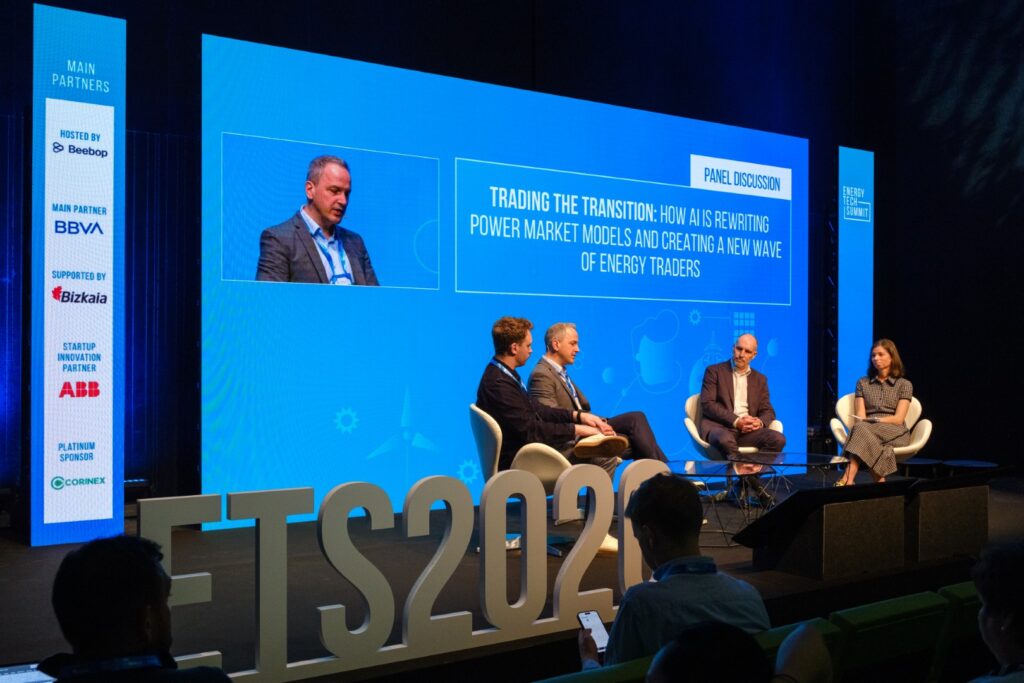
Speakers of the panel at Energy Tech Summit 2026
Where AI Fits – And Where It’s Too Early to Say
Maxwell asked where AI belongs in the trading stack, and where it doesn’t. McDonald declined to define the negative space. It’s too early to say, he explained, and the answer changes week by week.
At tem, the work splits into two parts. The first is what he calls “almost old-school AI”: deep machine learning and reinforcement learning solving an operations research problem – matching many buyers to many sellers to create price discovery and forward transactions for electricity. He describes it as built on the back of Uber and Amazon’s fulfillment algorithms, but applied to electricity, and only possible in the last two or three years.
The second layer is agentic, and built on top of the first. The numbers here were the most striking of the session. tem’s neo utility serves 5,000 businesses with just five people. A comparable UK supplier, McDonald said, runs the same book with 180 to 210 staff. Billing, back office, trading, service, and growth are all automated. The company moves more than two terawatt hours of annualized power without a single trader.
The Disintermediation Risk
“There is a disintermediation opportunity here,” McDonald said – one where market participants win more than today’s intermediaries do. In his view, that’s the real disruption risk AI poses to energy trading.
Can Incumbents Catch Up?
Maxwell asked whether the layers being disintermediated are deploying AI themselves. McDonald doubted the mechanics, not the intent. Rebuilding the core of an existing business is hard. It means cannibalizing trading profit, replacing trading teams, introducing new systems, and cancelling SaaS contracts.
He didn’t call it zero-sum, though. Everyone using the new infrastructure can still win. And short-term markets still need trading and optimization to manage residual imbalance. As in financial services, there’s also a continuing role for speculative trading using AI. Over the next 10 years, McDonald expects a major shift — some familiar names will win through innovation, and new entrants will arrive through more democratized access.
Rombouts pushed back from the supplier side. Internal teams are moving fast on analytics, he said, and they sit on more data than any startup arriving from outside. That raises the bar for a purely analytical SaaS product, and brings “not-invented-here” resistance with it.
What has changed, Rombouts said, is that suppliers now ask what their right to win actually is — a question they weren’t asking a few years ago. Brand still matters in Europe and the UK, less so among US utilities. He’s also been impressed by how much some large European suppliers are investing in algorithmic and automated trading, treating it as a core competence. They have liquidity, trading experience, and are automating with an eye on what it lets them offer customers.
Hartmann widened the lens. Energy markets are volatile and deeply interconnected — oil moves gas, and gas moves power — and there’s a lot of money in them. Big trading shops are profit machines, which attracts investment. Citadel, for instance, is active across the full stack, from weather forecasting down to execution. Hartmann said he likes that energy markets now attract the brightest minds, and that functioning markets need those profit opportunities.
The panel agreed on one thing: who gets a share is changing. European wholesale trading has historically meant roughly 200 trading houses. New business models, Hartmann argued, could give a few hundred or a few thousand companies easier access. They won’t always compete with the best. But they’ll still get fairer procurement, lower transaction costs, and better risk hedging than before.
Maxwell raised the question underneath it all: does the asymmetric information that has driven outsized returns still hold up once AI becomes ubiquitous? Her own answer, delivered dryly: Citadel still seems to be doing pretty well.
170,000 Batteries: A Different Scale of Problem
Rombouts framed the storage build-out as an all-of-the-above story. Front-of-meter storage matters, with its own challenges around interconnection and grid operator ramp-rate limits. But regulatory changes across Europe are now pushing batteries behind the meter, in both commercial and residential markets.
His example was the Netherlands, where net metering is ending. Roughly 170,000 residential batteries were installed there in about a year. Zoom out across Europe’s installed solar, a fast-falling battery price curve, and rising EV deployment, and you find tens of gigawatts — soon more than 100 — of genuinely valuable flexible power. Most of it sits idle.
The common use case is basic self-consumption: install a battery, use more of your own locally produced energy. Many solar plants installed over the past decades aren’t connected, controlled, or integrated into the power system the way today’s grid needs.
Why Many Small Batteries Beat One Big One
Rombouts then made the case for why this is specifically an AI problem. With one 100-megawatt battery, a trader can forecast availability precisely. They know what ramp rates a control signal will produce, and they know the cost and the cycle count. With 100,000 batteries behind meters, the job changes completely. You’re managing cycle budgets and warranties, and every customer sits on both an energy tariff and a grid tariff. Making money on continuous intraday trading while raising your customers’ grid charges isn’t a real business.
On top of that sit minute-by-minute control decisions across 100,000 highly unpredictable assets with limited visibility. The job, as Rombouts described it, is to abstract all of that away and present tradable “shapes” — low-dimensional, familiar to a trader, and tradable using mixed integer linear programming or reinforcement learning engines, just like a single battery would be.
Get that right, and the value unlocks for the whole market — and can be shared back with customers, while suppliers get a sticky, high-margin product. AI is what makes the unpredictability tractable: solar forecasts, load forecasts, user constraints (especially for EVs), and the abstraction layer on top. It turns a problem that scales linearly with the number of resources into one that scales sublinearly.
McDonald took the idea further than Rombouts had. All trading, he argued, is really just supply, demand, and probabilistic pricing — whether you’re predicting supply and demand three years out in the wholesale market, or the next half hour. If AI can handle fulfillment prediction and probabilistic pricing, and a decentralized asset class can perform the matching, the need for forward and wholesale market trading starts to fall away. Those participants become an infrastructure layer that manages imbalance, without ever taking liquidity into the short-term markets at all.
Maxwell noted what she felt was missing from the wider conversation: tying these innovations directly to the affordability crisis, and showing how they drive costs down at scale.
Agents on the Trading Desk
Hartmann reduced a trader’s job to two things: defining strategies and executing them. Strategies range from speculation to straightforward hedging for an asset owner or industrial producer, and they aren’t always complex. What’s changing is the volume of unstructured data. Machine learning arrived in structured-data energy trading years ago. The current challenge is making sense of market sentiment — whether that’s the next viral tweet or a piece of industrial news — with cycles running faster and smaller players increasingly able to extract signal from the noise.
The second half of the job is finding the trade, which is where Enmacc focuses. It provides agents that handle the tedious work of watching multiple screens for opportunities and arbitrage — something an agent does better than a person, since it can process several information streams at once. Today, it stays human-in-the-loop, proposing next steps rather than acting on its own. Hartmann expects that once traders trust the agents, they’ll hand over execution too. “We’re still pretty much alone around this,” he added. “So no one else is developing it. Maybe it’s a bad sign.”
On the replacement question, Hartmann was firm in the opposite direction: there aren’t enough energy traders. Recent years have made them a scarce resource. Smaller players wanting market access will either go through service providers or lean on smarter software and agents. Simplification, he said, leads automatically to automation — and most traders will welcome it.
What Happens to Human Traders
Rombouts’ agents point downstream instead of at the trading desk. When customer assets start trading on their own, customers look at their power profile and get confused about what their battery is doing. Beebop runs agents that explain the behavior and the reasoning behind it: idle overnight, discharging as wholesale prices climb into the morning peak, reacting in real time to an imbalance opportunity, then returning to self-consumption.
The people installing batteries and buying EVs today are early adopters, and they want to understand what’s happening. Beebop built its own LLM-powered application for exactly this. It’s tunable by expertise level — explaining things to your grandmother at one end and to an expert at the other — and lets the customer double-click into any part of it.
McDonald had promised some spice, then delivered it. In his view, it’s a matter of timing rather than possibility — but there’s no future for physical power that still needs traders, trading services, or back-office staff. That’s why tem isn’t building an agent to do a trader’s job. It’s removing the job entirely, through fulfillment algorithms.
Where he does see the agentic layer mattering is on the customer-facing side. Businesses and homes get poor service from their suppliers and are frustrated by their bills. What they actually want is to talk to a human. His forecast: tem expects around a thousand new utilities to launch on its infrastructure within 24 months, in a market that has traditionally seen about 30. He was careful to leave the rest intact — in non-physical power, speculation, and short-term trading, he still sees a continuing role for agentic trading, algorithmic trading, and human traders alike.
Maxwell disclosed her own position here, noting that portfolio company Octopus has been an early adopter and is ahead on customer relationship management. In the US, she said, that layer is generally abysmal. The only thing worse, she suggested, is the cable companies.
Who Wins Across the Stack
Maxwell closed by asking each panelist who wins across the stack — utilities, optimizers, traditional traders, hedge funds — with one rule: nobody could pick themselves.
Hartmann finds it hard to believe fully integrated models will win, even while acknowledging UK companies making waves doing everything from building and operating solar through to serving the consumer directly. He expects specialist players at every layer, because the market is large and attracts capable people.
That said, in trading, owning a vertical stack matters — what he called “owning a flow.” Whether that flow is a collection of small home batteries or a set of industrial loads, it counts in the market. That’s where a marketplace model competes directly with vertical integration.
He expects more intelligence at the fringes. What a market does — aggregating information into a single price and sending signals back — is information processing, and AI processes far more of it than before. So decentralized business models will increasingly compete with the market itself, which means the market has to be cheap to access, digital, and fast enough to sit underneath them. He doesn’t see that as a threat, though, because even the most innovative companies still need a market: nobody is ever 100% balanced.
Rombouts wouldn’t underestimate the traders — both the strong desks inside large energy companies and the traditional financial traders now arriving from Wall Street. Having worked at Goldman Sachs between 2005 and 2010, he watched traders walk out the door while quants came in to automate everything. He knows what that side brings: infrastructure, experience, market depth, access to liquidity, and — critically — balance sheet. A great algorithm isn’t enough if you’re not willing to put a balance sheet behind it.
His hope since founding his first company in 2010 was that flexibility would become tradable liquidity, the way derivatives did in financial markets. He thinks that moment is arriving now, with traders stepping in to capture everything from short-term volatility to congestion markets.
McDonald expects a couple of very large winners at the customer application layer, though he doesn’t think anyone can name them yet. Revolut, he suggested, could be doing energy within a few years. Once power distribution changes and access to homes and businesses opens up, everything that historically kept outsiders out of energy supply becomes available to them.
He’s most bullish, though, on companies that combine software and hardware — owning the home, owning the infrastructure, installing the batteries and solar behind the meter, and connecting it all together. Failing that, the infrastructure providers — the people selling shovels — will capture the opportunity over the next 10 years, because the customer application layer is going to be brutally competitive.
How Close to Real Time Can Trading Go?
An audience question asked whether precision timing has a future in power trading — the kind of high-frequency trading play familiar from currency markets, where firms place data centers right next to the exchange.
Rombouts said everything is already moving closer to real time. Settlement has gone from hourly to 15-minute intervals. Imbalance management now runs at minute scale, and many grid services operate at second or sub-second speed. Part of what optimizers earn today comes from old-school traders still working hour by hour, leaving ramp rates uncaptured. That opportunity will grow as participants chase the last remaining inefficiencies in the market.
So yes, he said, there’s a big place for precision timing. “But not now.” Give it a year or two.

Panel audience at Energy Tech Summit 2026
Takeaway
The panel described the same shift from three different vantage points, and disagreed mainly on how far it goes. Everyone agreed that AI in power trading collapses the cost of processing market information, and that this pulls value toward whoever can aggregate small, messy, distributed assets into something tradable.
Where they parted ways was on the trading desk itself. Hartmann sees agents making scarce traders more productive. Rombouts sees financial traders arriving with balance sheets to capture new liquidity. McDonald sees physical power trading disappearing as a job category altogether. All three arguments end at the same place: a lower cost per electron — a part of this story that hasn’t yet made it into the affordability debate.
Energy Tech Summit 2027 returns to Bilbao on April 7–8, with more conversations like this one.