

Grid connections that vanish, uptime measured in seconds per year, and temperature treated as something to control rather than monitor.
Bar Ben Horin, VP of Product at Carrar, used her keynote to argue that battery systems for AI data centers are now an architecture problem rather than a chemistry problem. She opened with what she called the hottest topic of the decade: how to power the AI revolution. Hyperscalers will pay a fortune for the data centers that train and run their models. Forecasts she cited put AI data centers at around 10% of US electricity consumption by 2030. Whoever wants to lead the revolution, she said, has to invest in more than software and compute. They also have to invest in the infrastructure that keeps the buildings running.
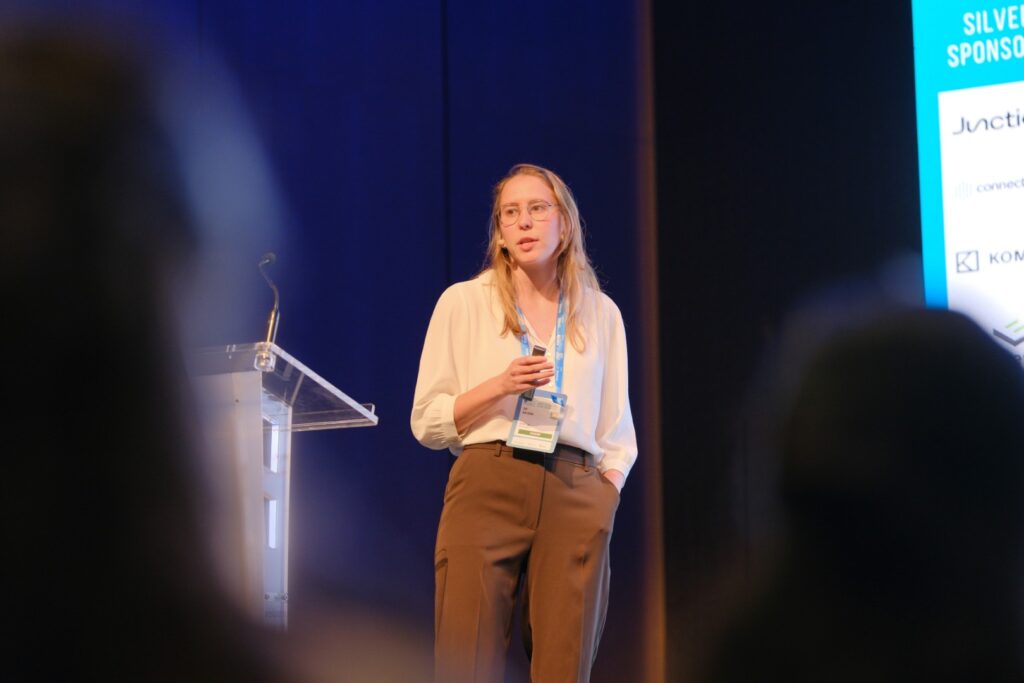
Bar Ben Horin, VP of Product at Carrar speaking at Energy Tech Summit 2026
The connection that isn’t there
The biggest challenge she sees is grid connection, in both size and stability. Developers build the data center, sign off the perimeter, and then ask where the grid connection actually is. “It’s simply gone,” she said.
Getting connected does not end the problem. Power stability issues and voltage swings degrade GPU performance, which makes stability the whole game rather than a detail of it.
What downtime costs now
That cost has moved the goalposts on availability. Operators used to offer three or four nines of uptime in their SLAs. The bar now sits at five and six nines. In practice, that means the tolerance for downtime is measured in minutes, and in some cases seconds, across an entire year.
Why commodity batteries don’t answer it
Energy storage looks like the obvious response, and Ben Horin agreed that batteries are becoming critical infrastructure. Her objection is to what the market currently offers.
Conventional systems have become a commodity, she said, and commodity systems carry five problems: safety risks, dependency on environmental conditions, performance limitations, short lifespan and high costs. Buying a better version of the same thing solves none of them.
Her conclusion was that the industry needs a fundamentally different approach rather than a wait. “We cannot just wait to the perfect chemistry to emerge.”
Chemistry sets the baseline, the system sets the outcome
To make the point she quoted a former battery industry executive who, she said, has seen more battery failures than almost anyone. What does battery chemistry have to do with battery safety? Not as much as many believe. Chemistry sets the baseline and the boundary conditions. The system determines the outcome.
That distinction is where Carrar starts, and it framed the rest of the keynote. The question is not which cell chemistry wins. It is what happens when every aspect of the system is designed together from day one.
Three layers, one architecture
Carrar’s answer is three layers of proprietary IP that function as a single two-phase immersion architecture.
The first layer is what the company calls its nucleation IP. Carrar submerges the cells in a dielectric liquid and has worked out the physics of boiling, so the system removes heat at the exact point it is generated. Nothing is conducted outward through layer after layer of material.
Second comes module design. Cell housing, bus bars and liquid vapor management were co-designed into one unit rather than assembled from parts. “The safety isn’t bolted on,” Ben Horin said. “It is structural.”
The third layer is thermal management: a closed loop that self-regulates and, under normal conditions, runs almost passively. There is no parasitic energy draw, no HVAC, no cooling towers, and no water at all.
From that architecture she claimed no thermal runaway, zero safety events, 50% higher peak power and no compromise on lifetime. She was explicit that this is not an incremental gain. It is a different product category, and one that changes project economics.
Temperature as a control input
The clearest illustration came from the battery management system. Every BMS on the market controls three variables: voltage, current and state of charge.
Carrar adds a fourth. Because the immersion architecture lets the system physically control temperature rather than simply monitor it, temperature becomes a control input rather than a constraint to respect. That in turn unlocks charging and discharging protocols that would not otherwise be available.
Here Ben Horin drew the loop closed between the two halves of her title. The relationship between energy and AI runs both directions. The batteries power the models, and the software layer sitting on top of well-instrumented hardware improves what the batteries can do.
Audience at Energy Tech Summit 2026
Takeaway: battery systems for AI data centers
The keynote made a narrow argument rather than a broad one. Most conversations about battery systems for AI data centers are conversations about chemistry. Ben Horin’s case is that chemistry only sets the boundary conditions. What actually determines safety, peak power and lifetime is how the housing, the cooling and the controls were designed relative to each other. Uptime expectations now run to seconds per year, and downtime costs thousands of dollars per minute. At that point the design question stops being an engineering preference and becomes the economics of the project.
Energy Tech Summit 2027 returns to Bilbao on April 7–8, with more conversations like this one.