
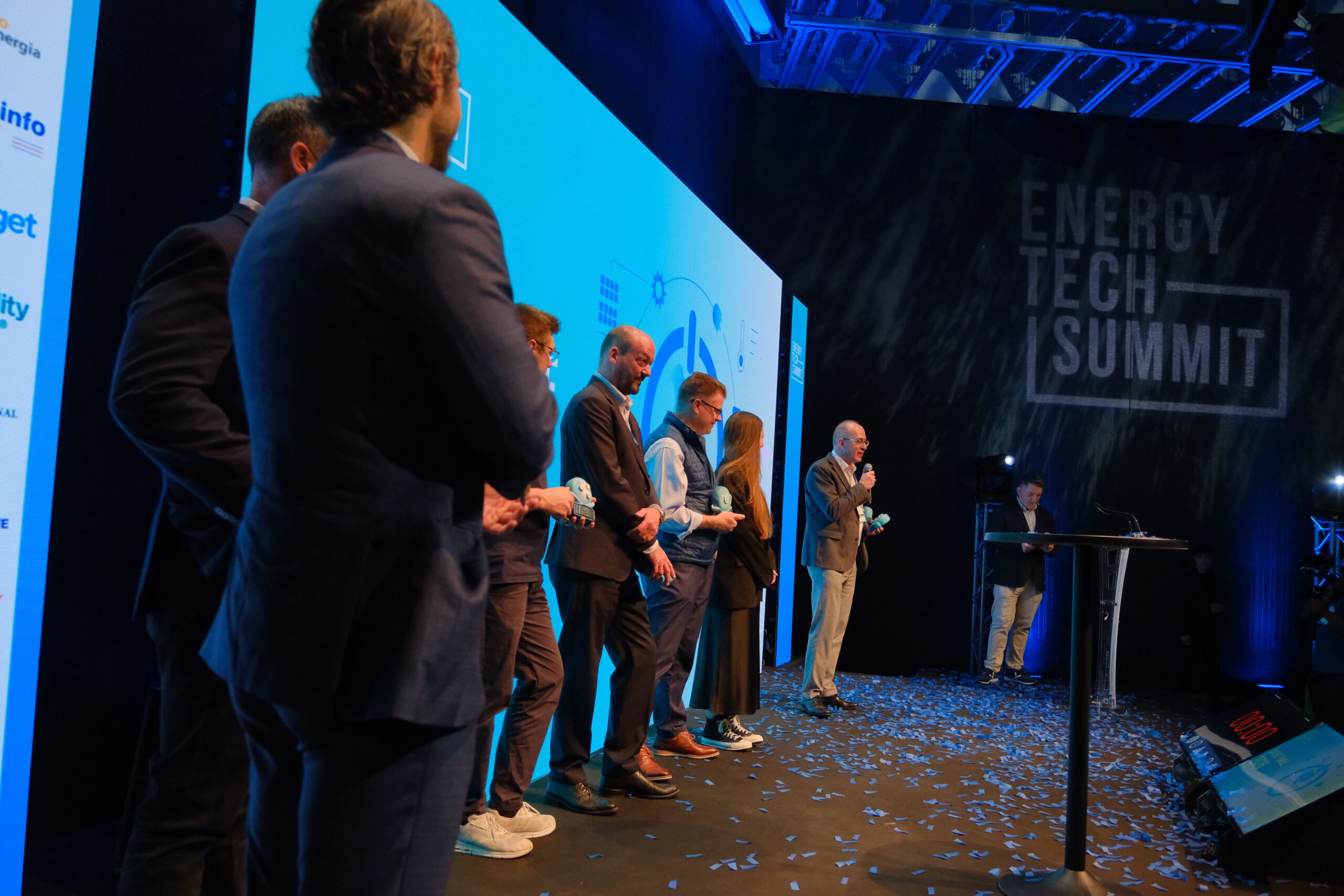
Refurbished membranes, wave-powered desalination, pink solar panels and a $35 barrel of oil: the widest-ranging track of the final.
The wild card track exists for climate tech startups that do not fit anywhere else. These are companies working on climate problems adjacent to energy rather than inside it. That is also where a lot of undercapitalized opportunity sits. The rules matched every other track: three minutes to pitch, a hard cut when the clock ran out, then jury questions. Here is what each company said, in pitching order.
Chemdoc Water Technologies
Salvador Perez, CEO and founder, opened on scarcity. Demand for water will exceed the resource by 40% in 2035, and industry currently reuses only 3% of wastewater. He framed recycling as a business continuity problem rather than an environmental one.
Chemdoc designs and builds systems for water treatment, purification and recycling. The company commits to recycling volume while using less energy and fewer chemicals. Based in France with 56 people, it targets €30 million in sales by 2030. Half of that is meant to come from a water-as-a-service model built on a fleet of loaned units.
The difference is in the membranes. Worldwide, four million membranes go to landfill or incineration every year, with no reuse route. Industrial water recycling needs them, because the water quality involved is so demanding. Chemdoc therefore takes those discarded membranes and converts them through a chemical attack into nanofiltration membranes.
Perez ran through applications: industrial facilities, energy, cooling, and drinking water where PFAS is a concern. One example from the drinks industry runs a short-loop, zero liquid discharge system. The plant reuses food-grade water on site, and the concentrated organics become a methanogenic feedstock that makes the facility energy positive. Another example is a truck in the company’s fleet that recycles process water on site. A third takes a community wastewater treatment plant and upgrades its output to drinking water grade to feed an industrial plant, saving 800,000 liters a day.
Asked about the business model, Perez said revenue today comes mainly from selling systems plus the services around them: maintenance, some operation, consumables. The company is now pivoting toward water as a service, which requires building the fleet. Fifteen containers are out on loan today.
His reasoning was commercial rather than technical. Capex is difficult to secure in industry, especially for an innovative application, and those decisions take a long time. An opex decision moves much faster, and the recurring revenue suits Chemdoc better. Selling the refurbished membranes on their own comes later, once the company has spent a few more years proving the quality grade. On cost, the 800,000 liters per day installation represented roughly €800,000 of investment.
Dryad Networks
Carsten Brinkschulte, CEO, pitched ultra-early wildfire detection, and started with the scale of the problem. Around 20% of global CO2 emissions come from wildfires, roughly what all the world’s traffic emits.
Cameras and satellites, he said, are good at managing fires that have already spread out of control. They coordinate large-scale response across thousands of firefighters. Dryad takes the complementary approach: detect within minutes of ignition, so a fire can be put out before it spreads at all.
The product is Silvanet, a solar-powered off-grid mesh network paired with solar-powered gas sensors. Customers install them in forests, along power lines, and in the wildland-urban interface. The network extends to large-scale deployments without relying on existing infrastructure. Hang the sensors on trees and they run for 10 to 15 years.
That product is fully industrialized, with 30,000 sensors installed and more than 50 clients. Next comes Silvaguard, still in development: autonomous drones that fly without a pilot to extinguish detected fires within minutes.
The unit economics work out at roughly $100 per sensor to protect one hectare of forest over a 10 to 15 year life, on a subscription model. Revenue reached 4 million last year, and the company was raising a 16 million Series A+ to extend sales and marketing. Brinkschulte also finished inside three minutes, which the host pointed out was a first.
Asked how the sensors are monitored, he described a cloud platform that manages the network, tracks the sensors and monetizes their data through a recurring subscription set at 20%. Customers buy the hardware and pay the subscription, because without the platform the sensors do nothing.
A tougher question followed. With customers like CalFire and major US utilities, why is revenue not further along? Brinkschulte did not dodge it. Utility sales cycles run 12 to 18 months, or “snails on tranquilizer,” as he put it. Still, the customers are reliable and long term, and the base extends beyond power lines and railroads to forestry departments. Revenue went from 700,000 euro in 2024 to 4 million in 2025. On insurers, who would seem the natural buyer, he was blunt: it makes sense theoretically, but practically they are too slow and they do not buy.
EcoSafi
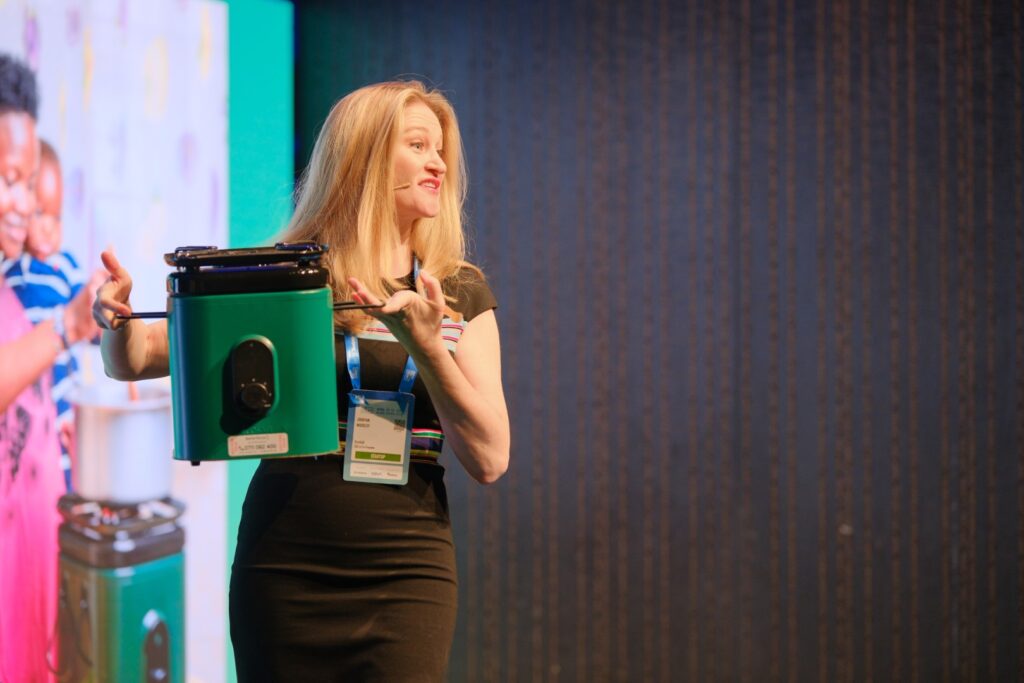
Bartosz Sroka, Chief Engineer at NanoSci pitching at Energy Tech Challengers 2026
Ocean Oasis
Sebastian Feimblatt, co-founder and co-CEO, is building desalination powered entirely by wave power. By 2030 the world will need 20 billion cubic meters of desalinated water, and desalination as currently practiced cannot deliver it. It needs land, it has to manage brine, and above all it runs on grid electricity.
That last dependency was his central point, and it connected to the rest of the summit. Grid electricity already competes with electrification and infrastructure demand. In the remote locations that rely most on desalination, the grid itself often runs on fossil fuels. That makes the whole solution unreliable.
Ocean Oasis puts a floating unit on the water that uses wave movement mechanically to drive a reverse osmosis system. It delivers fresh water to shore with zero emissions and no dependence on the grid or any other energy source. One buoy produces 2,000 cubic meters a day, enough water for 15,000 people.
With no land cost, no electricity cost and no brine impact, Feimblatt said the company lowers traditional desalination cost by 50%. It removes exposure to international oil supply along with it.
The team is 12 people. His co-founder Thomas, the inventor, brings 30 years of offshore and maritime experience from Norway, including work at DNV. Full-scale testing finished last year with strong results. The company is now building its first commercial installation with the water utility in Gran Canaria, where the islands have named it a strategic project and awarded a €6 million grant. Projects are also starting in Chile, and Ocean Oasis was raising €6 million.
The jury asked two questions at once. First, longevity, since this has to be infrastructure-grade equipment surviving years at sea. Second, cost against other desalination technologies.
On the first, the unit meets Norwegian offshore standards, meaning 30 years standing in the ocean through the worst potential storms. On the second, electricity is normally between 40 and 60% of the variable cost of desalination. Ocean Oasis saves all of it. There is extra capex to compensate for, but the company typically sees a 40 to 60% cost reduction against conventional plants.
Robotics Cats
Andre Cheung, founder and CEO, opened with a local hook: protecting Spain’s solar boom from a triple threat. The company builds AI wildfire detection and climate resilience software, and it serves paying customers in 14 countries. Detection works in both daylight and darkness.Solar PV customers use it to mitigate wildfire risk around their plants. Those customers taught the company something, Cheung said. Vegetation growth and wildlife inside the power plant are operational problems in their own right.The product the company co-created with its customers to handle all three is already protecting solar plants in Chile and Brazil. It detects outbreaks at 15 kilometers and beyond. Vegetation growth monitoring keeps sites compliant with insurance requirements, and bird detection automatically triggers acoustic deterrence.The deployment model requires no capex. The software runs on existing cameras and CCTV, with cloud AI and real-time alerts. “We make existing hardware 10 times smarter,” Cheung said. A new customer in Greece was being deployed that week.Pricing runs from $500 to $2,500 per camera per year, sold partly through channel partners: CCTV integrators, automation providers and renewable energy consultants. The team brings 25 years in IP networking and wildfire detection, spread across four countries and seven languages. Meanwhile, it was working with an investor in Asia on a Series A while looking for pilots and utility introductions in Spain.Asked for the unique value proposition against competitors, Cheung named two dimensions. Distance first: detecting early-stage wildfire far away matters, because fires often start in a neighboring area rather than on your own asset. Then time to deploy: running on existing cameras from any of thousands of vendors means installation is not the bottleneck.A follow-up asked what actually happens to a solar park owner when a fire is detected in the middle of the night. Alerts go out automatically through the company’s portal and through WhatsApp or Telegram. National parks and energy companies work directly with firefighters and go to the authorities. Homeowners get simpler advice: call the emergency number, take your bag and evacuate.
Totex Energy
Berlin Raj, co-founder and CEO, started with himself. As a kid he was obsessed with power electronics and got electrocuted hundreds of times building things, having failed to listen to his parents. That obsession led to a company in India working on hospital power systems. It replaced the power setup in 100-bed hospitals across the country, in demanding conditions.The recurring headache in those projects was heating, cooling and hot water, which accounted for more than 70% of energy demand and the bulk of the cost. Totex is his answer: a single all-in-one device handling heating, cooling, hot water, pool heating and backup power. Built-in storage combines lithium and thermal, the equivalent of more than four Tesla batteries.The starting market is US single family homes. A builder currently needs an air conditioner, a water heater, an EV charger, a battery and a panel upgrade, costing over $65,000 together. Totex does all of it in one device for $24,000. Because it is 30% more efficient than those systems combined, builders can hit their energy efficiency ratings without spending extra on triple pane glass and similar upgrades. Installing one device instead of many also cuts installation time by around 60%.The part Raj was most interested in came next. Totex turns the building’s entire load into grid capacity, shifting consumption to hours when energy prices are close to zero or negative. Customers get a fixed rate 20% below market, and when prices spike the system exports back to the grid. Traditional systems, by contrast, run whenever they run, adding stress and cost.Against the conventional ways of adding grid capacity, gas plants and grid-scale batteries, he claimed Totex is 100 times faster and six times cheaper than the best alternative. The added advantage: the customer pays for it. He was cut off there.The jury asked which segments beyond hospitals. The focus now is US single family homes, working with four of the top 10 volume builders to scale quickly, with mid-scale commercial buildings to follow.The obvious challenge followed. If a household does not need all nine components, does the math still work? Raj said the comparison holds against just an air conditioner and a water heater, which every building needs anyway. Backup power, energy recovery ventilation and everything else come on top.The sharpest question came from a juror who had read the website. The cost comparison was built on a 2,500 square foot home in Texas, while most homes are bigger and colder. Most heat pumps also struggle in cold weather. Raj said the system has been tested to -20°C, with a pilot running in Boston to test -30°C, and is rated for cold climates. On capacity, an average home needs around three and a half tons. Totex delivers six and a half, so it can run in very cold conditions without falling back on resistive heating.
Voltiris
Nicolas Weber, CEO and co-founder, closed the track with renewable energy for greenhouses that does not cost the grower any yield.Greenhouses, he argued, are a key solution for the future of agriculture: higher yields, local supply chains, less water and fewer pesticides. That is why global greenhouse surface is growing quickly, and Rabobank expects about 70,000 hectares of high-tech greenhouses worldwide by 2030. The problem is that growers still rely on fossil fuels, which are increasingly expensive, volatile and emitting.Solar should be the obvious replacement, and is not, for one reason. Conventional panels cannot go on a greenhouse because they shade it. Take light away from the crop and you take yield away from the grower, and the energy produced does not compensate for the loss.Voltiris built solar panels around spectral filtering. The part of the light needed for photosynthesis passes through to the crop. The panel harvests the rest and concentrates it onto a small solar cell. Growers get the benefits of shade while keeping the full light their plants need. Meanwhile, the electricity powers the electrification they are moving toward anyway: heat pumps, batteries, LEDs, robots and other automation. Because the panels sit within agrivoltaics, growers need no building permits, which makes deployment fast. The panels have a distinctive pink color, a side effect of the filtration.The opportunity Weber described is every high-tech greenhouse worldwide becoming a potential solar field: around 35 gigawatt peak in total, with a further 1.5 gigawatt peak added each year as growers build.Commercially, Voltiris sells energy as a service through long-term PPAs. It works with its own financing partners to fund and deploy the assets on site, so growers put nothing down. The company works with growers, greenhouse builders, utilities and financing partners. It targets around €8 million in sales this year and €15 million next, with a Series A aimed at Q2 2027. The team is about 35 people across Switzerland and the Netherlands.On cost, Weber said the alternative for most growers is simply the grid. Against grid prices in a market like Switzerland, the energy-as-a-service contract comes in about 30% cheaper per kilowatt hour.Asked how it compares with a grower building a solar park next door, his answer was that solar is cheaper, and that this is not the constraint. Growers do not have enough supply for what they need, which is the entire point. He recommends growers start with conventional solar, and expects Voltiris installations to sit alongside it in future. The differentiator is agronomic. Of every 100 in value the system delivers, he put 60 in energy cost savings and 40 in agronomic benefit to the crop.A final question on IP: three patents covering the optical properties of the solution, a tracker he could not show, and joint intellectual property developed with 3M.
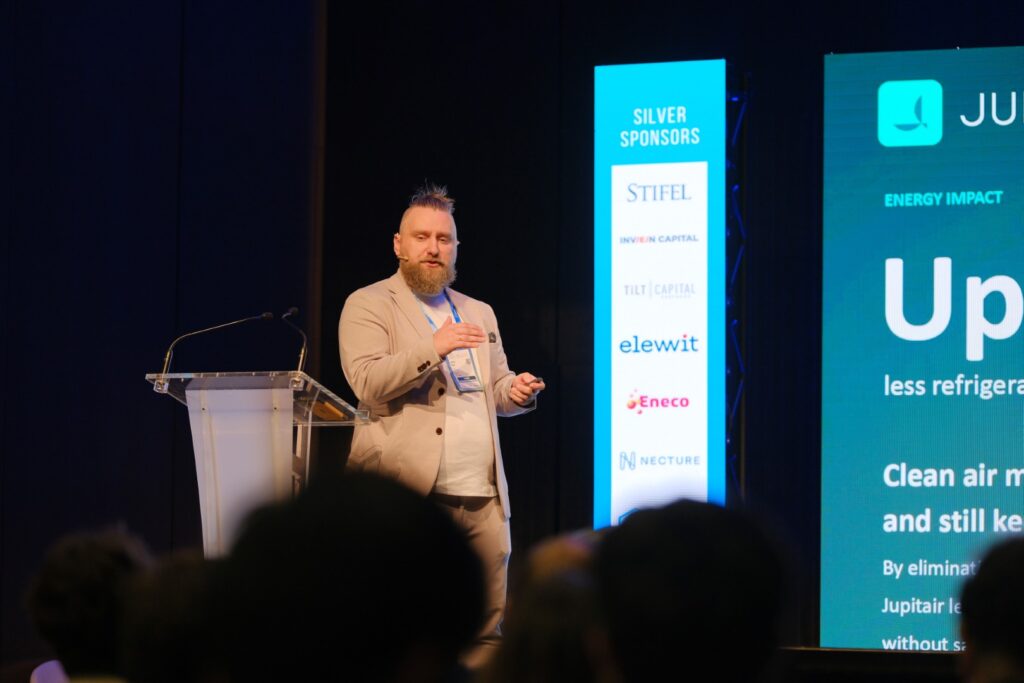
Nicolas Weber, CEO & Co-Founder of Voltiris pitching at Energy Tech Challengers 2026
Takeaway
The wild card track is the one where the connection to energy has to be argued rather than assumed. The climate tech startups that landed did it through cost. Discarded membranes become nanofiltration. Fatty sludge becomes a $35 barrel. Wave motion replaces the 40 to 60% of desalination cost that is electricity. Light a tomato plant cannot use becomes power for the heat pump heating it. Across ten very different companies, the recurring move was the same: find a waste stream or an idle surface that somebody is already paying to deal with, then turn it into the input for something else.
Energy Tech Challengers returns at Energy Tech Summit 2027 in Bilbao, April 7–8. Do you want to watch the next generation of energy startups pitch live, or take the stage yourself?