
Over 100,000 potential industrial sites in the EU alone – and a black box that nobody wants to buy on faith.
David Dunnett, CTO and Co-Founder of HEAT, opened the second day with a keynote on power plant control for industrial battery energy storage systems. He started, sensibly, by defining the term.
Power plant control is what keeps the lights on. It ensures no generation equipment gets overloaded, prevents blackouts, and keeps everything running so smoothly that nobody notices their electricity is being supplied at all.
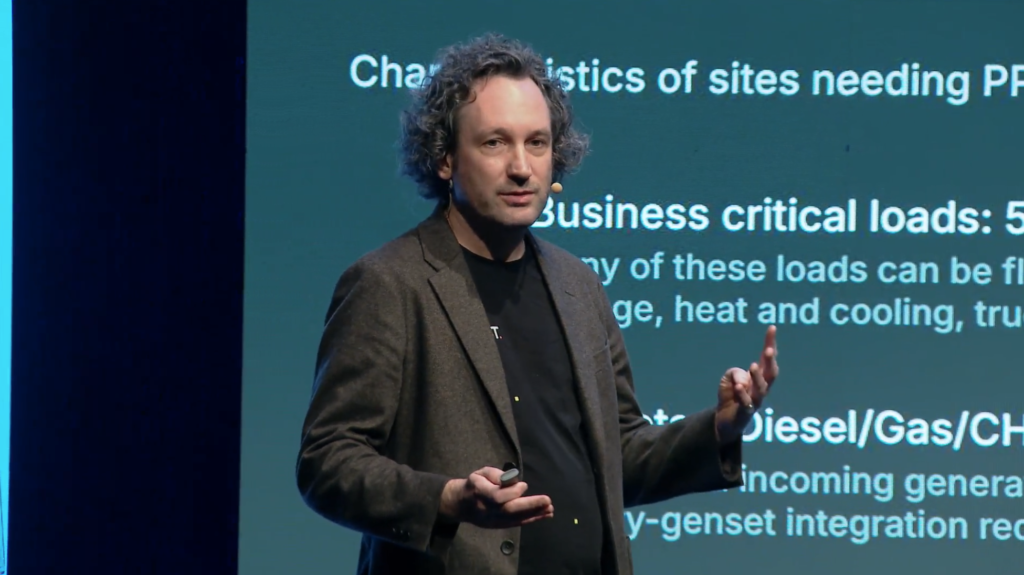
David Dunnett, CTO and Co-Founder of HEAT delivering his keynote during Energy Tech Summit 2026
Who needs it
Dunnett identified four customer groups. Data centers frequently have their own generation systems. Heavy industry typically runs a mixture of on-site generation alongside backup power needs.
Utility-scale systems in front of the meter form the third group, particularly large co-located battery and PV installations, which need very fast power plant control because of the sheer number of inverters involved.
Finally, any off-grid site without a grid connection requires it by definition.
For on-grid sites, however, there is an additional consideration. Once you have power plant control and a substantial amount of generation equipment, several routes to market open up – so sophisticated market integration becomes worth pursuing.
Why industrial sites are the opportunity
Dunnett focused on one segment: industry, where he sees a boom in adding batteries.
The reasons are the familiar ones. Batteries are cheaper, grid congestion is widespread, and regulatory changes have made industrial customers considerably more interested than before.
Industrial sites lagged on battery adoption historically. Now that is changing, and the market is substantial: over 100,000 potential sites in the EU alone for this segment.
Delivering batteries to those sites successfully, though, requires robust power plant control – which is the argument the rest of the keynote made concrete.
Splitting the transformer
Dunnett’s technical example described a complex industrial site: a factory with substantial rooftop solar, a large battery providing flexibility, backup power, combined heat and power delivering process heat, perhaps truck chargers and EV charging. The owner wants to stack as much revenue as possible.
A power plant controller acts extremely fast. HEAT’s has a 150 millisecond response time, which enables the trick at the heart of the pitch: dividing up the space at the transformer.
That division lets a site do front-of-meter revenue stacking and behind-the-meter optimization simultaneously, rather than choosing between them.
Front-of-meter means services like fast frequency response and the various frequency regulation products available in different markets. HEAT frees up transformer space so that whoever is bidding the site into those markets has the freedom and the security to bid as they choose.
Meanwhile, the controller maintains what Dunnett called a virtual base load in the background, keeping the transformer available for the site’s own use while running other optimizations such as peak shaving and dynamic tariff optimization.
Selling to the people who sell to industry
HEAT does not sell to factories directly. Instead, Dunnett described the company as democratizing project development, providing a power plant controller with embedded energy management functionality to three types of solution provider.
The first are installers and EPC contractors doing classical hardware sales. The second are virtual power plant operators, many of whom now arrive with substantial financing behind them and offer batteries and funding together.
The third group is newer: battery and inverter manufacturers approaching industrial facilities directly, offering energy savings alongside their product.
Three problems, three answers
Dunnett laid out the challenges those solution providers face, which is effectively the company’s product roadmap.
First, they have to sell it. Selling a battery into an industrial site demands considerable trust, because the customer is buying a black box performing something quite abstract. Confidence during the sales process makes the difference between a fast sale and no sale.
Second, they have to integrate it, typically alongside legacy equipment from many different manufacturers.
Third, sites change over time, so adding equipment and providing service has to stay straightforward once everything is interacting.
Simulating with the software you actually deploy
HEAT’s answer to the sales problem is what the company calls true simulation, and the technical detail underneath it matters.
Because the software is written in Rust, the company can run a simulation using the exact same software it deploys to site. That allows a one-second resolution simulation demonstrating how the virtual base load frees up front-of-meter services.
The distinction Dunnett drew is with other simulation tools built on assumptions or pure market analysis. Here, what the customer sees is precisely what gets deployed, which is what makes it a confidence-building tool rather than a modelling exercise.
What the controller does on site
Once installed, the controller is designed as a foundation that scales. Dunnett stressed ease of setup and the ability to handle any site configuration.
It is a true hybrid controller, so adding EV chargers, heat pumps, batteries, PV inverters, transformers or monitoring equipment happens through a dropdown list. Importantly, it is vendor agnostic with no lock-in, so it works with any manufacturer.
Resilience is built in too. The company supports backup power systems that back-synchronize to the grid after island mode.
All of that arrives through what Dunnett described as a modern and easy to understand interface, because getting the right information quickly matters. Robust analytics support servicing, with alarm and warning information plus high resolution snapshot capture, so providers can guarantee uptime to their customers.
Why the team claims the right to be here
The industrial market has a high barrier to entry, Dunnett acknowledged. Stakes are high, the equipment is heavy, and the loads are exactly where the customer makes their money. Consequently, trust is decisive.
His argument for HEAT’s credibility is the founders’ history. All three were early employees at a Berlin containerized lithium-ion battery system integrator that, back in 2014, was selling battery systems to off-grid sites combining diesel, battery and PV. That gives them over a decade of experience with exactly this combination of technologies.
That company was acquired by Rolls-Royce in 2022, and all three founders left shortly afterwards to form HEAT.
The company is only a couple of years old, having spent the first year building the core product. It now has four operational sites, a further 18 contracted and under construction, and 11 activated sales channels. Crucially, it has no preference for any particular electricity market, because the work happens on the ground with the power plant control itself – so it can partner with any market integrator anywhere.
Takeaway
The technical claim in this keynote is that fast power plant control lets an industrial site serve two masters at once, splitting transformer capacity between market services and its own optimization rather than choosing. The commercial insight underneath it is more interesting. Dunnett identified the real obstacle to selling batteries into factories as trust, not economics – a plant manager is being asked to put a black box next to the equipment that generates all their revenue. Running the simulation on the identical software that will later run the site is an unusually direct answer to that problem: it turns the sales pitch and the deployment into the same artifact.
The keynote stage returns at Energy Tech Summit 2027 in Bilbao, April 7–8.