
Half the world’s flights travel under a thousand kilometers. Elysian wants to fly them on batteries that already exist.
Daniel Rosen Jacobson, Co-Founder and CEO of Elysian Aircraft, opened his keynote on electrifying aviation with a childhood memory rather than a specification. He asked the room how many had flown in a propeller aircraft, and roughly half the hands went up – fewer than he expected.
The aircraft on his slide was a Fokker 50. He flew in that type as a boy, because his father built a regional airline around it through the 1990s. Moreover, he often sat in the cockpit, looking out over the world from the air. That, he said, planted a seed about what aviation could mean.
Despite his father’s ventures, he did not go into aviation at first. Instead, he spent time at Google and built a video streaming startup to global scale and an exit. Eventually, though, the pull grew stronger. He then met two aerospace engineers, and together they founded Elysian.
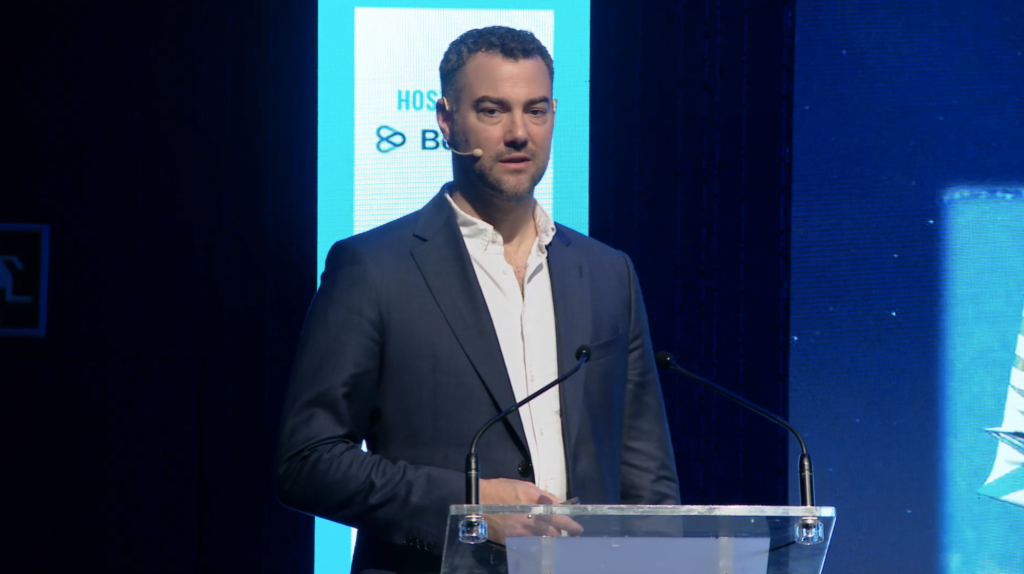
Daniel Rosen Jacobson, Co-Founder and CEO of Elysian Aircraft, delivering a keynote on the ETS2026 stage.
Two insights behind the company
The first insight concerns fuel, and it applies to civil and defense aerospace alike. Aviation has a massive dependency on fossil fuels, and solving it is genuinely hard, because working with other energy sources in the air is difficult.
That dependency carries consequences. It means emissions, and it also means noise and heat. Consequently, it obstructs decarbonization on the civil side. Furthermore, it creates problems for defense, where an aircraft that is loud and hot is also detectable – and a detectable aircraft, as recent conflicts have shown, can be spotted and taken out. Therefore the same bottleneck sits across both industries.
The second insight is that aviation is intensely local. Around half the world’s flights travel up to a thousand kilometers, while roughly 80% travel up to two thousand.
Crucially, the aircraft flying those routes are not the propeller planes he grew up with. Those have been phasing out slowly over the past decades. Instead, narrow bodies now dominate – the Boeing 737 and Airbus A320, the most profitable planes in the world. Although they can fly 6,000 kilometers, airlines also use them for 500-kilometer hops, purely for economic reasons.
As a result, any concept aiming at this market has to compete with those aircraft on a per passenger basis. That constraint shaped the design.
The aircraft: 90 passengers, 800 kilometers, no new chemistry
Elysian’s design is a 90-passenger aircraft travelling 800 kilometers purely on batteries, using battery technology that exists today. Notably, that means no new chemistries. The company does need efficiency improvements, but within the lithium sphere. With solid state batteries, meanwhile, the range could extend to a thousand kilometers or beyond.
Rosen Jacobson stressed that the invention has been validated externally, naming the Technical University of Delft, DLR in Germany and MIT.
So what makes it work? At first glance the aircraft looks conventional, yet it is not. It has a very large wing and a small fuselage, with batteries integrated into the wing – which forms part of the company’s core IP.
It is also heavy. In fact, a 90-passenger Elysian weighs about as much as a Boeing 737 carrying twice as many people.
Beyond the wing, four further elements define the design. First, multiple engines distribute the power, which allows optimization for both efficiency and noise. Second, a high voltage system. Third, a reserve energy system using a turbo generator, since carrying reserves as battery weight would be less efficient. Finally, reusable battery packs developed in house, which allow circular swapping every year.
Importantly, these technologies have applications beyond Elysian’s own aircraft. They suit certain UAV applications, and they also serve hybrids, which need batteries and power systems too. Accordingly, the company is running a hybrid fuel cell project with another aerospace firm, partially funded by the Dutch government.
From project to flying demonstrator
The timeline started as a project in 2021, and the company followed in 2023. After validation, Elysian moved into preliminary design. Currently, it is turning those ideas into physical technology demonstrators.
Recently, the team completed the first flight of its scaled demonstrator – roughly 7.5% of the eventual aircraft, though built to the exact form and shape of the final design. Naturally, performance is scaled down in batteries and engines. Even so, Rosen Jacobson called it a major milestone, because it lets the company test aerodynamics and software properly.
Alongside the demonstrator, several rigs are running in the workshop. There is a power distribution rig built as a one-to-one scale wing. There is also a wing integration mockup testing battery systems at full scale. In addition, the company builds its own battery modules and recently completed thermal runaway testing on them.
Is it actually cleaner, and is it affordable?
Two questions decide whether any of this matters. First, how clean is it? Second, does it make economic sense?
On the first, Elysian commissioned research with a Dutch research institute examining every option for travelling distances up to a thousand kilometers, assessed across the full life cycle including production and infrastructure. On that basis, the aircraft performs best per passenger kilometer. Remarkably, it even beats the electric train once infrastructure is included, in cases where no track exists yet.
On the second, operational costs must undercut the alternatives before airlines will adopt anything. Therefore the company built an extensive economic model. According to that model, the aircraft beats regional jets on a per passenger basis straight away. Furthermore, at higher fuel prices it beats narrow bodies as well.
Rosen Jacobson was careful about the caveat. Today’s fuel prices are unusual because of geopolitical conditions, so current competitiveness reflects an atypical moment. Nevertheless, he expects sustainable aviation fuel costs and charges on fossil fuels to close that gap durably over time.

Audience at Elysian Aircraft’s keynote delivered by Daniel Rosen Jacobson, Co-Founder and CEO.
What airports would need to charge it
Since this was an energy conference, Rosen Jacobson also addressed charging, drawing on a research report the company produced on the future of airports.
The capacities involved are substantial: around 15 megawatts per aircraft. However, the technologies already exist. Megawatt charging standards are established, and comparable power units already operate in shipping, mining and trucking. Consequently, the company has seen equipment capable of delivering what it would need.
Installing that capacity brings additional benefits, too. Airports could optimize between peak and off-peak demand, and they could add stationary storage alongside it.
Partnerships, team and the raise
Elysian announced a co-development partnership last year with an airline group, and it also works with an aircraft leasing company. Meanwhile, support from the wider industry continues to grow.
The team numbers around 30. Many are aerospace engineers or industry veterans who have worked on aircraft programmes in both civil and defense aerospace.
Takeaway
Most electric aviation concepts wait on a battery breakthrough. By contrast, Elysian’s argument is that the chemistry needed already exists, and that the real work sits in airframe design – a very large wing, batteries built into it, distributed engines and reserve power handled by a turbo generator rather than extra cells. Whether that holds depends on economics rather than physics. Short-haul routes are flown today by narrow bodies chosen for their profitability, so electrifying aviation on those routes means beating them on cost per passenger. That, ultimately, is the number to watch.
The keynote stage returns at Energy Tech Summit 2027 in Bilbao, April 7–8.