
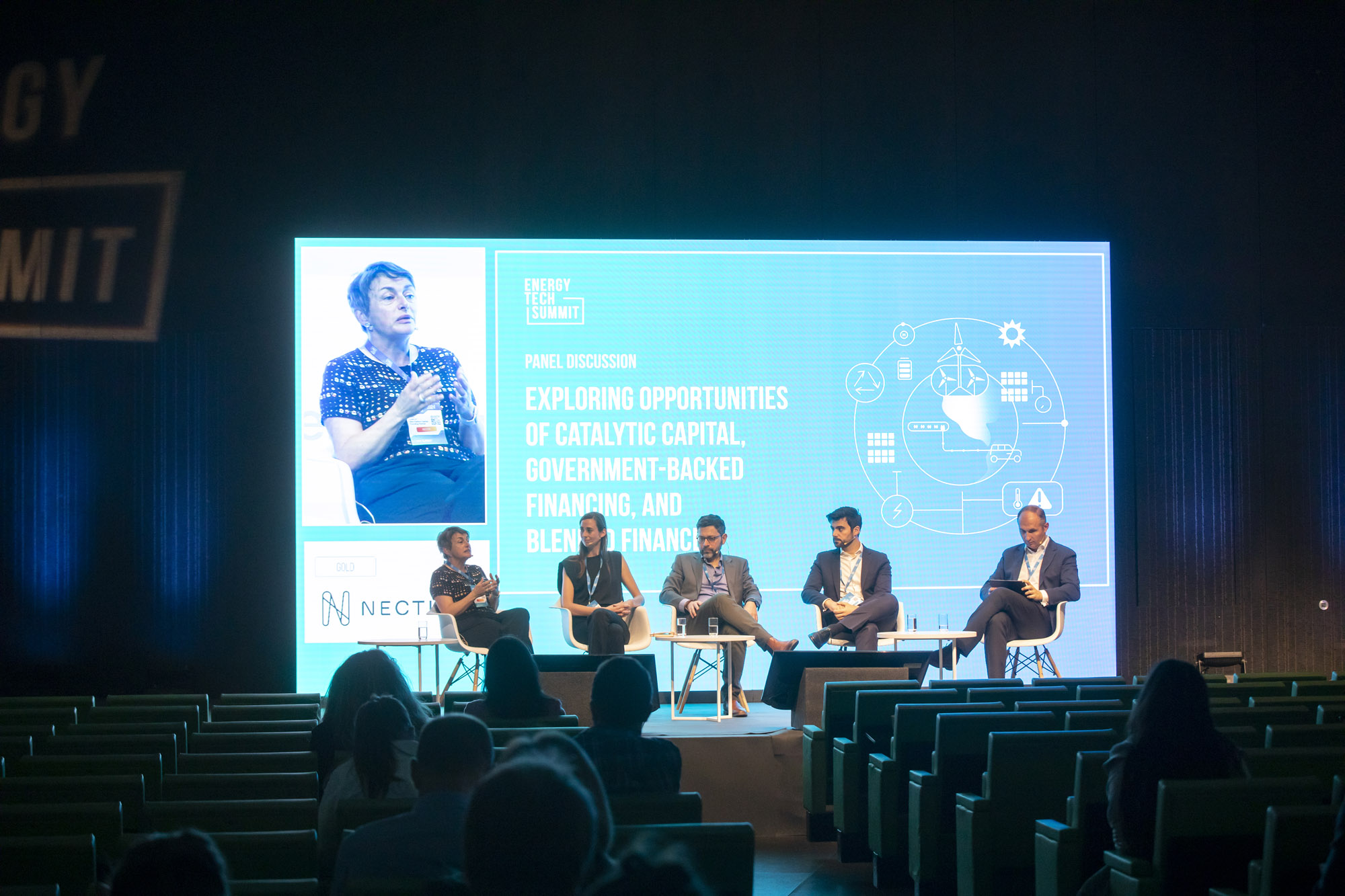
Philanthropic, public and venture investors explained how grants, flexible equity and public debt can carry climate innovation through the valley of death.
Decarbonization could become one of the largest investment cycles in human history. Yet many of the technologies it needs are too risky for traditional lenders and too capital-intensive for venture capital alone. At Energy Tech Summit, a panel explored how catalytic capital, public finance and philanthropy can help close that gap.
Antonio Bravo Acín, Global Head of Sustainability Strategy and Net Zero at BBVA, moderated the discussion. He was joined by Alberto Toril of Breakthrough Energy, Pippa Gawley, Founding Partner at Zero Carbon Capital, Beau-Anne Chilla, Partner at Anthemis, and Khalid Naqib, Senior Investment Officer at EIB Cleantech Equity & Growth Capital.

Beau-Anne Chilla from Anthemis at Energy Tech Summit 2024 panel discussion.
A technological revolution with a purpose
Bravo Acín framed decarbonization as a technological challenge that touches almost every industry. Like every technological revolution, it depends on investors to fund and support new technologies. Because the purpose is to cut greenhouse gas emissions, the challenge is even more appealing to entrepreneurs, investors and academia.
The panel set out to make that tangible: which technologies are emerging, and how is the money reaching them?
Breakthrough Energy’s funnel from lab to market
Toril explained that Breakthrough Energy, founded by Bill Gates, brings together scientists, policy experts, innovators and investors. Its goal is to make green “as cheap as brown” by eliminating the green premium. Every technology it backs must be able to cut at least half a gigaton of CO2-equivalent emissions a year at scale.
Its platforms cover each stage of maturity. Breakthrough Energy Fellows supports researchers and very early-stage founders over two years. Breakthrough Energy Ventures then invests in startups across electricity, transport, agriculture, buildings and manufacturing.
Toril shared several examples. In storage, Form Energy develops iron-air batteries for multi-day storage, while Rondo’s heat batteries store electricity and release it as high-temperature heat for industry. In Spain, H2SITE uses palladium-based membranes to separate hydrogen from ammonia or gas blends more efficiently.
Finally, Breakthrough Energy Catalyst targets the valley of death, when companies build pilots and first-of-a-kind plants. It blends equity and grants with public funding to lower risk and help projects become bankable.
Backing science at the earliest stage
Gawley’s firm, Zero Carbon Capital, invests at pre-seed and seed in scientific innovations across Europe and Israel. Like Breakthrough, it targets problems on the half-gigaton scale.
Most VCs avoid companies that still carry scientific or technical risk. That is why Zero Carbon Capital’s team of scientists and engineers focuses on that stage, helping founders de-risk their technology and reach the next round.
One portfolio company, RepAir, is developing electrochemical direct air capture with the potential for very low energy costs. Another, Phycobloom, engineers algae to secrete oil, so producers can skim it off without killing the algae. In Gawley’s view, the company has “fundamentally reinvented the technoeconomics” of algae biofuels, with sustainable aviation fuel as a promising market.
Why hardware deserves more investors
Chilla came to deep tech investing from impact investing, where she saw how few VCs back hardware. Yet “we are not going to solve the climate crisis with only software,” she said. Her firm invests in hardware and deep tech at seed and Series A and keeps capital in reserve for follow-on rounds.
She highlighted Nuventura, a Berlin startup making what she called “an incredibly sexy product”: switchgear without SF6. That gas, widely used in grid switchgear, is around 23,500 times more potent than CO2 and stays in the atmosphere almost indefinitely.
Nuventura’s CTO once asked his former employer why it didn’t develop an SF6-free alternative. When the answer was that SF6 made them a lot of money, he quit and founded his own company. Its switchgear is now certified and on the market. Meanwhile, EU rules are phasing SF6 out of new switchgear from 2026 – a strong example of hardware innovation and regulation reinforcing each other.
The EIB’s role from venture to project finance
Naqib explained that the European Investment Bank lends tens of billions of euros a year. In his view, its most impactful activity is the much smaller share that goes into venture equity and venture debt for clean tech, deep tech and life sciences.
The EIB tries to cover the full spectrum. At seed stage, the European Innovation Council provides grants and equity. The EIB then follows with venture debt, typically in the tens of millions, before supporting project finance once technologies mature. Its clean tech scope spans energy, mobility, industrial decarbonization, the bioeconomy and the circular economy, with examples including silicon anode developer LeydenJar and long-duration storage company Energy Dome.
How catalytic capital can unlock scale
Bravo Acín then asked how policymakers and financial institutions can maximize impact. Naqib stressed dialogue: regulatory obstacles often hold back promising technologies, so feedback from the venture world matters.
However, he warned that “subsidy is not the answer” in the long run. Technologies that depend on subsidies alone won’t scale. Instead, they must become “better cheaper faster than fossil equivalents.”
The key, he said, is to create assets that infrastructure investors can back – with reliable revenues, insurance structures and contractor risk-sharing. That happened in solar and offshore wind, and it can happen in energy storage and e-fuels too.
Toril described the partnership between Breakthrough Energy Catalyst and the EIB. Catalyst provides grants or flexible equity, while the EIB adds venture debt, tailoring the mix to each project’s risks. Projects announced at COP28 included Energy Dome’s long-duration storage plant in Sardinia.
In the US, Catalyst also backed Infinium’s sustainable aviation fuel project. For Toril, the most innovative part wasn’t the equity but helping secure a long-term offtake agreement with American Airlines, which made the project bankable.
Europe’s missing growth capital
Chilla argued that Europe’s main gap is growth capital. Early rounds attract enough interest, but large-scale factories need far more money. The EIB plays a critical role, she said, but Europe could learn from the US in channeling institutional money, such as pension funds, into venture capital.
Gawley summed up the opportunity. “We know how to scale things we know how to build things we know how to fund projects,” she said. The challenge is to offset the higher risk of unproven climate technologies – through foundation money, government funding or clever insurance vehicles – so traditional project finance can follow.
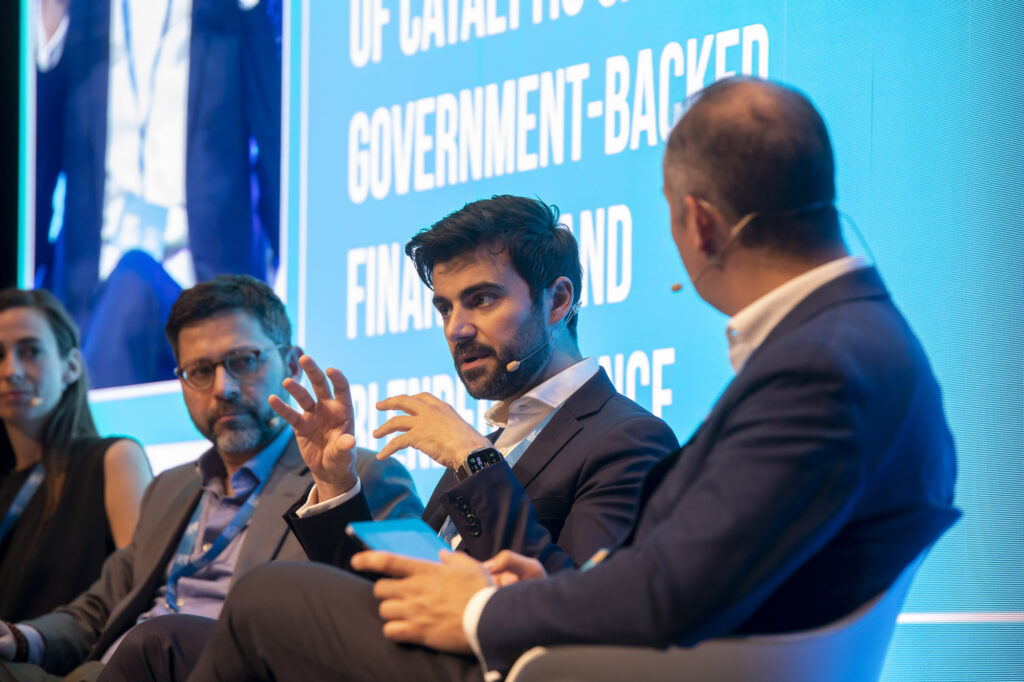
Alberto Toril from Breakthrough Energy sharing insights at ETS2024 in Bilbao.
Takeaway
Promising climate technologies already exist, from multi-day storage to SF6-free switchgear and new biofuels. Scaling them, however, requires far more than equity.
Catalytic capital – grants, flexible equity, public debt and smart offtake structures – can de-risk first-of-a-kind projects until mainstream investors are ready to step in. Ultimately, the goal is technologies that are cheaper than fossil alternatives and bankable on their own.
Secure your pass
Want to meet the investors funding climate technology from lab to market? Join us at Energy Tech Summit Europe 2027, the 8th edition, on 7–8 April in Bilbao, Spain.
Passes cost €1,399 until 30 November, then €1,599 from 1 December, €1,799 from 1 February 2027 and €1,999 from 1 March 2027.
Founders can join with the Founder’s Pass for €699. Use code ETS100 for €100 off.