

Computer vision on power lines, acoustics inside transformers, thermal models behind heat pumps. Inside the AI Applications pitches at Energy Tech Summit.
AI energy startups tend to get discussed in the abstract. On the Energy Tech Summit pitch stage, they get eight minutes and a jury instead. The AI Applications track brought founders working on inspection, fault prediction, flexibility, district heating and building efficiency – and the jury pushed hard on business models, differentiation and traction.
Arkion: seeing defects before they fail
Louise Gauffin opened with a blind spot. Grid outages and failures cost the global economy an estimated $150 billion a year, and around 90% of defects go undetected, because “we haven’t had proper tools to inspect and assess the condition of our grids”.
Arkion, a computer vision company headquartered in Stockholm, works on data utilities already collect. Grid inspections mean flying the network by helicopter or drone while capturing images, thermal data and LiDAR point clouds. Arkion ingests those datasets, gives operators a visual representation of their assets, then flags defects, anomalies and vulnerabilities. Maintenance, investment planning and inventory decisions therefore become preventive rather than reactive.
The company works with transmission and distribution operators across Europe and the Americas, including E.ON. Customers have moved from testing to deployment at scale, which generates real operational proof points.
On the jury’s question about revenue quality, Gauffin explained a two-part software model: a monthly subscription based on grid size, plus a transactional fee each time an operator uploads inspection data for analysis. Both recur, since inspections are mandatory in most markets – annually in the Nordics.
Clevergy: helping retailers survive the transition
Beltran Aznar framed a countdown for energy retailers. Distributed energy resources are spreading fast, and within a decade most households will own several. That shift demands enormous grid investment, yet households could help solve the problem instead.
The retailers winning today share three capabilities: smart services, tariffs and operations; the ability to sell and manage assets such as solar, batteries and heat pumps; and the ability to work with grid flexibility. For traditional players, Aznar was blunt. “Either they adapt or they die.”
Clevergy takes retailers from zero to all three. The platform integrates smart meter data, energy assets and market data. It then delivers either a white-label consumer app or enrichment of an existing one, plus APIs into the systems retailers already run, including CRM and billing.
The market is crowded, so go-to-market matters more than features. Aznar argued the winner will be whoever manages the most households, and retailers are best placed to gather them. Clevergy therefore leads with the problems retailers have today rather than with flexibility, which remains less urgent in southern Europe than in the UK.
Dyneo Technologies: heat is the bigger half
Max Carrel started by resizing the problem. Clean electricity dominates the conversation, yet heating and cooling represent a far larger share of global energy use – and remain largely unelectrified and fossil-fuelled.
District heating and cooling offers one route through, and European policy pushes hard for it. Existing networks still run mostly on fossil fuel, though, and their operators face real pressure to decarbonize.
Dyneo sells utilities software that reduces heat loss, raises the renewable share in the mix and simplifies operation. The technology collects data from existing infrastructure through purpose-built connectors, without heavy modernization first. It then detects and prioritizes performance-degrading issues and recommends fixes, so networks gain efficiency that lasts.
Asked about differentiation, Carrel pointed at the data layer. The sector remains largely undigitalized, so Dyneo collects what exists and deploys easy-to-connect IoT gateways where it does not, using third-party electricians. Its data-driven modelling also saves client time. The aim, he said, is to be “as frictionless as possible in terms of deployment”.
Eneryield: predicting faults without new hardware
Ebrahim Balouji went straight to the nightmare scenario for any utility: the outage. Faults and failures cost the United States more than $150 billion, and the global figure runs past $300 billion. Full modernization would cost trillions, and even partial substation upgrades carry a price.
Eneryield avoids that spend entirely. The software uses relays and merging units utilities already own, analysing only voltage and current to detect abnormalities and predict failures. It localizes faults to the meter and identifies the root cause – a transformer, for instance, or overhead lines. The approach works for underground cables and for assets inside and outside the substation.
Balouji reported 97% accuracy across projects deployed in the United States, Sweden, wider Europe and the Middle East. Customers see lower maintenance costs, most failures predicted before they happen, and meaningful savings per substation.
Geographic reach at this stage comes from partners, including ABB and system integrators. Crucially, each new customer does not require training from scratch. A model trained on a large historical anomaly dataset transfers with light tuning. Pricing runs either as a perpetual licence with support or as a subscription, cloud or on-premise.

Ebrahim Balouji, CEO & Co-founder of Eneryield
enjoyelec: flexibility starts with the customer experience
Ethan Zhu made an argument the flexibility debate often skips. Households will only let their equipment be flexed if the experience stays good. Nobody surrenders control of their heating to save money if the house gets cold.
The obstacles are practical. Manufacturer clouds respond too slowly for real-time control. Optimising a single house in isolation achieves little. And grid-side limits, such as German rules on curtailable loads, are hard to honour from the cloud alone.
enjoyelec installs one hardware unit per home to connect every device, then optimizes across all of them. Connecting them is the hard part, because almost every manufacturer uses a proprietary protocol, so integration work dominates engineering. The system combines cloud AI with an edge AI chip, drawing on weather, spot prices, tariffs and demand data alongside live household data. Local optimization continues when connectivity drops during storms.
The company sells white-label through installers, distributors and utilities, adapting to national rules market by market. Revenue comes from one-off hardware plus a recurring cloud subscription, sold either direct to consumers or bundled by partners.
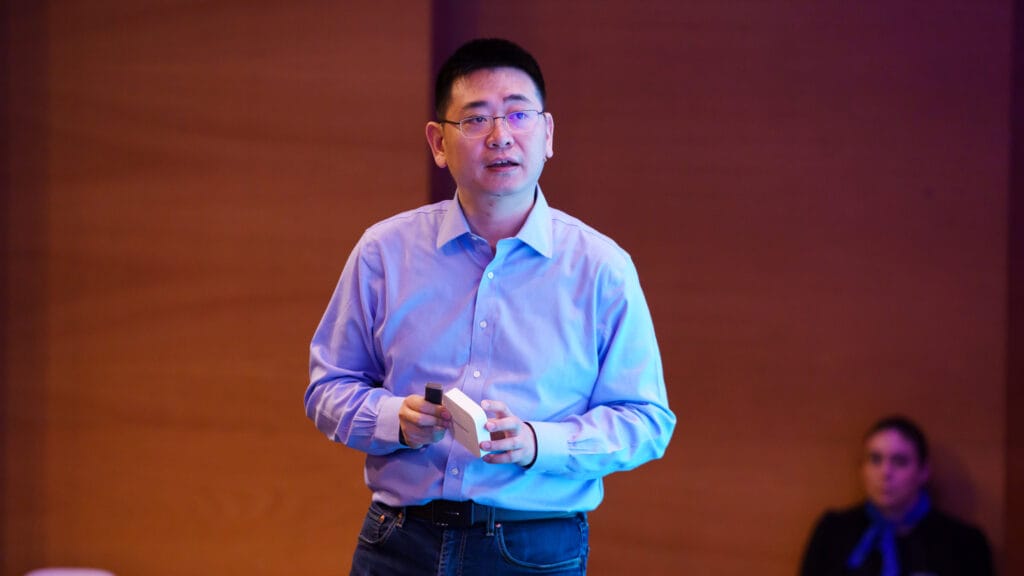
Ethan Zhu , CEO of enjoyelec
Neuron Soundware: machines that can be heard
Pavel Konecny builds what he calls “brainware for machines”. Self-driving cars get the attention, yet countless industrial machines could work far more intelligently than they do.
Neuron Soundware processes sound first, then other sensor types, to catch faults early. Applications range from preventing scrap on production lines to predictive maintenance on hydro plants, turbines and, increasingly, transformers. If a machine exists and stays in place, it can be monitored.
The product ships as one industrial-grade IoT device powered by NVIDIA compute modules, handling up to 16 sensors and processing data in the box. A newer feature trains models on the device itself, calibrating large pre-trained models to each individual machine to strip out false alerts.
Scalability comes from that calibration loop. Deploy the hardware, record for two days, then train. Konecny also described integrating large language models, so a service manual upload turns a detected issue into concrete steps for a technician.
Revenue arrives through an activation fee covering hardware deployment, plus SaaS or OEM licensing.
NOX Energy: flexibility through heat pumps
Axelle Moortgat opened in Texas during the 2021 freeze, when plants failed, operators were overwhelmed and the damage ran into the tens of billions. “But here’s the thing, this isn’t just a Texas problem.” As electric cars, solar panels and heat pumps multiply, grids everywhere approach their limits.
The conventional answer is to build more infrastructure. Moortgat asked a different question: what if the assets already installed could do the work? Suppliers balance supply and demand every second, while millions of renewable assets sit idle with spare capacity. The two sides simply do not talk.
NOX integrates directly into manufacturers’ systems, which opens access to entire asset portfolios. When the grid runs over or under capacity, the platform adjusts power within seconds.
Differentiation comes from focus. NOX ships no hardware, and it targets heat pumps while most competitors chase EVs and batteries. The algorithm predicts thermal need first, then converts that into electrical consumption, which makes it far more precise. Europe also has many more heat pumps installed than EVs or home batteries, so the wedge is wide.
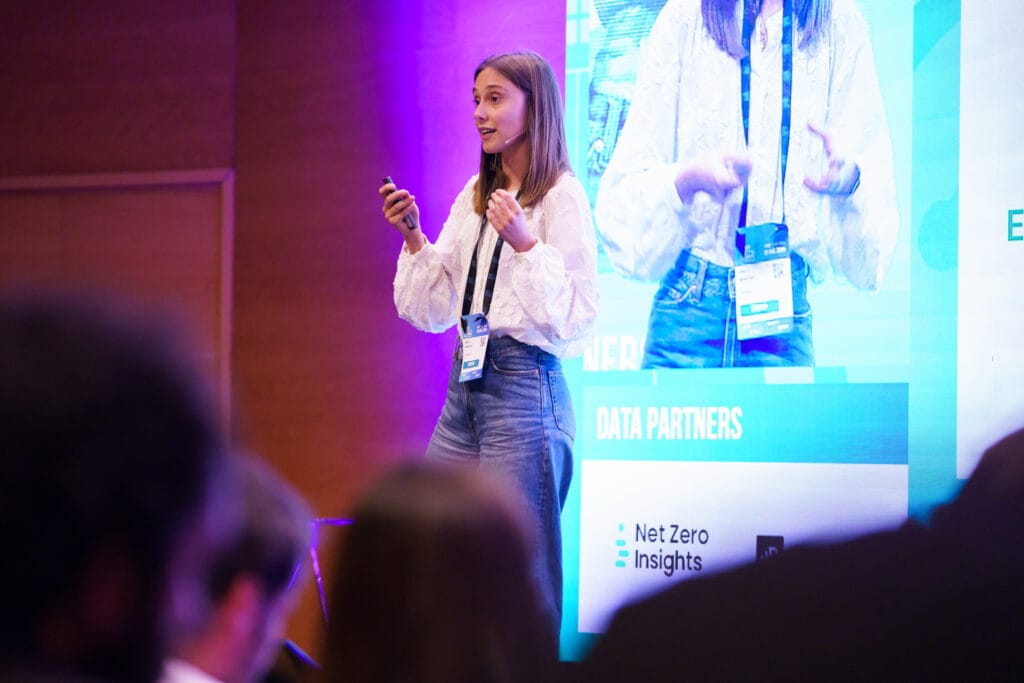
Axelle Moortgat, CEO of NOX Energy
Takeaway: what these AI energy startups share
Across the track, one pattern repeated. These AI energy startups avoid asking utilities and consumers to build something new. They work with data and hardware already installed – inspection flights, protection relays, smart meters, heat pumps, building management systems – and extract value from it. The jury pushed hardest on recurring revenue and on how each company reaches customers at scale. Those answers, more than the models themselves, separated the pitches.
Secure your pass
Energy Tech Summit brings together the startups, investors and corporates building the energy transition. Founder’s Pass is €699, fixed.