
Investors from across Europe explained how climate tech funding has matured – and why public capital, incumbents and carbon markets will shape what comes next.
Climate tech has lived through several hype cycles. Now, investors are looking for smarter ways to fund it. At Energy Tech Summit, a panel explored how blended finance, public capital and new financial tools can drive more investment into sustainable solutions.
Margarita Skarkou, Principal at 2150, moderated the discussion. She was joined by Matthias Dill, CEO and Managing Partner, Europe at Energy Impact Partners, Jeremy Brown, Investment Principal at Anthemis, Elisa Steccaglia, Principal at XAnge, and Bianca Dragomir, Director at Cleantech for Iberia.

Bianca Dragomir, Director at Cleantech for Iberia, moderating a panel on blended finance in energy tech at ETS2024.
Five perspectives on climate tech investing
The panel brought together very different investment views. Skarkou invests at Series A and B for 2150, a climate tech firm based in London and Copenhagen. She also advises UKRI and Innovate UK, the UK government’s main innovation funding bodies.
Energy Impact Partners is a global platform focused on the energy transition, investing in the US and Europe. Anthemis, by contrast, is a fintech investor with a strong interest in climate fintech, backing companies from pre-seed to Series D.
XAnge is an early-stage VC firm based in Paris and Berlin, investing across industries with energy as a key focus. Finally, Cleantech for Iberia brings together investors and innovators to turn Spain and Portugal into Europe’s next industrial clean tech leader.
How generalist VCs approach climate tech
Steccaglia explained that XAnge starts with macro trends and large markets. The EU’s goal of climate neutrality by 2050, for example, drives demand for new energy sources as well as solutions that remove CO2. That is why XAnge has backed companies in direct air capture and forest health.
Grid stability is another trend. As renewables take a larger share of the energy mix, storage becomes essential.
Team matters too. XAnge looks for complementary skills, manufacturing expertise for industrial businesses and founders who build customer relationships early. As a generalist fund, it leans towards software, which is less risky. Still, it makes exceptions for strong hardware plays.
Public funding has also changed the picture. Support from governments and the EU gives climate companies leverage on private equity that other sectors rarely enjoy.
From hype cycles to fundamentals
Dill has watched the sector go through several waves. Around 2007 and 2008, excitement was high. Some technologies, such as residential solar, worked, while others didn’t.
Then came a lonely period. When he built his first energy-focused fund in 2014, “people literally questioned my sanity,” he recalled. Excitement returned later, peaking when companies went public via SPACs at billion-dollar valuations without a working product.
Beyond the hype, however, a real shift has taken place. In Dill’s view, “the heavy lifting has been solved,” since renewables are now often the cheapest source of energy. That success creates new problems, such as managing fluctuating generation and storage. Those challenges lend themselves to software, which makes this an exciting time to invest.
Why startups need incumbents
Energy Impact Partners works with a large group of utilities and industrial companies. Dill sees them embracing innovation far more actively than before.
That matters because energy is different from sectors such as e-commerce. “You cannot ship electrons by mail or by email,” Dill said. Startups need to understand – and often partner with – the players that run existing infrastructure.
Why blended finance matters for Iberia
Dragomir described Cleantech for Iberia as a bridge between innovators, investors and government. Iberia, she said, is “already a clean energy superpower.” At the time of the session, she noted that around 20% of the world’s green hydrogen projects were in Spain, and that clean tech investment in the region had grown sixfold in five years.
Yet there is a severe Series B gap. According to Dragomir, Iberian clean tech startups received 70% less investment than their peers in Germany and France, while around 500 clean tech startups in Spain alone needed funding to scale. Many of them sit in a no man’s land, unable to scale without public support to de-risk them.
Public funding can de-risk private investment and build confidence. For Dragomir, the closest thing to a silver bullet is blended finance: mechanisms that combine grants, equity and venture debt from public and private sources.
Public money as a catalyst
Dill strongly agreed. Public, state-backed investors often sit behind private platforms, and they bring patience and a longer view. He singled out countries such as Norway and Ireland for helping ecosystems emerge.
Steccaglia added that Europe is ahead in some ways. The EU aims to mobilize around €1 trillion for the green transition this decade, and its Innovation Fund offers grants for net-zero projects. For example, battery maker Verkor raised around €2 billion, with only about a third of it as equity.
Skarkou shared a UK example. Innovate UK has rolled out programs that match equity with grants, as well as innovation loans with a higher risk appetite. She is now working on how to scale those loans for first-of-a-kind projects in a blended finance model.
Dragomir pointed to a European example announced at COP28. Breakthrough Energy Catalyst, the European Investment Bank and the European Commission combined forces to fund first-of-a-kind projects in sustainable fuels and long-duration storage, including Energy Dome in Italy. However, “we need this to become business as usual,” she said.
Europe versus the US
Dill also warned about competition from the US. The Inflation Reduction Act has a strong pull, and several of his companies have moved there. One early-stage company received a large US grant. As he put it, “people go where the money is.”
Dragomir argued that Europe already has the tools to respond. She estimated a clean tech investment gap of around €50 billion until 2030. Institutional capital, public guarantees and carbon pricing revenues could help close it. In her view, more of those revenues should fund clean tech deployment rather than traditional infrastructure.
Climate fintech and carbon markets
Brown shared Anthemis’ view from the fintech side. He is especially interested in carbon markets, and in particular the voluntary carbon market. “As an investor we like some degree of certainty,” he said, and growing emphasis on integrity and credit quality is helping.
Some banks forecast dramatic growth for the voluntary market by 2030. “I’m honestly skeptical,” Brown said. The market still lacks the digital infrastructure and robust marketplaces needed to scale.
Meanwhile, governments are cracking down on false green claims, and registries such as Gold Standard and Verra are tightening control over how credits are validated. Brown expects a more registry-centric approach to create a single source of truth. Together with exchanges and startups, that could help the market scale.
Skarkou added a portfolio example. CarbonCure injects CO2 into concrete during curing, reducing the cement needed. It also generates carbon credits, which add a high-margin revenue stream to a hardware business.
Dill noted that buyers seem willing to pay a premium for high-quality removal credits. Brown was more cautious: some buyers later found they had overpaid for credits of poor quality.
Predictions for climate tech finance
To close, Skarkou asked each panelist for a prediction. Dragomir hopes to see more blended finance across Europe, including more flexible financing for Spain’s large decarbonization projects.
Steccaglia sees a great moment to start a company, as VC investment picks up after a tough 2023. Brown expects insurers to develop new products, for example to protect carbon credit buyers. Finally, Dill predicted “more pragmatism,” leading to more transactions and, he hopes, the first exits in energy tech.
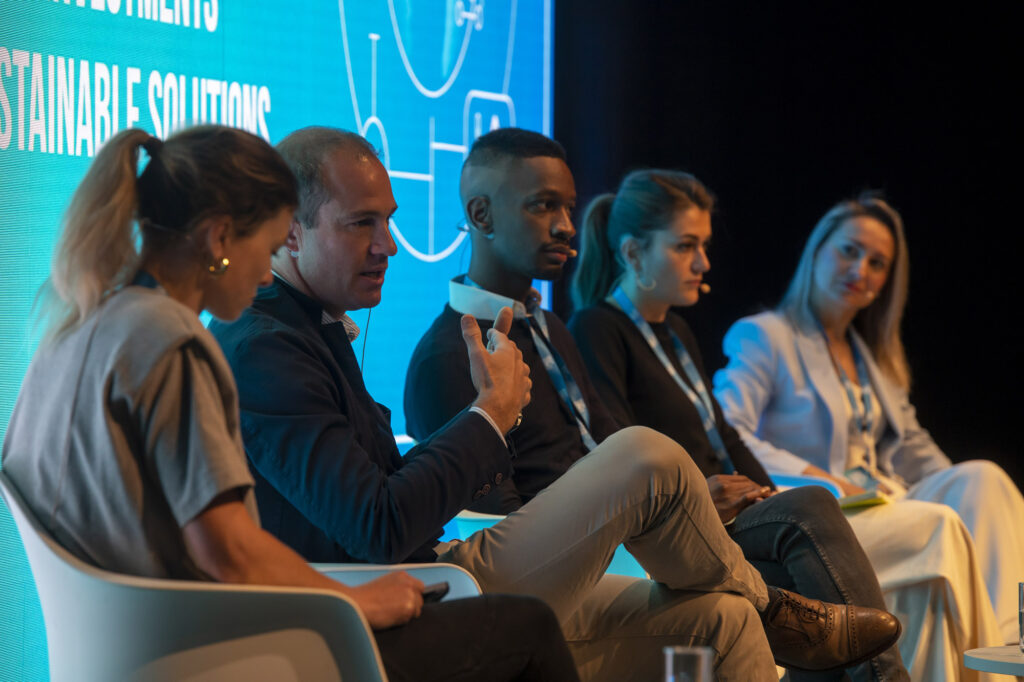
Expert panelist discussing financing solution in climate tech sector at Energy Tech Summit 2024.
Takeaway
Climate tech finance is moving beyond hype. Renewables have solved much of the generation problem, but scaling the next wave of solutions needs more than venture capital alone.
Blended finance, patient public capital and partnerships with incumbents can close the gaps that private investors can’t fill on their own – especially at Series B and for first-of-a-kind projects.
Secure your pass
Want to meet the investors shaping the future of climate tech finance? Join us at Energy Tech Summit Europe 2027, the 8th edition, on 7–8 April in Bilbao, Spain.
Passes cost €1,399 until 30 November, then €1,599 from 1 December, €1,799 from 1 February 2027 and €1,999 from 1 March 2027.
Founders can join with the Founder’s Pass for €699. Use code ETS100 for €100 off.