

Investors, recruiters and solar founders explained why skilled workers may be the energy transition’s biggest bottleneck – and what can fix it.
The energy transition needs more than new technology. It needs people who can plan, sell and install it. At Energy Tech Summit, a panel explored how upskilling and reskilling can fill green jobs – and why the shortage of skilled workers may be one of the transition’s biggest bottlenecks.
Danny Cotter, Partner at The Westly Group, moderated the discussion. He was joined by Michael Diamond, Managing Director at Norman Broadbent, Juliana Garaizar, General Partner at Malaika Ventures, Christopher Cederskog, Co-Founder and CEO of Sunhero, and Jamie Heywood, CEO at Zolar.
Four views on the green skills gap
Diamond leads the investor practice at Norman Broadbent, a UK-listed executive search and leadership advisory firm, with a focus on energy, industrials and decarbonization.
At the time of the session, Zolar ran a residential solar marketplace in Germany, connecting homeowners with around 700 partner installers. The company has since exited the residential market and entered insolvency proceedings in 2025. Heywood described two shortages: white-collar product and tech talent, and blue-collar installers. “The one that keeps me awake is the blue collar problem,” he said.
Sunhero, based in Spain, helps homes and businesses electrify. Unlike a marketplace, it keeps installation skills largely in-house, which brings its own challenges.
Garaizar has spent her career in incubation and venture capital. In Houston, she brought Greentown Labs, a major climate incubator, to the city. There, she saw firsthand how many oil and gas workers wanted to move into clean energy jobs.
Cotter opened with a personal story. His father spent 42 years at a single California utility. Six months after retiring, he was called back – on fewer hours and higher pay – because nobody else could solve the problems he knew. For Cotter, that shows how much knowledge leaves the energy sector as its workforce ages.

Panelists: Michael Diamond, Managing Director at Norman Broadbent, Juliana Garaizar, General Partner at Malaika Ventures, Christopher Cederskog, Co-Founder & CEO of Sunhero, Jamie Heywood, CEO at Zolar Danny Cotter, Partner at The Westly Group.
What reskilling really means
Garaizar pointed out a fundamental challenge. Many of the technologies needed to decarbonize the world haven’t been invented yet, so it is hard to train people for them.
Oil and gas companies responded by hiring and keeping people with two qualities: “the capacity to learn fast and the other one is the capacity to teach fast.” Many existing skills also transfer well. Drilling expertise, for example, applies to carbon capture, and hydrogen draws on oil and gas know-how.
Much of her work in Houston was about demystifying new energy jobs. Workers often had most of the skills already – “you already have you just don’t know it,” as she put it. Self-learning matters too. Many people became sustainability leads inside oil and gas companies simply because “they were the ones who talked about it first.”
From solar panels to full electrification
For Cederskog, the Spanish residential market is moving beyond solar towards full electrification, including heat pumps, batteries and EV chargers. That is harder to execute than it looks.
Installers need three kinds of skills. First, technical planning know-how. Second, practical skills on the ground. Third, interpersonal skills, because they work face to face with customers who ask what they’re doing and why.
Spain also needs to show that these are real, lasting careers – for example, for immigrants from Latin America and young rural men facing unemployment. Boom-and-bust cycles don’t help. In a boom year like 2022, “everybody and their mother can install solar,” Cederskog said, and quality suffers. When the market cools, workers drift back to plumbing or heating. What the sector needs most, in his view, is stability.
Solar panels on fences, not roofs
Heywood illustrated Europe’s installer gap with a striking image. A Financial Times article had shown solar panels in the Netherlands being used as garden fences, because panels had become so cheap.
The real problem, he argued, is the lack of installers to put those panels on roofs. Europe faces a gap of hundreds of thousands of solar installers. Meanwhile, panel production capacity sits underused. Heywood’s goal was to make existing installers more efficient and raise the quality of installation across the industry.
Is education keeping up with green jobs?
Diamond looks at the challenge from the boardroom. Many growing companies struggle to find technical and commercial leaders.
He questioned whether education systems are keeping pace. Schools and career advisers still point young people towards conventional industries. Responsibility for upskilling those already in work is also unclear: should it fall on governments, companies or individuals?
He also urged the sector not to dismiss talent from conventional industries. Those industries have lasted because they are successful. Some investors see candidates from oil majors as a negative. In his view, what matters more is whether people can learn quickly, transfer their skills and help build businesses. After all, many startups “will be successful because of the people that they’re able to bring into their business.”
What keeps the panel up at night
Diamond’s concern is access to experienced leaders from proven sectors. Corporate experience doesn’t always translate to high-growth startups, but it brings knowledge that young companies lack.
Heywood’s focus is installer economics. Germany has a strong apprenticeship system, yet still lacks installers. Rather than quotas, he believes the answer is making the job more profitable. By taking non-installation tasks off installers’ plates and using technology, Zolar aimed to halve installation time – and potentially double what installers could earn.
Cederskog worries about two things: installing quickly without sacrificing quality, and the industry’s huge gender gap. Excluding women, he said, simply shrinks the talent pool the sector needs.
Garaizar shares that concern about diversity. In her view, women and underrepresented communities are often the first to feel climate impacts. And “when you’re the closest to the problem you might also be the closest to the solution.” Too many startups treat diversity as an afterthought once investors are happy. By then, the culture is set. For real impact, “it has to be at founder level.”
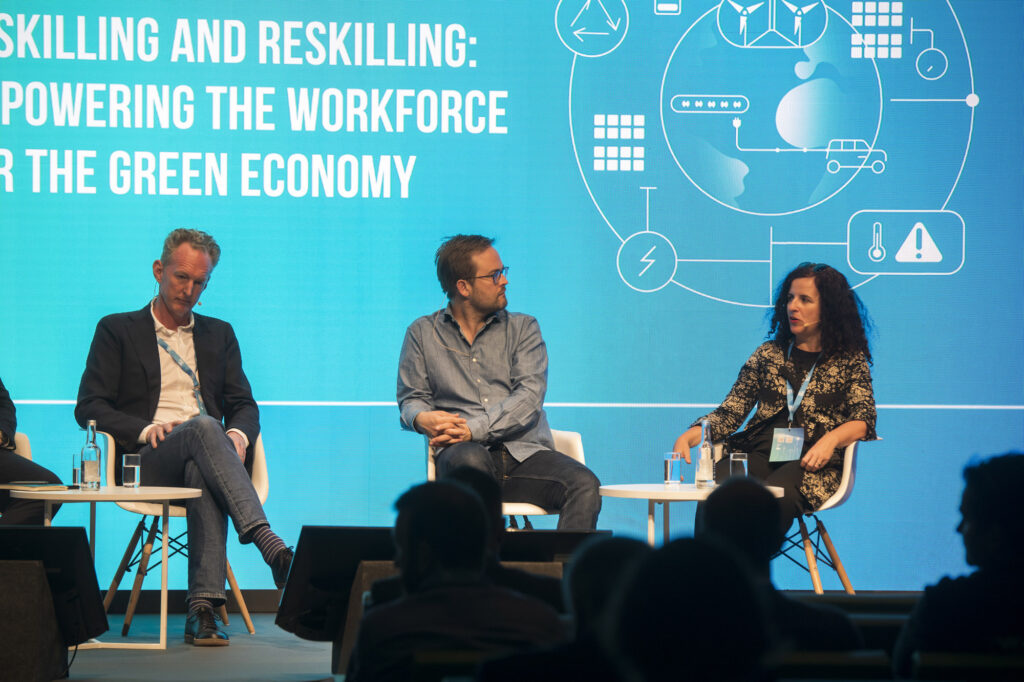
Panelists: Michael Diamond, Managing Director at Norman Broadbent, Juliana Garaizar, General Partner at Malaika Ventures, Christopher Cederskog, Co-Founder & CEO of Sunhero, Jamie Heywood, CEO at Zolar Danny Cotter, Partner at The Westly Group.
The role of government
Garaizar highlighted US efforts to tie climate funding to community benefits under the Justice40 initiative. At the time, the Department of Energy worried there might not be enough projects with community benefit agreements to deploy all the funds. The initiative was terminated in January 2025.
Cederskog took a drier view. With a wry nod to European governments’ track record on electrification, he argued they should step back as much as possible. At most, they could standardize job roles and help market the work. Like Heywood, he believes making installation more profitable will draw people in. Asked if he agreed, Heywood joked: “I agree with Chris and myself.”
Can AI help close the gap?
Next, Cotter asked how AI changes the picture. Diamond urged a mix of skepticism and openness. Companies need to define what AI skills their workforce actually needs.
Heywood argued that too much of the AI debate focuses on replacing jobs. “No AI is going to be able to install a solar system for quite a while,” he said. Instead, the real question is “how can AI make solar installers better installers.” Better planning and technical information on site could make installers faster. According to Heywood, a German installer earned around €60,000 a year at the time; raising that to €100,000 would draw many more people into the trade.
Cederskog sees AI as powerful for analyzing roofs and current energy use. However, planning for a customer’s future needs is a conversation. As he put it, “think of it like we can see a little bit around the corner,” and that guidance should stay human for now.
Garaizar raised two concerns. AI consumes huge amounts of energy, though it could also deliver major efficiency gains. Moreover, women are often missing from the datasets AI learns from, so biased data risks reinforcing bias. Feeding AI more representative data is therefore an opportunity.
Inspiring the next generation
An audience member asked how to excite young people about the green economy. Garaizar believes younger generations already feel responsible for fixing climate problems, and they use AI naturally.
Diamond was less sure that schools point them in the right direction. His teenage son studies solid STEM subjects, but nobody tells him where they could lead, for example in hydrogen. In his view, companies profiting from the transition should invest in building a sustainable workforce – ideally together, rather than in competition.
Takeaway
Green jobs won’t fill themselves. Better pay, practical training and stable markets can draw more installers into the trade, while recognizing transferable skills can unlock talent from conventional industries.
Equally, the sector can’t afford to ignore half the workforce. Building diverse teams from the start, and using AI to augment rather than replace workers, will help close the skills gap faster.
Secure your pass
Want to meet the founders, investors and leaders building the green economy workforce? Join us at Energy Tech Summit Europe 2027, the 8th edition, on 7–8 April in Bilbao, Spain.
Passes cost €1,399 until 30 November, then €1,599 from 1 December, €1,799 from 1 February 2027 and €1,999 from 1 March 2027.
Founders can join with the Founder’s Pass for €699. Use code ETS100 for €100 off.