

In a keynote, Dr Carsten Heinz Joachim Borchers argued that hydrogen will get cheap the same way solar and wind did – by building more of it.
Few people arrive at a conference by hydrogen car or on a plane running on sustainable aviation fuel. That simple observation set the tone for a keynote at Energy Tech Summit by Dr Carsten Heinz Joachim Borchers, Managing Director at E.ON Hydrogen.
Hydrogen has been discussed for decades, yet its real-world impact remains small. Borchers set out to explain why – and to make the case that green hydrogen can follow the same cost path that made solar and wind mainstream. “My purpose and why I’m here is I really want to excite you about hydrogen,” he told the audience.
The energy system as a chocolate bar
To illustrate the challenge, Borchers used a familiar image: a four-by-four chocolate bar. Each column represents a sector – transport, heating, industry and electricity generation. Meanwhile, each row shows how much of that sector has been decarbonized, from zero to 100%.
The picture is sobering. Depending on the country, electricity has made real progress, while mobility, heat and industry have barely moved. In Germany, for example, decarbonization in those sectors relies largely on biogenic fuels and remains small.
Yet that gap is also a massive opportunity. The undecarbonized part of the bar represents today’s oil and gas economy, an industry that shapes the planet. In other words, whoever replaces it is entering a huge market.
Why industry still chooses gas
Borchers shared impressions from CERAWeek, the major energy conference in Houston. There, many people described the current period as the decade of LNG. One CEO of a major contractor said his company alone was working on 15 LNG terminal projects.
Similarly, the CEO of a large Japanese utility described two options. He could import green ammonia and hydrogen now, or he could replace coal plants with gas-fired power. From a practical point of view, he was choosing gas.
Part of the problem, Borchers argued, is hydrogen’s reputation. It is “very often labeled as a champagne of the energy transition which is really unfair.” That narrative suggests hydrogen should be rationed to a few sectors. Consequently, decarbonization would depend on banning alternatives or making them expensive.
Subsidies alone can’t fix that either. As Borchers put it, “even in Germany with a huge budget you can’t really solve that problem with funding.”
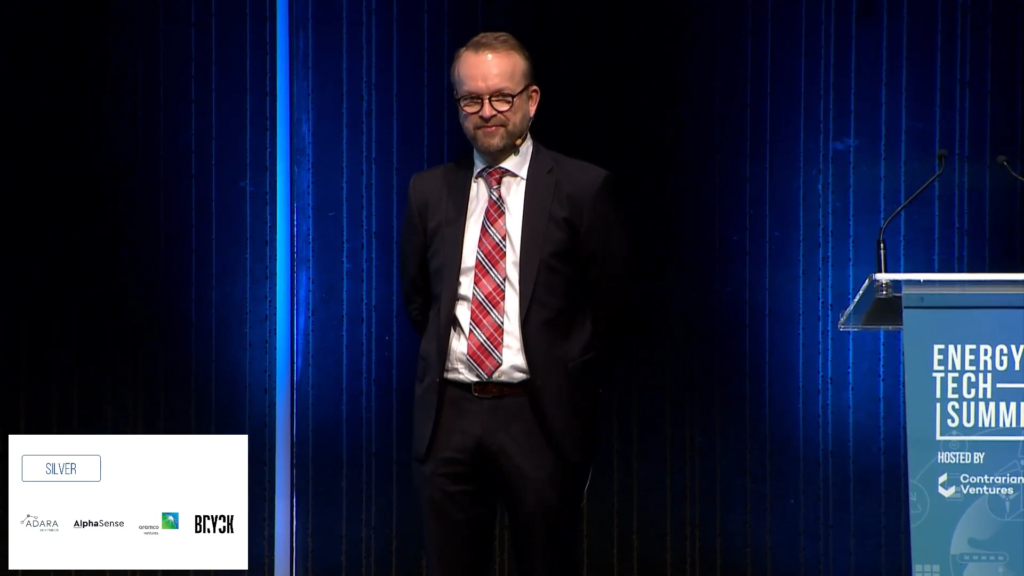
Dr. Carsten Heinz Joachim Borchers, Managing Director at E.ON Hydrogen
The power of the learning curve
Instead, Borchers pointed to manufacturing. To make his point, he showed a Second World War bomber. “It’s not about technology actually it’s about something else it’s about manufacturing,” he explained.
The learning curve was first described in 1936, when engineers noticed that each new aircraft took less effort to build than the last. As a rule of thumb, every doubling of output cut the effort to around 80% of what it was before. Over many doublings, that effect becomes dramatic.
Bruce Henderson later brought the idea into business strategy. It explains why large companies hold such strong advantages through scale. In Borchers’ words, “this concept is extremely powerful,” and the energy transition needs to use it.
Renewables already show how. Borchers worked in the US around 2016 and followed the “bring back coal” campaign closely. In his view, coal struggled because solar and wind prices had fallen so far, helped by learning curves, while cheap shale gas also played a role.
Where green hydrogen can get cheaper
Borchers then mapped the hydrogen value chain to show where learning curves could apply. Renewable power is the first, as wind turbines have already proven.
Electrolyzers offer at least three more. The technology itself is still young, so there is plenty of room for improvement. Next, building larger electrolyzers unlocks economies of scale. Finally, production methods can mature. Borchers recently visited an electrolyzer assembly plant that still worked in a workshop style. By contrast, automotive-style mass production could drive costs down sharply.
Transport and applications have similar potential. At the time of the session, a truck container holding 1,000kg of hydrogen cost around €800,000, enough to refuel only a handful of trucks. Likewise, a fuel cell truck cost roughly half a million euros, compared with around €100,000 for a diesel truck.
Yet fuel cells don’t need many high-value materials. They are technically complex, which is precisely where learning curves tend to pay off. Ammonia cracking for long-distance hydrogen supply chains is another area to watch.
The conclusion is simple. “The more we use it the cheaper it gets,” Borchers said – and that matters most for industry, which needs hydrogen the most.
Closing the cost gap, sector by sector
Borchers compared the cost of green hydrogen with the energy carriers it would replace. In industry, replacing grey hydrogen requires green hydrogen at a competitive price. Power and heat still show a clear gap.
Mobility, however, looks more promising. Based on diesel prices at the time, his analysis suggested hydrogen was already close to competing at the pump. Meanwhile, niche applications such as hydrogen-powered garbage trucks are already on the road. That creates a market that can start moving hydrogen down the learning curve.
E.ON Hydrogen works with customers to compare current costs with the next best alternative. Sometimes that alternative is battery-electric, which Borchers welcomes. In other cases, the application calls for hydrogen. Today, closing the price gap means combining every available tool, from subsidies to greenhouse gas quota trading.
Why moving early pays off
If costs keep falling, why should anyone invest now? Borchers’ answer: early movers are “actually overcompensated for what is expected on the learning curve.”
Subsidies for electrolyzers, trucks and refueling stations reduce early costs. Moreover, infrastructure built today can be extended later, once costs fall. Early movers can also win new B2B customers by offering green products.
Most importantly, “the power balance in the value chain is changing.” The undecarbonized part of the chocolate bar is controlled by a single industry today. With hydrogen, as with electricity, consumers can source energy wherever they want – or produce it themselves.
A logistics company, for instance, no longer has to buy fuel from an oil and gas major. Instead, it can produce hydrogen itself, “become resilient to the market” and capture value that was previously out of reach. As Borchers concluded, “it’s time to move now.”
Takeaway
Green hydrogen won’t become affordable through subsidies or bans alone. Instead, it needs volume. Every electrolyzer, truck and refueling station built today moves the industry down the learning curve.
For companies willing to move early, the reward goes beyond cost savings. It is the chance to take control of their own energy supply and claim a share of a market long dominated by oil and gas.
Secure your pass
Want to hear more keynotes on the future of hydrogen and the energy transition? Join us at Energy Tech Summit Europe 2027, the 8th edition, on 7–8 April in Bilbao, Spain.
Passes cost €1,399 until 30 November, then €1,599 from 1 December, €1,799 from 1 February 2027 and €1,999 from 1 March 2027.
Founders can join with the Founder’s Pass for €699. Use code ETS100 for €100 off.